


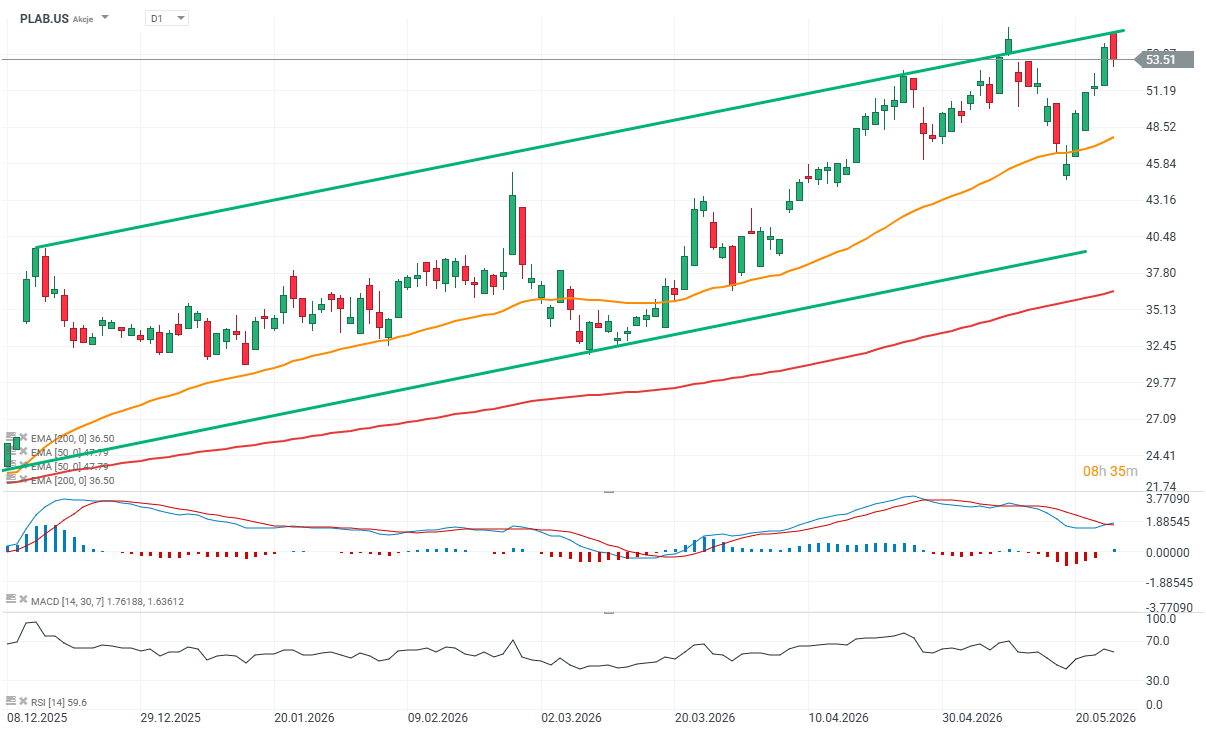
Photronics (PLAB.US), one of the world’s leading photomask manufacturers for the semiconductor industry, reported earnings that sharply disappointed Wall Street and triggered a massive selloff in the stock. The company not only missed expectations for both revenue and earnings, but also issued weaker-than-expected guidance for the upcoming quarter. As a result, shares plunged roughly 26–29% immediately after the report, despite still being up around 67% year-to-date before earnings and more than 200% over the last 12 months.
For the market, this was a clear reminder that even companies indirectly benefiting from the AI boom are not fully insulated from traditional semiconductor industry problems such as delayed design launches, weaker demand in certain end markets, or rising cost pressures. The company explicitly stated that geopolitical tensions, particularly the conflict involving the U.S., Israel, and Iran, negatively impacted both its business environment and demand visibility.
Key facts
- Photronics reported revenue roughly $6.7 million below consensus expectations, with sales remaining essentially flat year-over-year.
- The company continues to execute strategic expansion projects in the U.S. and South Korea aimed at supporting future growth.
- Revenue from the high-end IC segment declined 5%, disappointing investors who expected stronger near-term AI-related demand contribution, while the FPD segment grew 13%.
- Results were negatively affected by difficult market conditions, including elevated fab utilization rates and memory supply constraints. Total revenue came in at $210 million, flat year-over-year.
- Diluted GAAP EPS reached $0.54, slightly above consensus estimates. Non-GAAP EPS was $0.42, partly impacted by foreign exchange effects.
- Gross margin stood at 31%, reflecting continued operational leverage, while operating margin reached 20%.
- Photronics is currently valued at approximately 18.5x trailing earnings (P/E ratio) and roughly 15x forward 12-month earnings.
Photronics - a hidden pillar of the semiconductor industry?
Photronics operates in one of the most strategic niches within the entire semiconductor supply chain. The company manufactures photomasks, extremely precise templates used during the lithography process to transfer circuit patterns onto silicon wafers. Without photomasks, modern chip production is practically impossible.
Photronics’ business model differs from traditional chipmakers. The company does not design processors or manufacture wafers. Instead, it supplies critical tools used by foundries, memory manufacturers, and semiconductor design companies. In practice, this means Photronics is highly dependent on overall semiconductor industry activity and the number of new chip designs entering production.
This is precisely why the company is often viewed as a highly sensitive indicator of the broader semiconductor cycle. When semiconductor companies reduce new projects or delay next-generation chip launches, Photronics typically feels the impact very quickly.
Photronics performs best when customers migrate to new process technologies and execute large numbers of “tape-outs,” the first production implementation of new chip designs. Every new generation of GPUs, HBM memory, or advanced AI accelerators creates demand for increasingly complex and higher-margin photomasks.
The problem emerges when fabs become capacity constrained or customers postpone new chip launches. Even with very strong end demand for AI, Photronics can still experience short-term order slowdowns almost immediately.
Results showed the first signs of a slowdown
In its fiscal second quarter, Photronics generated revenue of $209.9 million compared to $211 million a year earlier. The sales decline itself was minimal, but results came in well below analyst expectations of roughly $216–216.7 million.
Profitability disappointed even more. Adjusted EPS came in at $0.42 versus expectations of around $0.53. However, investors also noticed an interesting paradox — despite the severe stock market reaction, the company’s net income still increased sharply year-over-year. GAAP net income reached $31.4 million versus only $8.9 million a year earlier, while diluted EPS rose from $0.15 to $0.54, slightly exceeding market consensus.
Still, the report revealed clear deterioration in the company’s business mix. Revenue from the high-end IC segment, which includes the company’s most advanced semiconductor photomasks, declined 5%. Meanwhile, the FPD display-related segment grew 13%, partially offsetting weakness in the core semiconductor business.
This is an important signal for investors because advanced IC masks generate the highest margins and are most directly tied to the AI boom and leading-edge semiconductor manufacturing.
Despite pressure on revenue, the company maintained relatively solid profitability. Gross margin reached 31%, while operating margin remained around 20%, showing that Photronics continues to benefit from operational leverage and high technological barriers to entry.
This suggests the main issue was not a collapse in the business itself, but rather extremely elevated investor expectations following the earlier AI-driven semiconductor rally.
Guidance looked even more concerning. The company expects next-quarter revenue between $207 million and $215 million, with the midpoint around $211 million, while Wall Street had been expecting roughly $218.9 million. Earnings guidance also came in meaningfully below expectations, with Photronics forecasting EPS between $0.39 and $0.45 versus analyst expectations near $0.54.
The market reacted especially negatively to management’s comments regarding delays in new chip projects. CEO Peter Kirlin and CFO Eric Rivera stated that some chip launches had been postponed due to extremely high fab utilization, memory supply shortages, rising OEM cost pressures, and geopolitical tensions.
Rivera also emphasized that the conflict between the U.S. and Iran during the quarter further reduced demand visibility and increased customer uncertainty. Management additionally acknowledged that after Chinese New Year, the company experienced an unusually prolonged slowdown that disrupted the normal seasonal recovery in orders.
This is an extremely important signal for the broader semiconductor industry. Photronics sits very high in the production chain, meaning delays in new chip projects often appear here earlier than in the earnings reports of the largest semiconductor manufacturers.
AI is still helping, but it does not solve inventory concerns
Perhaps the most interesting aspect of the report is that fundamentally the company’s situation does not appear catastrophic. EBITDA increased nearly 45% year-over-year, while EBITDA margin exceeded 40%. Photronics continues to benefit from long-term growth in demand for advanced chips, especially in AI, data centers, and high-performance memory applications.
The problem is that the AI boom is not translating evenly across the entire semiconductor market. The largest benefits currently accrue mainly to GPU manufacturers, HBM memory suppliers, and the most advanced foundries. Companies like Photronics remain heavily dependent on the overall pace of new chip design launches by customers.
In practice, this means that even if AI spending remains extremely strong, some segments of the semiconductor market can still experience temporary cooling periods.
One of the more notable warning signs was the increase in Days Inventory Outstanding to 43 days from 39 days in the previous quarter. In the semiconductor industry, rising inventory levels are often among the first signs of weakening demand or slowing order activity.
For Photronics, this does not necessarily indicate a major structural problem yet, but investors are watching closely for any signs of deterioration in the semiconductor cycle — especially after the sector’s powerful AI-driven rally.
The company continues investing aggressively despite near-term pressure
Despite weaker results, Photronics continues to invest aggressively in the development of advanced photomask technologies. The company is expanding production capacity in both the U.S. and South Korea in an effort to strengthen its position in the high-end segment, where technological barriers to entry remain extremely high.
This is a crucial part of the company’s long-term strategy. Manufacturing advanced photomasks for modern lithography processes is becoming increasingly complex and capital-intensive, limiting competition. Over time, this could allow Photronics to maintain strong margins and benefit from continued growth in demand for advanced AI-related semiconductors.
Another important factor is the company’s very strong balance sheet. Photronics currently operates with zero net debt and holds more cash than debt, giving it substantial financial flexibility to continue investing even during periods of temporary market weakness.
However, investors are concerned that the next several quarters could bring further order slowdowns before new investments begin contributing meaningfully to revenue growth.
The market reaction highlights how high expectations had become
The nearly 30% decline in the stock primarily reflects how elevated investor expectations had become for the entire semiconductor sector. Over recent quarters, the market largely ignored most signs of industry cyclicality, assuming the AI boom would drive uninterrupted growth across virtually all technology companies.
Photronics reminded investors that semiconductors remain one of the most cyclical industries in the world. Even companies with strategically important positions in the supply chain can experience sharp swings in demand, project delays, and margin pressure.
The key question now is whether the company’s current challenges represent only a temporary disruption caused by short-term production bottlenecks and geopolitical tensions — or the beginning of a broader cooling phase in the semiconductor market following the record AI-driven rally.
Source: xStation5



Daily Summary: Is the End of the War Drawing Near? (28.05.2026)



Nasdaq climbs on software rebound 📈 Is the Wall Street rally far from over?



Is Barclays reassuring investors about Ferrari shares❓


This AI stock surged 1000% in 18 months 📈 Is "low valuation" a cyclical trap?
The content of this report has been created by XTB S.A., with its registered office in Warsaw, at Prosta 67, 00-838 Warsaw, Poland, (KRS number 0000217580) and supervised by Polish Supervision Authority ( No. DDM-M-4021-57-1/2005). This material is a marketing communication within the meaning of Art. 24 (3) of Directive 2014/65/EU of the European Parliament and of the Council of 15 May 2014 on markets in financial instruments and amending Directive 2002/92/EC and Directive 2011/61/EU (MiFID II). Marketing communication is not an investment recommendation or information recommending or suggesting an investment strategy within the meaning of Regulation (EU) No 596/2014 of the European Parliament and of the Council of 16 April 2014 on market abuse (market abuse regulation) and repealing Directive 2003/6/EC of the European Parliament and of the Council and Commission Directives 2003/124/EC, 2003/125/EC and 2004/72/EC and Commission Delegated Regulation (EU) 2016/958 of 9 March 2016 supplementing Regulation (EU) No 596/2014 of the European Parliament and of the Council with regard to regulatory technical standards for the technical arrangements for objective presentation of investment recommendations or other information recommending or suggesting an investment strategy and for disclosure of particular interests or indications of conflicts of interest or any other advice, including in the area of investment advisory, within the meaning of the Trading in Financial Instruments Act of 29 July 2005 (i.e. Journal of Laws 2019, item 875, as amended). The marketing communication is prepared with the highest diligence, objectivity, presents the facts known to the author on the date of preparation and is devoid of any evaluation elements. The marketing communication is prepared without considering the client’s needs, his individual financial situation and does not present any investment strategy in any way. The marketing communication does not constitute an offer of sale, offering, subscription, invitation to purchase, advertisement or promotion of any financial instruments. XTB S.A. is not liable for any client’s actions or omissions, in particular for the acquisition or disposal of financial instruments, undertaken on the basis of the information contained in this marketing communication. In the event that the marketing communication contains any information about any results regarding the financial instruments indicated therein, these do not constitute any guarantee or forecast regarding the future results.
