


A basket of Software stocks, understood mainly as SaaS, has been lagging the main US stock indexes by more than 40% for some time now. Many sector leaders have fallen more than 60% from their peaks. This would not be so puzzling if most of these companies were showing clear signs of weakness in their results, but they are not.
- A market that buys stocks, often with questionable health and prospects, hoping for growth far greater than what the market environment and or the company’s business model might superficially suggest, is a fairly common phenomenon.
- Investors who dump a single company’s shares en masse based on poorly understood market mechanisms, or who price in catastrophic scenarios with a negligible chance of occurring, are much rarer, but still happen with some regularity.
- But extrapolating that second process to an entire industry, despite good results, and keeping valuations below levels implied even by the most pessimistic valuation models, is almost unprecedented. The unprecedented phenomenon I mean is the “SaaS-o-calypse”, a trend of persistent and deep selloffs in the software sector (the name refers to the dominant “Software as a Service” model in the sector).
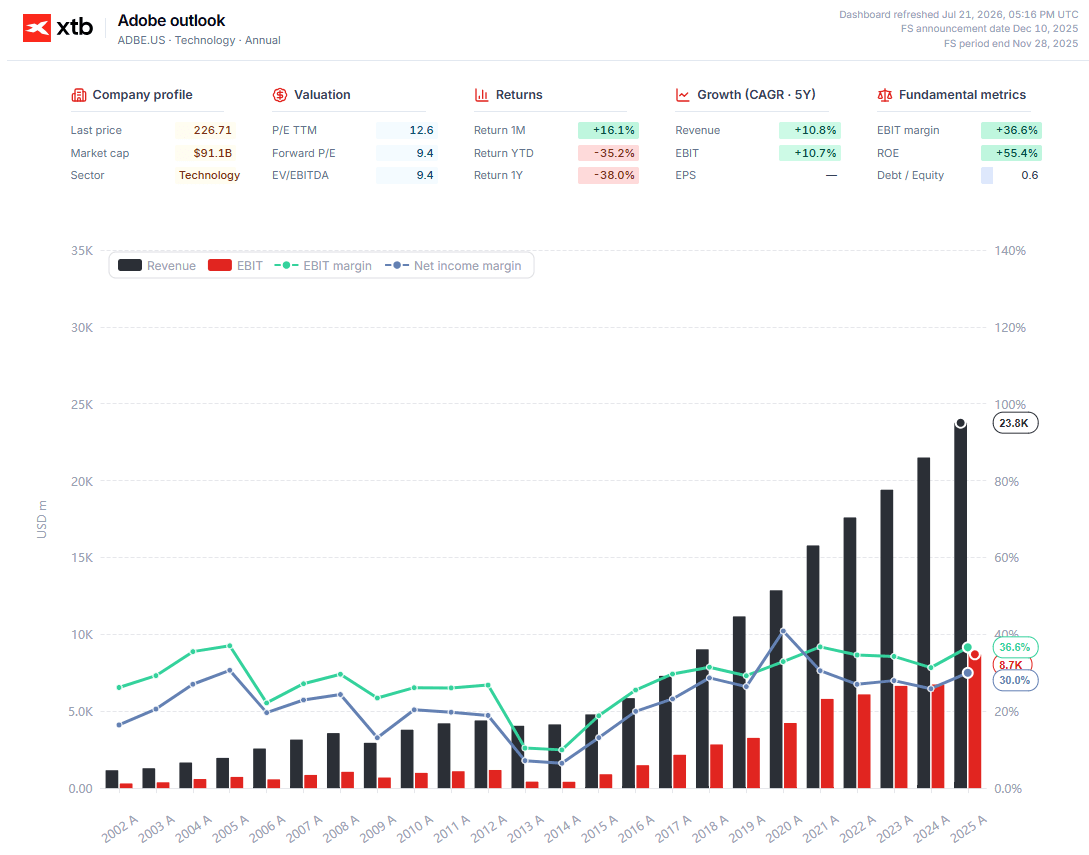
Morgan Stanley has already highlighted this phenomenon, publishing an extensive set of reports and recommendations for SaaS companies and the industry as such.
“The moat and the journey”
The scale of the selloff in SaaS companies is now so deep and so disconnected from fundamentals that it can no longer be explained by any speculation (the term “hypothesis” should not be used for solutions that often do not even exist yet) about further AI development. The investment bank commented on the state of this market segment in a measured but specific way.
The bank’s analysts pointed to a number of issues that are pushing the market to mark down SaaS companies. One is the degree of potential threat to the business model from AI and “agentic intelligence”.
In the publication, the analyst refers to the “Moat & Journey” framework, which in a fairly simple way measures and explains how difficult a company’s business model is to replicate or marginalize. As leaders in “resilience”, the bank points mainly to cybersecurity (Palo Alto, Cloudflare), Microsoft, selected cloud companies (Datadog, Snowflake), Shopify, and ServiceNow.
The last one is particularly interesting because even though the company is a leader in designing and deploying AI solutions in businesses, with double digit year over year profit growth, the mere classification as “SaaS” was enough for the stock to lose more than 60% of its valuation in 1.5 years.
ServiceNow price (D1)
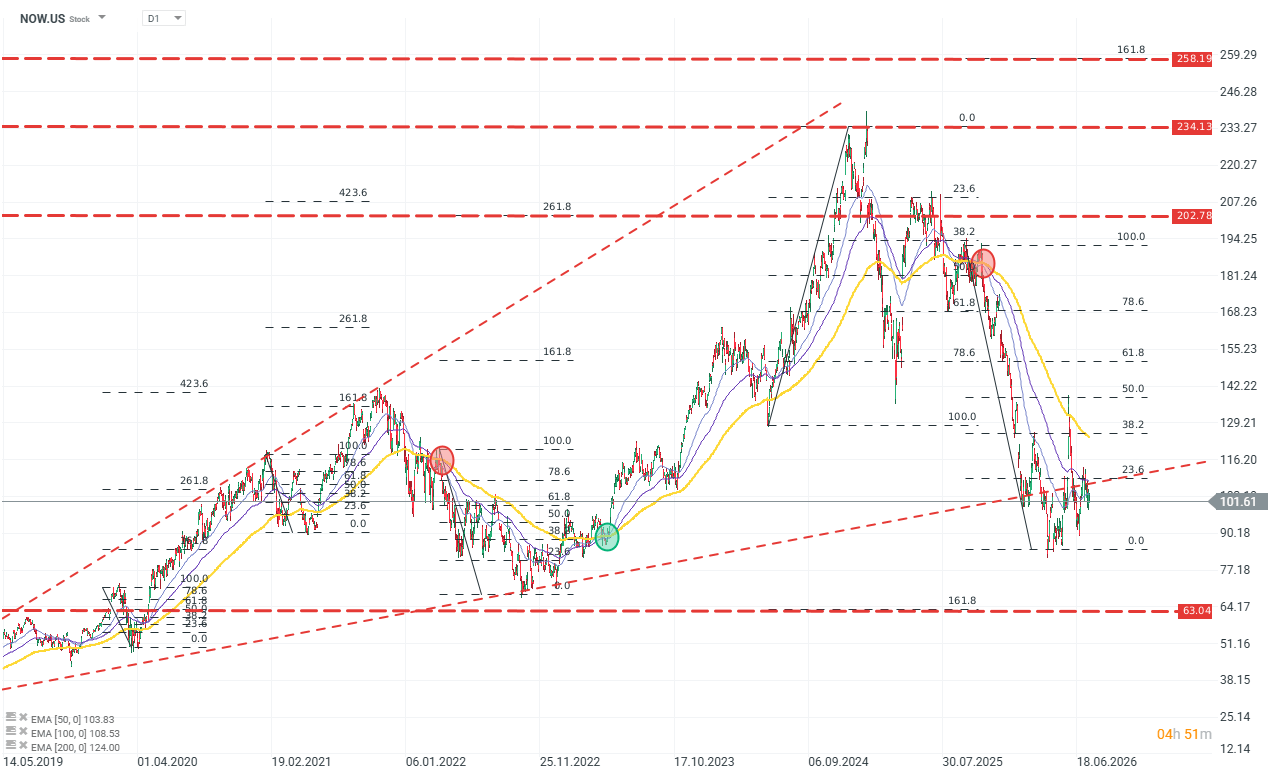
Despite significant changes in the business model and steady improvement in results, the stock remains in a steep downtrend, currently fighting to preserve its long term uptrend. Source: xStation5
Another very interesting and important issue raised in the report is the cyclical nature of the market, with the current cycle showing extreme values in every respect. The key point of the cycle argument, however, is that value and benefits move through successive sectors, industries, and companies depending on the stage of the investment cycle. Software and SaaS companies are usually at the end of it, and this time is expected to be the same.
This suggests that current results at SaaS companies are a byproduct of the market environment, and that real profit growth still lies ahead for these companies in later stages of the “AI boom”. Given very low valuations on a multiples basis, the likely normalization of valuations in this sector over the next 2 to 6 quarters could be very sharp.
Valuations say more than words
The market’s reaction to the report is quite telling. Almost all the companies mentioned in the report posted noticeable losses in today’s session, despite gains in the broader market and generally positive sentiment in Tuesday’s US session. This may clearly show the scale and persistence, the depth, but also the currently irrational selectivity in how information is being priced in that is affecting the SaaS sector.
Kamil Szczepański
Financial Market Analyst at XTB


US OPEN: The market extends losses as investor concerns grow



Daily Summary: Lower inflation weakens the dollar and awakens gold and S&P 500 to gains


Worse than the Dot-com bubble: IBM stock crash


Daily Summary - Escalation in the Middle East. FOMC fears inflation
The content of this report has been created by XTB S.A., with its registered office in Warsaw, at Prosta 67, 00-838 Warsaw, Poland, (KRS number 0000217580) and supervised by Polish Supervision Authority ( No. DDM-M-4021-57-1/2005). This material is a marketing communication within the meaning of Art. 24 (3) of Directive 2014/65/EU of the European Parliament and of the Council of 15 May 2014 on markets in financial instruments and amending Directive 2002/92/EC and Directive 2011/61/EU (MiFID II). Marketing communication is not an investment recommendation or information recommending or suggesting an investment strategy within the meaning of Regulation (EU) No 596/2014 of the European Parliament and of the Council of 16 April 2014 on market abuse (market abuse regulation) and repealing Directive 2003/6/EC of the European Parliament and of the Council and Commission Directives 2003/124/EC, 2003/125/EC and 2004/72/EC and Commission Delegated Regulation (EU) 2016/958 of 9 March 2016 supplementing Regulation (EU) No 596/2014 of the European Parliament and of the Council with regard to regulatory technical standards for the technical arrangements for objective presentation of investment recommendations or other information recommending or suggesting an investment strategy and for disclosure of particular interests or indications of conflicts of interest or any other advice, including in the area of investment advisory, within the meaning of the Trading in Financial Instruments Act of 29 July 2005 (i.e. Journal of Laws 2019, item 875, as amended). The marketing communication is prepared with the highest diligence, objectivity, presents the facts known to the author on the date of preparation and is devoid of any evaluation elements. The marketing communication is prepared without considering the client’s needs, his individual financial situation and does not present any investment strategy in any way. The marketing communication does not constitute an offer of sale, offering, subscription, invitation to purchase, advertisement or promotion of any financial instruments. XTB S.A. is not liable for any client’s actions or omissions, in particular for the acquisition or disposal of financial instruments, undertaken on the basis of the information contained in this marketing communication. In the event that the marketing communication contains any information about any results regarding the financial instruments indicated therein, these do not constitute any guarantee or forecast regarding the future results.
