


The USDJPY market currently resembles another round of a fight between two heavyweight contenders. On one side stands the dollar, supported by high US asset yields and the ongoing advantage in interest rates. On the other side stands the yen, which despite the Bank of Japan beginning the process of monetary policy normalization, remains under pressure.
Japan has taken the first step away from its ultra-loose monetary policy, but the gap between interest rate levels in the United States and Japan remains extremely wide. This difference continues to be the main argument supporting the dollar.
At the same time, USDJPY is trading at levels that are attracting increased attention from speculators and Japanese authorities. Today’s holiday in Japan means lower market liquidity, and such conditions often increase the risk of sharp price movements. Tokyo has been signaling for months that it will not tolerate excessive yen volatility, meaning markets must continue to account for the possibility of direct intervention.
USDJPY currently resembles a fight in which the dollar continues to score points thanks to its fundamental advantage, but every additional move higher increases the risk of a response from Japan.
Source: xStation5
The key factors currently shaping USDJPY
1. Japan and the risk of currency intervention
The most important psychological factor for the USDJPY market remains the possibility of direct action from Japanese authorities.
Japan’s Ministry of Finance has been monitoring developments in the currency market for months and has repeatedly emphasized that excessive yen volatility may require action. The issue is not only the absolute level of USDJPY, but above all the speed of the move.
History shows that Japan has typically reacted when yen weakness became too rapid and started affecting expectations among businesses and households. Tokyo understands that an excessively weak currency increases the cost of imported energy and raw materials, making the fight against inflation more difficult.
Today’s holiday in Japan adds another layer of attention to the market. With liquidity reduced, even smaller capital flows can generate larger moves in exchange rates. For authorities, such conditions could create a situation where a potential intervention would have a stronger psychological impact.
At the same time, Japan needs to remain patient. Using foreign currency reserves too quickly could produce only a short-term effect if fundamentals continue to favor the dollar. Tokyo needs the right moment, when the market is most vulnerable to a change in direction.
2. Interest rate differentials remain the main argument supporting the dollar
The most important fundamental factor for USDJPY remains the difference between monetary policy in the United States and Japan.
The Bank of Japan has started raising interest rates, but the path toward a more restrictive policy will likely remain very gradual. The Federal Reserve, meanwhile, continues to maintain rates at elevated levels, while investors continue to assess when and how quickly the Fed may begin a rate-cutting cycle.
For the currency market, the key factors are not only current interest rate levels but also bond yields and expectations regarding future monetary policy.
If the Fed maintains a cautious approach and continues limiting expectations for rapid policy easing, the dollar may remain supported. Even with lower inflation in the United States, dollar strength can persist as long as real interest rates remain attractive for investors.
Japan faces a different challenge. The Bank of Japan must balance the need to normalize monetary policy with the risk of weakening economic growth. Moving too quickly with rate increases could hurt the economy, which is why the tightening process remains cautious.
3. Middle East tensions and oil prices increase pressure on the yen
Another factor influencing USDJPY remains the geopolitical situation in the Middle East.
The intensifying conflict in the Persian Gulf has increased the importance of the oil market and the risk of disruptions to energy supplies. Rising oil prices can affect currencies through several channels.
The first channel is inflation. Higher energy costs make further declines in price pressures more difficult and may limit the room available for central banks to ease monetary policy.
The second channel is related to security. During periods of heightened uncertainty, investors often move capital toward the dollar as the world’s primary reserve currency. This provides additional support for the US currency during periods of increased risk.
The situation is particularly challenging for Japan, as the country remains a major energy importer. Higher oil prices can worsen the trade balance and increase costs throughout the economy. As a result, geopolitical developments may currently work against the yen, despite the fact that the Japanese currency has historically benefited during periods of elevated risk aversion.
USDJPY: The Dollar Still Leads, but Japan Remains in the Fight
The current situation in USDJPY is the result of several overlapping factors that are pushing the market in different directions.
The dollar continues to benefit from the interest rate advantage and high US Treasury yields. Despite softer inflation data, the Federal Reserve remains cautious about starting a rapid easing cycle, which limits pressure on the US currency.
Japan, meanwhile, remains in a difficult position. The Bank of Japan has started changing the direction of monetary policy, but the pace of normalization remains slow. At the same time, every additional decline in the yen increases pressure on the Ministry of Finance, which must consider the economic costs of an excessively weak currency.
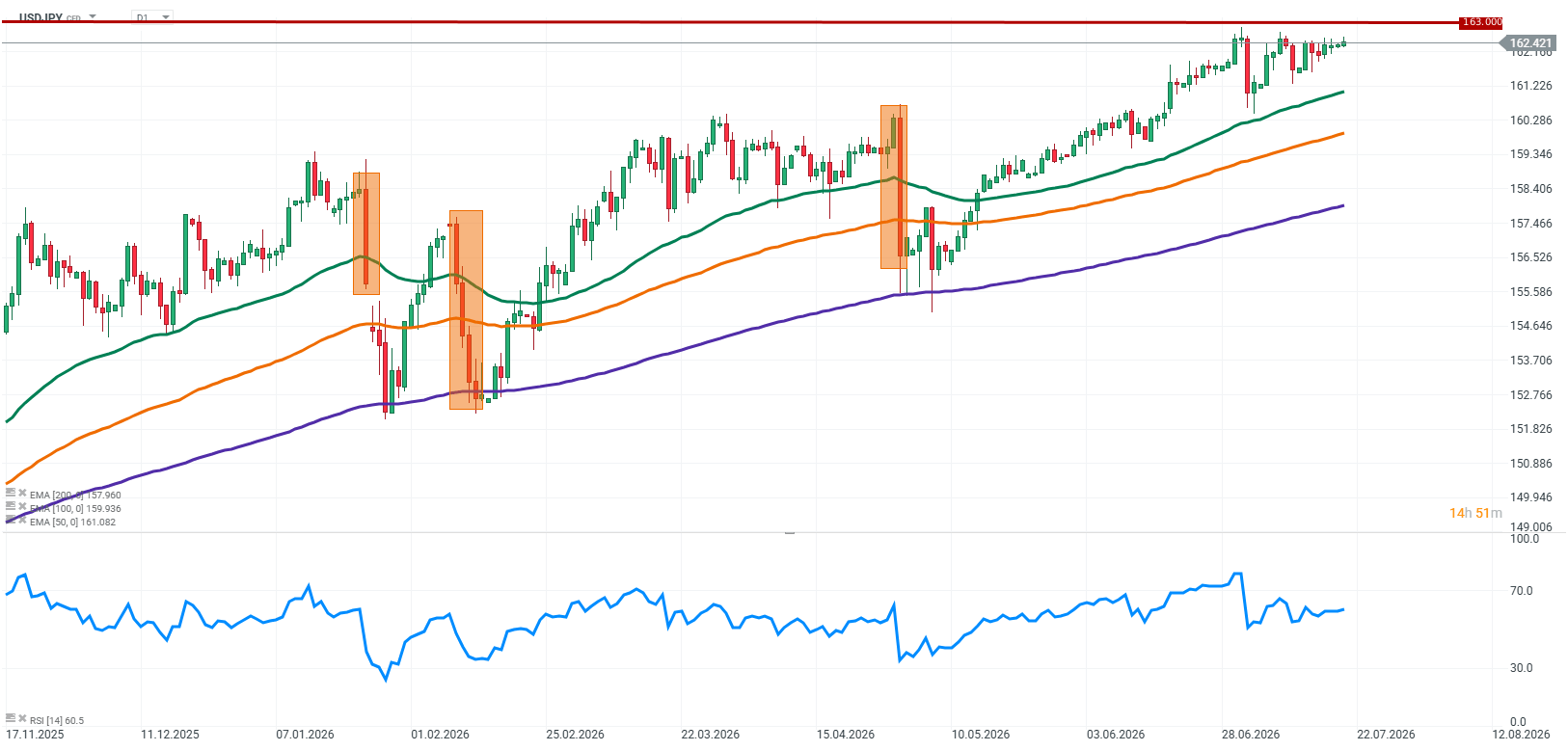
From a technical perspective, the pair remains in an uptrend and continues to trade within an ascending channel. The RSI indicator remains in positive territory but has not yet reached extreme overbought levels, suggesting that buying pressure remains present.
The key question for the market is whether the dollar’s fundamental advantage will be strong enough to overcome the growing risk of Japanese intervention.
Key Takeaways
- USDJPY remains one of the most important currency pairs due to the combination of strong fundamentals and the possibility of political action from Japan.
- The interest rate differential between the US and Japan remains the main argument supporting the dollar.
- The Bank of Japan has started the process of monetary policy normalization, but the pace of change remains significantly slower than in the United States.
- Today’s holiday in Japan increases market attention toward the possibility of intervention during a period of reduced liquidity.
- Middle East tensions and rising oil prices may add further pressure on the yen through the energy channel while increasing demand for the dollar as a safe-haven currency.
- Technically, USDJPY remains in an uptrend, but levels near historical highs increase the risk of a sharp market reaction.
- USDJPY is currently at a very interesting point. The dollar continues to score points thanks to its fundamental advantage, but every additional move higher increases the importance of Japan as a contender capable of changing the course of the entire fight at the right moment.



Red Sea, but not the indices : The effects of the Bab al-Mandab blockade.



US OPEN: Semiconductors drive a rebound


Market Wrap: Bulls Return to Europe Thanks to U.S.-Iran Mediation and Data from Germany



Silver breaks above $59 and attracts capital again. Gold remains in the shadow of its younger sibling
The content of this report has been created by XTB S.A., with its registered office in Warsaw, at Prosta 67, 00-838 Warsaw, Poland, (KRS number 0000217580) and supervised by Polish Supervision Authority ( No. DDM-M-4021-57-1/2005). This material is a marketing communication within the meaning of Art. 24 (3) of Directive 2014/65/EU of the European Parliament and of the Council of 15 May 2014 on markets in financial instruments and amending Directive 2002/92/EC and Directive 2011/61/EU (MiFID II). Marketing communication is not an investment recommendation or information recommending or suggesting an investment strategy within the meaning of Regulation (EU) No 596/2014 of the European Parliament and of the Council of 16 April 2014 on market abuse (market abuse regulation) and repealing Directive 2003/6/EC of the European Parliament and of the Council and Commission Directives 2003/124/EC, 2003/125/EC and 2004/72/EC and Commission Delegated Regulation (EU) 2016/958 of 9 March 2016 supplementing Regulation (EU) No 596/2014 of the European Parliament and of the Council with regard to regulatory technical standards for the technical arrangements for objective presentation of investment recommendations or other information recommending or suggesting an investment strategy and for disclosure of particular interests or indications of conflicts of interest or any other advice, including in the area of investment advisory, within the meaning of the Trading in Financial Instruments Act of 29 July 2005 (i.e. Journal of Laws 2019, item 875, as amended). The marketing communication is prepared with the highest diligence, objectivity, presents the facts known to the author on the date of preparation and is devoid of any evaluation elements. The marketing communication is prepared without considering the client’s needs, his individual financial situation and does not present any investment strategy in any way. The marketing communication does not constitute an offer of sale, offering, subscription, invitation to purchase, advertisement or promotion of any financial instruments. XTB S.A. is not liable for any client’s actions or omissions, in particular for the acquisition or disposal of financial instruments, undertaken on the basis of the information contained in this marketing communication. In the event that the marketing communication contains any information about any results regarding the financial instruments indicated therein, these do not constitute any guarantee or forecast regarding the future results.
