

One of the main organizations that are part of Iran’s so-called “axis of resistance” against the United States and Israel in the Middle East announced earlier this week that it is resuming the blockade of Saudi Arabia, allegedly in response to increased U.S. activity in the region after the ceasefire between Iran and the United States collapsed.
Neither equity indices nor energy commodity prices, however, seem to be paying much attention to this. Why?
Two questions need to be asked:
- How REALLY important was shipping through the Red Sea area, especially for the oil market, specifically in the context of the conflict with Iran?
- Only after knowing the answer to that question can we use it as a starting point to understand the current price dynamics (mainly) in oil.
We need to start by going back to 2023, when the Houthis were able for the first time to seriously disrupt shipping in the Red Sea. The actions of the Gulf states and the coalition led by the United States significantly degraded their ability to attack infrastructure and vessels in the region. Given Iran’s difficult situation, the tight blockade and embargo imposed on both countries limit their ability to replenish weapons stockpiles.
However, the marginalization of the Houthis themselves is only one piece of the puzzle. Despite the reduced danger, many shipowners still avoid the region.
Daily ship transit: Suez and Bab al-Mandab
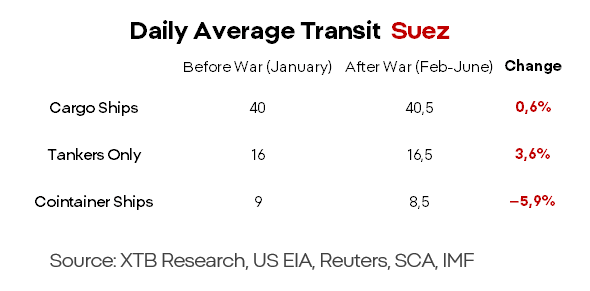
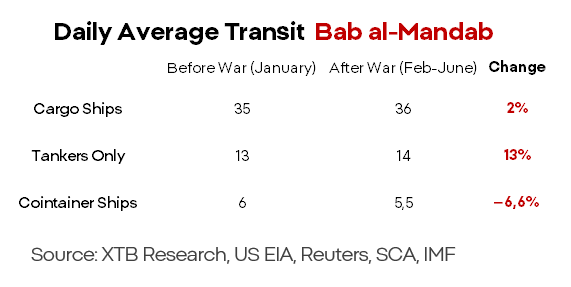
The peak of cargo traffic through the strait occurred in 2023. Since then, it has gradually but clearly declined. Today, the number of ships crossing both chokepoints each day is a little more than half of the late-2023 peak. This means that the threat from the Houthis has been priced in and has been visible on freight maps not since yesterday and not since the beginning of the year, but for more than two years already.
Not all ships are made equal
Not every cargo ship is a container ship. Right now the market is watching oil prices with concern, so analysts and investors need to focus on supertankers. Here the situation is more complex.
According to data including from SCNT, Reuters, and the EIA, although the number of ships has fallen at both exits from the Red Sea basin, the volume of oil transported in the region has increased markedly, primarily in the Bab al-Mandab Strait, where the increase is about 40%. In light of this, a blockade of the strait should clearly push prices up, right?
Oil transit volume: Bab al-Mandab
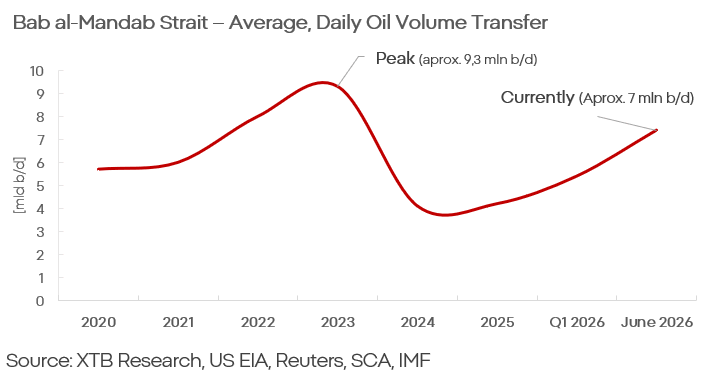
The missing element in the pricing equation is scale and context. A 40% increase today means a level of 7.5 million barrels per day, which is just under 7% of daily global demand. If the Bab al-Mandab Strait were completely closed tomorrow, it would not mean cutting off 25%, 15%, or even 10% of global oil transport volume. It would be only about 7%.
A complete closure is also unlikely due to the Houthis’ fading ability to conduct attacks in the region. In addition, unlike the Persian Gulf, the Red Sea has two exits rather than one.
It will get worse before it gets better
So can we conclude in this context that “everything will be fine”? Unfortunately not. In a sense, the Bab al-Mandab Strait is a “prototype” for the status quo the United States seems to be pursuing in the Persian Gulf, namely using sanctions and airstrikes to reduce Iran’s ability to attack to such an extent that transit through the Strait of Hormuz becomes a level of risk acceptable to shipowners. Can this work?
By analyzing the current situation in the strait, we can gather a set of observations and draw conclusions from them:
- The United States has clearly expanded the scale and nature of attacks on Iran. It is no longer only air power and naval forces being used, but increasingly also ground-based launchers.
- Targets now include not only IRGC facilities but also those of Iran’s regular army.
- Particular attention should also be paid to attacks on bridges, roads, and tunnels in southern Iran. Cutting off the ports in Bandar-e Abbas from the rest of the country is easy for the United States, but it implies the U.S. is prepared to keep escalating gradually. This can even be seen as preparation for seizing islands in the Persian Gulf.
- Worst of all, Iran allegedly attacked water desalination facilities in Kuwait. This information suggests Iran feels an existential threat and may choose the most radical step: attempting to disable the water infrastructure of other states in the Persian Gulf.
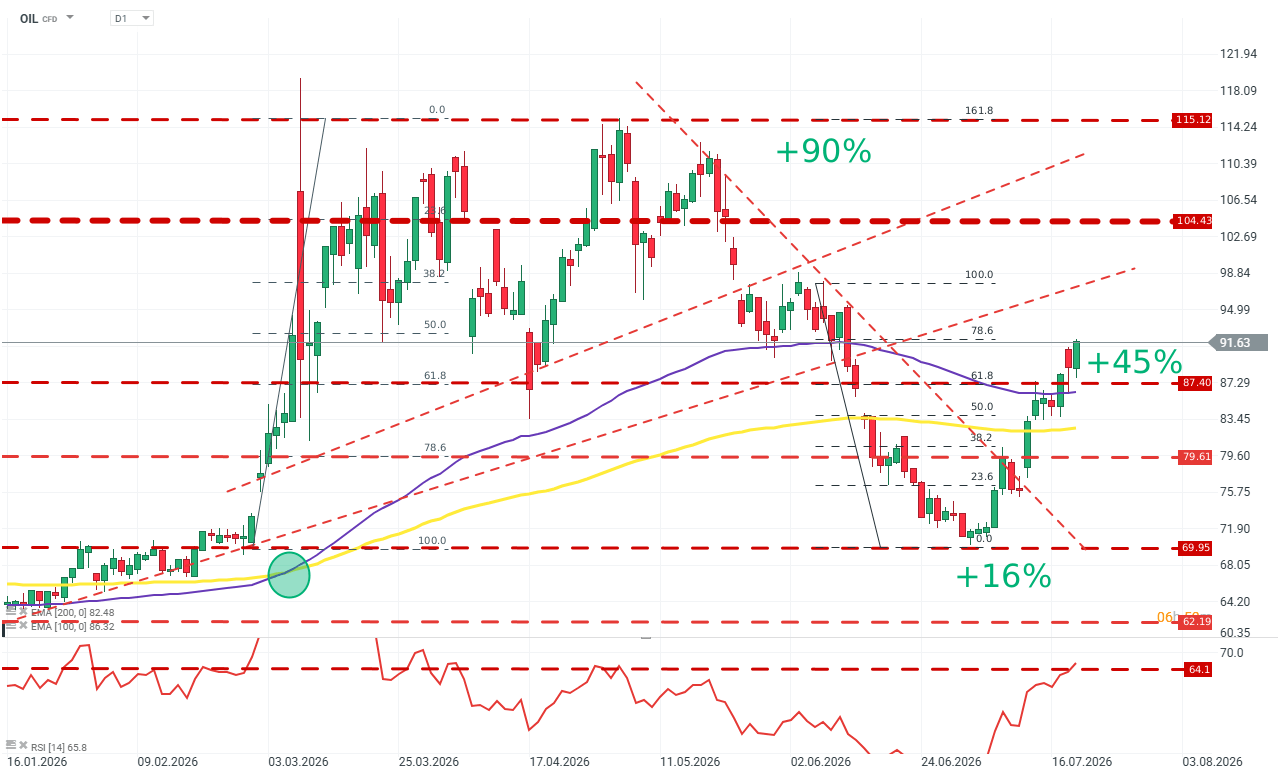
Even from these fragmentary pieces of information, one can infer that the United States is likely planning a significant escalation, which will have short- and medium-term implications for valuations, not only for oil but, to a limited extent, also for equity indices.
OIL (D1)
Source: xStation5
In the long term, however, Iran does not seem to have any chance of achieving its maximalist demands, and the country’s economic situation has been deteriorating for months from “terrible” to “catastrophic.” The market knows this, and given all the mitigation measures taken by market participants, one should not expect a breakout above previous highs or major increases in expectations for hydrocarbon prices in the long run.
Kamil Szczepański - Financial Market Analyst at XTB



Daily Summary: A sell-off with a spin-off
Iran Escalation: What to Watch and What to Expect



Daily Summary: Lower inflation weakens the dollar and awakens gold and S&P 500 to gains
Fed Chair Kevin Warsh’s Q&A from Congress Testimony: Inflation stability is a key
The content of this report has been created by XTB S.A., with its registered office in Warsaw, at Prosta 67, 00-838 Warsaw, Poland, (KRS number 0000217580) and supervised by Polish Supervision Authority ( No. DDM-M-4021-57-1/2005). This material is a marketing communication within the meaning of Art. 24 (3) of Directive 2014/65/EU of the European Parliament and of the Council of 15 May 2014 on markets in financial instruments and amending Directive 2002/92/EC and Directive 2011/61/EU (MiFID II). Marketing communication is not an investment recommendation or information recommending or suggesting an investment strategy within the meaning of Regulation (EU) No 596/2014 of the European Parliament and of the Council of 16 April 2014 on market abuse (market abuse regulation) and repealing Directive 2003/6/EC of the European Parliament and of the Council and Commission Directives 2003/124/EC, 2003/125/EC and 2004/72/EC and Commission Delegated Regulation (EU) 2016/958 of 9 March 2016 supplementing Regulation (EU) No 596/2014 of the European Parliament and of the Council with regard to regulatory technical standards for the technical arrangements for objective presentation of investment recommendations or other information recommending or suggesting an investment strategy and for disclosure of particular interests or indications of conflicts of interest or any other advice, including in the area of investment advisory, within the meaning of the Trading in Financial Instruments Act of 29 July 2005 (i.e. Journal of Laws 2019, item 875, as amended). The marketing communication is prepared with the highest diligence, objectivity, presents the facts known to the author on the date of preparation and is devoid of any evaluation elements. The marketing communication is prepared without considering the client’s needs, his individual financial situation and does not present any investment strategy in any way. The marketing communication does not constitute an offer of sale, offering, subscription, invitation to purchase, advertisement or promotion of any financial instruments. XTB S.A. is not liable for any client’s actions or omissions, in particular for the acquisition or disposal of financial instruments, undertaken on the basis of the information contained in this marketing communication. In the event that the marketing communication contains any information about any results regarding the financial instruments indicated therein, these do not constitute any guarantee or forecast regarding the future results.
