

The publication of June CPI inflation data for the United States is ahead of us. Many indicators suggest that the headline figure will slow down to around 3.8%. A larger decline could somewhat calm the frayed nerves of FOMC policymakers and encourage investors to withdraw some of their bets on rate hikes at upcoming meetings. A move upwards as early as the September meeting is currently priced in at around 80%.
A renewed rise in energy commodity prices has prompted the markets to hawkishly reprice. The base case scenario once again involves two interest rate hikes by the FOMC before the end of the year. Concerns regarding the inflationary situation are significant; markets are nervously searching for any signs that price pressure is slowing (or at least not growing).
CPI inflation
What is worth knowing about the American inflation reading scheduled for 1:30 PM?
- The consensus assumes a significant decline in the year-on-year index, from 4.2% in May to around 3.8% in June.
- A key factor in this context is expected to be the decline in fuel prices. It is estimated that in June it reached approx. 10% m/m.
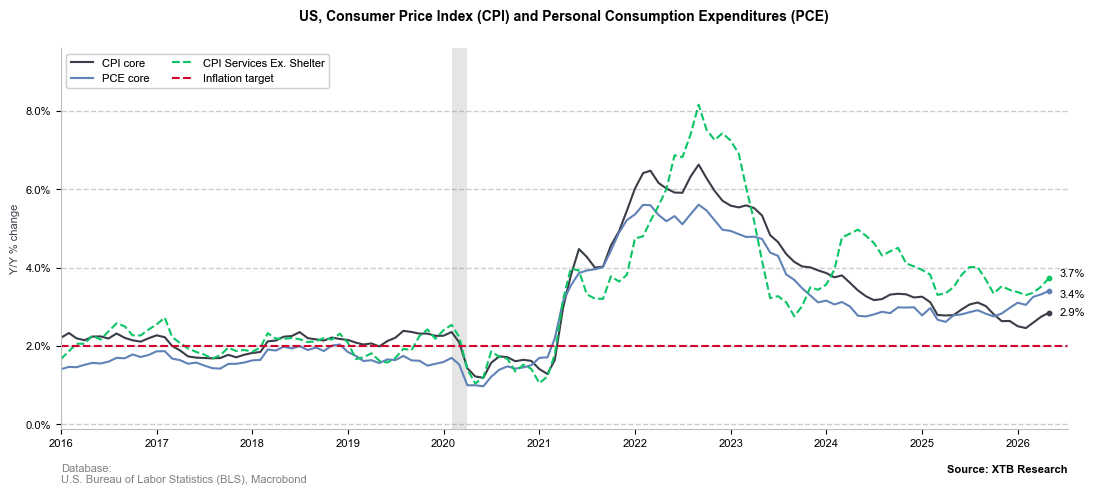
- Core inflation (inflation excluding the most volatile food and energy prices) is expected to remain sticky. It is in this direction that the Fed will look when making further decisions on monetary policy. The consensus assumes a reading of 2.8% year-on-year.
Figure 1: Core CPI and PCE Inflation in the United States (2016-2026)
 Source: XTB Research, 14.07.2026
Warsh's testimony
The Fed chair's semi-annual testimony before Congress is also scheduled for today.
Schedule
- As a rule, the entire event is preceded by the publication of a statement from the Federal Reserve (approx. 1:30 PM).
- Its reading at 3:00 PM sharp begins the main part of the hearing.
- Later, there is a transition to the section intended for questions from politicians of the House of Representatives.
- A day later, at the same time (Wednesday, 3:00 PM), the Fed chair will stand before the Senate.
Markets are still not convinced about what the new chair's approach to monetary policy will be. The first signals, which came as a surprise, were moderately hawkish.
We expect that the congressmen's questions will concern three key topics.
1. The end of forward guidance
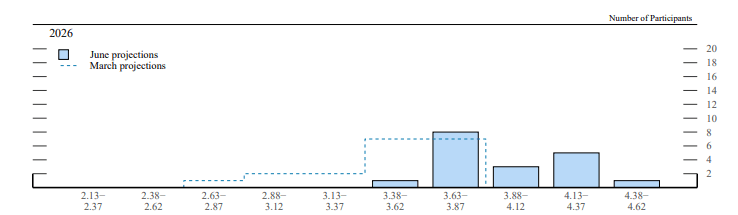
The new chair believes that making long-term promises deprives the central bank of the flexibility necessary to react to sudden changes in the economy. On Tuesday, however, he will be forced to present an outline of the plan that he will implement in the coming months. Let us recall that in the last dot plot, i.e., the projection of the interest rate path of the committee members, Warsh did not take part.
Figure 2: Difference Between the March and June Dot Plot (Interest Rate Levels at the End of 2026)
 Source: FOMC, 14.07.2026
2. Fed independence
Concerns regarding Trump's interference in the Fed's operations remain alive. Although the June conference somewhat calmed the sentiment, many still expect that Warsh will try to please the White House.
Let us recall that in the past year, the former chair, Jerome Powell, became the target of a criminal investigation by the Department of Justice. He called it an attempt to exert pressure on the independence of the Federal Reserve to force the central bank to faster interest rate cuts.
A months-long trial with the president was also endured by Lisa Cook, who was unlawfully "dismissed" from her position as a committee member by Trump.
Politicians will therefore likely try to get an answer to the key question: in what does Warsh's approach to the economy and monetary policy differ from that presented by Trump.
3. Inflation
90 minutes before the start of the hearing, the June inflation reading from the United States will be published. The consensus assumes no major changes regarding the core measure (consensus 2.8%) and a modest decline in the headline measure (consensus 3.8%). However, this is no reason for optimism. Price pressure remains decidedly too high, which means that Congress will demand very precise explanations as to how Warsh intends to bring it to the target.
Situation in the currency market
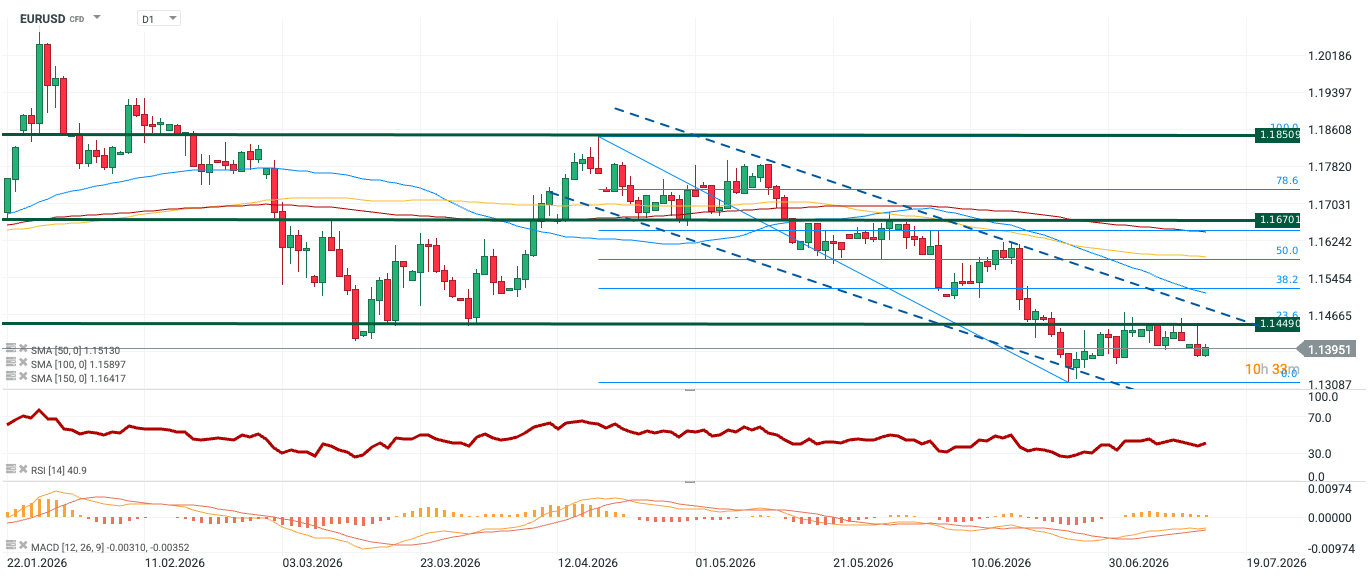
Waiting for the reading, the dollar is undergoing a very subdued weakening against the euro—by 0.1% on a daily scale. The EURUSD pair remains slightly below the 1.14 level.
Apart from speculations regarding the level of June inflation and the discussion surrounding Kevin Warsh's hearing scheduled for the next two days, attention is anchored on headlines from the Middle East. Let us recall that on Saturday, the Islamic Revolutionary Guard Corps issued a statement in which it announced that the Strait of Hormuz is closed to ship traffic "until further notice."
Figure 3: EURUSD (22.01 - 14.07)
 Source: xStation, 14.07.2026



Daily Summary: Lower inflation weakens the dollar and awakens gold and S&P 500 to gains
Fed Chair Kevin Warsh’s Q&A from Congress Testimony: Inflation stability is a key



Bypassing Hormuz: Gulf States Race Against Time
Warsh's Address to Congress: Zero Tolerance for Inflation, But No Change in Interest Rates?
