
Understand the three core financial statements, learn how they work together, and discover how investors use them to assess profitability, financial strength, cash flow, and overall business performance.
Understand the three core financial statements, learn how they work together, and discover how investors use them to assess profitability, financial strength, cash flow, and overall business performance.


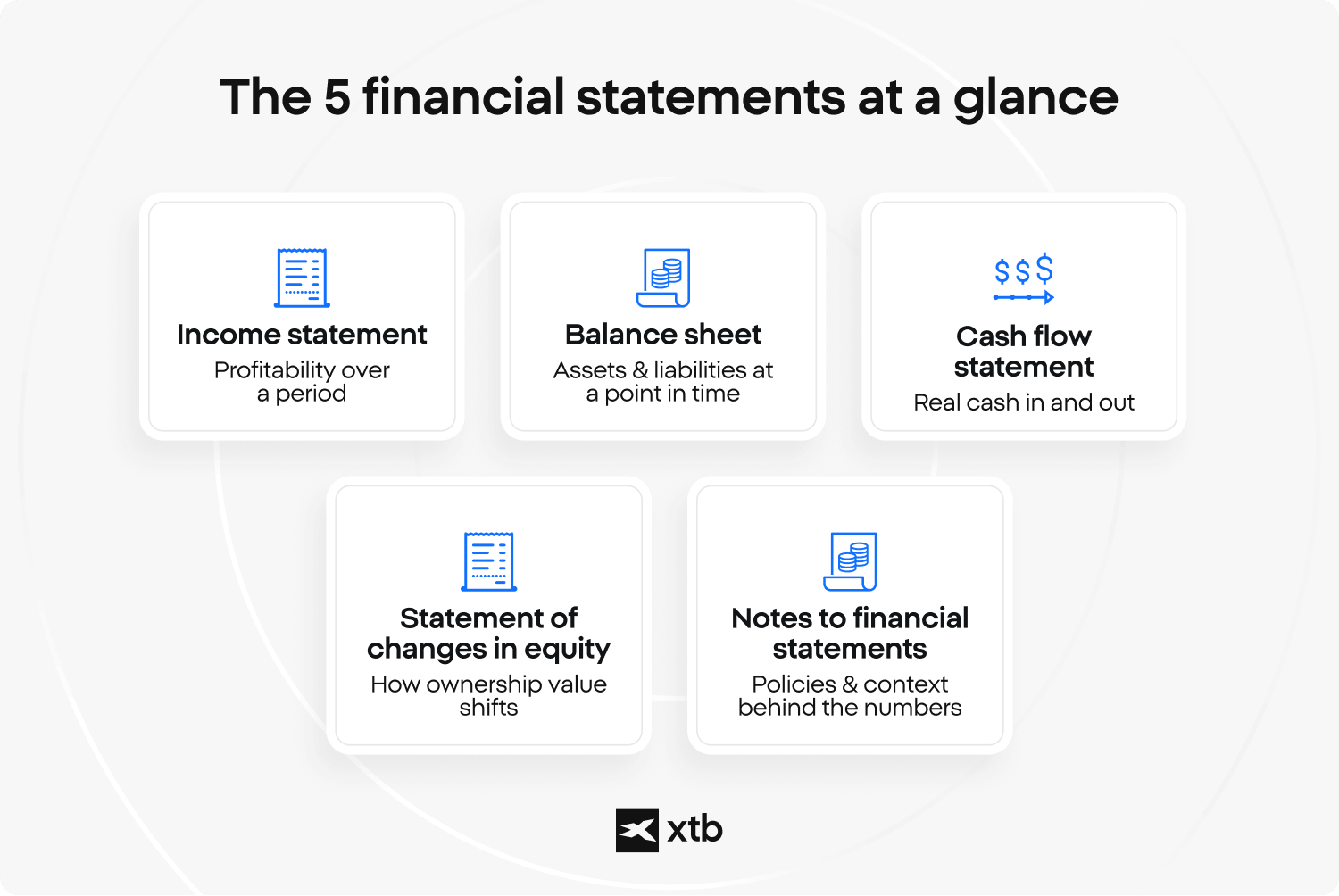
There are 3 core financial statements - the income statement, balance sheet and cash flow statement - but formal accounting standards outline 5 types when including the statement of changes in equity and the notes to financial statements. Investors typically analyse the main 3 to assess a company's performance, while the full 4 or 5 provide the complete legal picture required by GAAP and IFRS.
Key takeaways
-
The income statement, balance sheet, and cash flow statement represent the primary trio of documents, detailing profitability, asset health, and liquidity.
- The statement of changes in equity and notes to financial statements act as the fourth and fifth reports, offering mandatory granular data on shareholder value and accounting policies.
- All types of financial statements combined give investors a complete, interconnected view of a company's overall financial health.
- Financial statements exclusively report historical data, meaning they reflect past performance rather than predicting or guaranteeing future results.
What are financial statements?
A financial statement is a formal document presenting a company's financial position and business performance over a specific period. These official records aggregate a company's daily transactions into standardised categories, allowing external parties to evaluate the economic reality of the business.
Companies generate these documents to fulfil reporting requirements for investors, creditors, regulators, and internal management teams. Publicly traded companies release financial reports on a regular schedule. Most publish an annual report (10-K in the US), and many also release quarterly (10-Q in the US) or semi-annual reports (many European companies), depending on local stock exchange regulations. By standardising how financial data is presented, these documents ensure that you can compare different companies across the market using the same metrics.
What are the main types of financial statements?
There are three main types of financial statements
- Income statement,
- Balance sheet,
- Cash flow statement
while the statement of changes in equity and notes to financial statements complete the full reporting package under GAAP and IFRS, which is why different sources cite 3, 4, or 5 documents. This variation in numbering is not a contradiction but rather a difference in scope. When you evaluate the core 3 types of financial statements, you focus on the primary mathematical data needed for fundamental analysis. When auditors reference 4 or 5 types, they include the supplementary documents required for regulatory compliance.
1. Income statement
The income statement (also called the profit and loss statement) is the only core statement that measures performance over a period of time rather than at a single date, detailing revenue and expenses to arrive at net income. Investors use this document to determine whether the core business operations are profitable before factoring in external capital movements.
A typical income statement begins with revenue (sales), followed by the cost of goods sold (COGS) to calculate gross profit. Operating expenses such as research and development (R&D), selling, general and administrative (SG&A) costs, and depreciation are then deducted to arrive at operating income (EBIT), which reflects the profitability of the core business.
Below operating income, companies report items such as interest expense, taxes, and non-operating gains or losses before arriving at net income, often called the "bottom line." Investors frequently compare gross margin, operating margin, and net profit margin over several years to evaluate whether a company is improving its efficiency and profitability.
2. Balance sheet
The balance sheet provides a snapshot of a company's financial health at a single point in time, displaying assets and liabilities alongside shareholders' equity. You review this document to assess the company's net worth, capital structure, and ability to cover its short-term and long-term obligations. Understanding the balance sheet vs. income statement dynamic is crucial, as one shows a point in time while the other covers a period.
Assets are usually divided into current assets, such as cash, accounts receivable, and inventory, and non-current assets, including property, equipment, intangible assets, and goodwill. Liabilities are also separated into current liabilities, such as accounts payable and short-term debt, and long-term liabilities, including bonds and long-term borrowings.
The difference between total assets and total liabilities equals shareholders' equity, which represents the owners' residual interest in the business. Investors often analyse balance sheet metrics such as the current ratio, debt-to-equity ratio, working capital, and book value to assess financial stability and the company's ability to withstand economic downturns.
3. Cash flow statement
The cash flow statement is the only statement that tracks actual cash moving in and out of the business rather than accounting profit, split into three sections: operating, investing and financing activities.
Investors rely on the cash flow statement to verify a company's true liquidity because accounting profits do not always translate into real, spendable cash.
Operating cash flow includes cash generated by the company's core business, such as cash received from customers and cash paid to suppliers and employees. Investing cash flow covers transactions involving long-term assets, including capital expenditures (CapEx), acquisitions, and the purchase or sale of investments.
Financing cash flow records transactions with lenders and shareholders, including debt issuance or repayment, share buybacks, dividend payments, and proceeds from issuing new shares. Many investors focus on free cash flow (FCF)—typically calculated as operating cash flow minus capital expenditures—because it indicates how much cash a company generates that can be used to reduce debt, repurchase shares, pay dividends, or fund future growth.
4. Statement of changes in equity
The statement of changes in equity outlines the shifts in a company's equity accounts over a period, covering retained earnings, dividend payments, and share issuances or buybacks. This document is formally counted as the fourth statement because both US GAAP and IFRS require it to give investors transparency into how ownership value changes over time.
5. Notes to financial statements
The notes to financial statements contain detailed text explanations, accounting policy disclosures, and off-balance-sheet items that provide context to the hard numbers. They are frequently classified as the fifth type of financial statement because, especially under IFRS, the quantitative data is considered incomplete without these qualitative explanations.
How do the financial statements connect?
The financial statements connect through a single continuous flow: net income from the income statement feeds into shareholders' equity on the balance sheet (and the statement of changes in equity), while changes in balance sheet accounts and cash are reconciled by the cash flow statement.
This web of connections ensures the mathematical accuracy of the accounting process. The final line of the income statement, net income, travels directly to the balance sheet as retained earnings. Simultaneously, the cash flow statement bridges the gap between the accounting profit and the actual cash balance, explaining why cash changed even if a profit was recorded.
To gain a full picture, you must analyze all types of financial statements together. The balance sheet acts as the main link, ensuring that total assets always equal total liabilities plus equity. Looking at just one document can hide systemic risks; evaluating them collectively enables robust discounted cash flow modeling and proper risk assessment.
Why are financial statements important, and who uses them?
Financial statements provide a standardized view of a company's financial performance and position, making them one of the most important sources of information for business decisions. By presenting revenue, expenses, assets, liabilities, equity, and cash flows in a consistent format, they allow different stakeholders to evaluate a company's financial health using comparable data.
Financial statements are used by a wide range of people and organizations, including:
- Investors assessing profitability, valuation, and long-term growth potential.
- Lenders and banks evaluating whether a business can repay loans and meet its financial obligations.
- Company management monitoring performance, planning budgets, and making strategic decisions.
- Suppliers and business partners determining a company's creditworthiness before extending payment terms.
- Regulators and tax authorities verifying compliance with accounting and reporting requirements.
- Auditors reviewing whether the financial statements fairly present the company's financial position under the applicable accounting standards.
Because financial statements follow recognized accounting frameworks such as IFRS or US GAAP, they make it easier to compare companies across industries, countries, and reporting periods. However, they should always be interpreted alongside qualitative factors such as competitive position, management quality, and broader economic conditions.
|
|
What can financial statements tell investors, and what are their limits?
Financial statements show a company's profitability, stability, and liquidity, but they inherently describe past performance and do not guarantee future outcomes. These documents serve as the foundation of fundamental analysis, but interpreting them effectively requires acknowledging their structural limitations.
By examining the records, you can extract several key performance metrics:
- Profitability and margins: The income statement reveals how efficiently a company converts revenue into bottom-line profit.
- Debt and leverage: The balance sheet highlights the proportion of debt compared to equity, signaling financial stability or distress.
- Liquidity and cash generation: The cash flow statement confirms whether the business generates enough liquid capital to fund operations without external borrowing.
- Shareholder value distribution: The statement of changes in equity tracks exactly how much capital is returned to investors via dividends or buybacks.
Despite their utility, financial statements have significant limitations. They are built strictly on historical data, meaning they reflect the past rather than the current market reality. Furthermore, creative accounting practices can sometimes obscure the true financial position, and the numbers alone lack qualitative context such as management competence or shifting industry trends. To master this process, learing how to read financial statements and specifically how to read a balance sheet is essential for any serious market participant.
|
|
FAQ
FAQ
Most investors focus on three core financial statements: the income statement, balance sheet, and cash flow statement. However, a complete set of financial reports prepared under major accounting standards also includes the statement of changes in equity and explanatory notes, which is why some sources refer to four or five financial statements.
The income statement is often the easiest place to start because it explains whether a business generated a profit or loss over a reporting period. Once you understand earnings, reviewing the balance sheet and cash flow statement helps explain how those profits relate to assets, debt, and cash generation.
A business can report strong earnings while generating little or even negative cash flow. The cash flow statement shows whether operating activities are actually bringing cash into the business, making it an essential tool for assessing liquidity and financial sustainabili
The balance sheet shows what a company owns and owes at a specific date, while the income statement summarizes financial performance over a period such as a quarter or a year. Together, they provide different but complementary perspectives on a company's financial condition.
Yes. Private businesses also prepare financial statements for owners, lenders, tax authorities, and other stakeholders. The reporting requirements may differ from those of publicly traded companies, but the same core accounting principles generally apply.
In many jurisdictions, listed companies publish quarterly financial reports and a more comprehensive annual report. The exact reporting schedule depends on the stock exchange, local regulations, and the accounting framework the company follows.
No. Financial statements describe historical financial performance rather than future outcomes. Investors typically combine them with industry analysis, competitive positioning, management assessment, and economic conditions when evaluating a company's long-term prospects.
Public companies usually publish their financial statements in the Investor Relations section of their websites. They are also available through stock exchange filings and financial regulators, such as the SEC's EDGAR database in the United States or equivalent national filing systems in other countries.
One of the most common mistakes is analysing a single statement in isolation. For example, rising profits may appear attractive, but weak cash flow or a rapidly growing debt burden could reveal financial risks that are only visible when all statements are reviewed together.
Not entirely. Most countries use either International Financial Reporting Standards (IFRS) or U.S. Generally Accepted Accounting Principles (US GAAP). While both frameworks pursue the same objective of transparent financial reporting, certain recognition, measurement, and disclosure rules differ, which can affect comparisons between companies.