


- Geopolitical risks retreat
- Risk sentiment boosted at the start of the week
- Fed decision to take centre stage, as CBs expected to remain on hold
- Investors cautious about capex spenders, as semiconductors bounce back
- Earnings season crucial for 2H US stock market outlook
- Event Watch: Fed, BOJ, BOE, US GDP, earnings
- Geopolitical risks retreat
- Risk sentiment boosted at the start of the week
- Fed decision to take centre stage, as CBs expected to remain on hold
- Investors cautious about capex spenders, as semiconductors bounce back
- Earnings season crucial for 2H US stock market outlook
- Event Watch: Fed, BOJ, BOE, US GDP, earnings
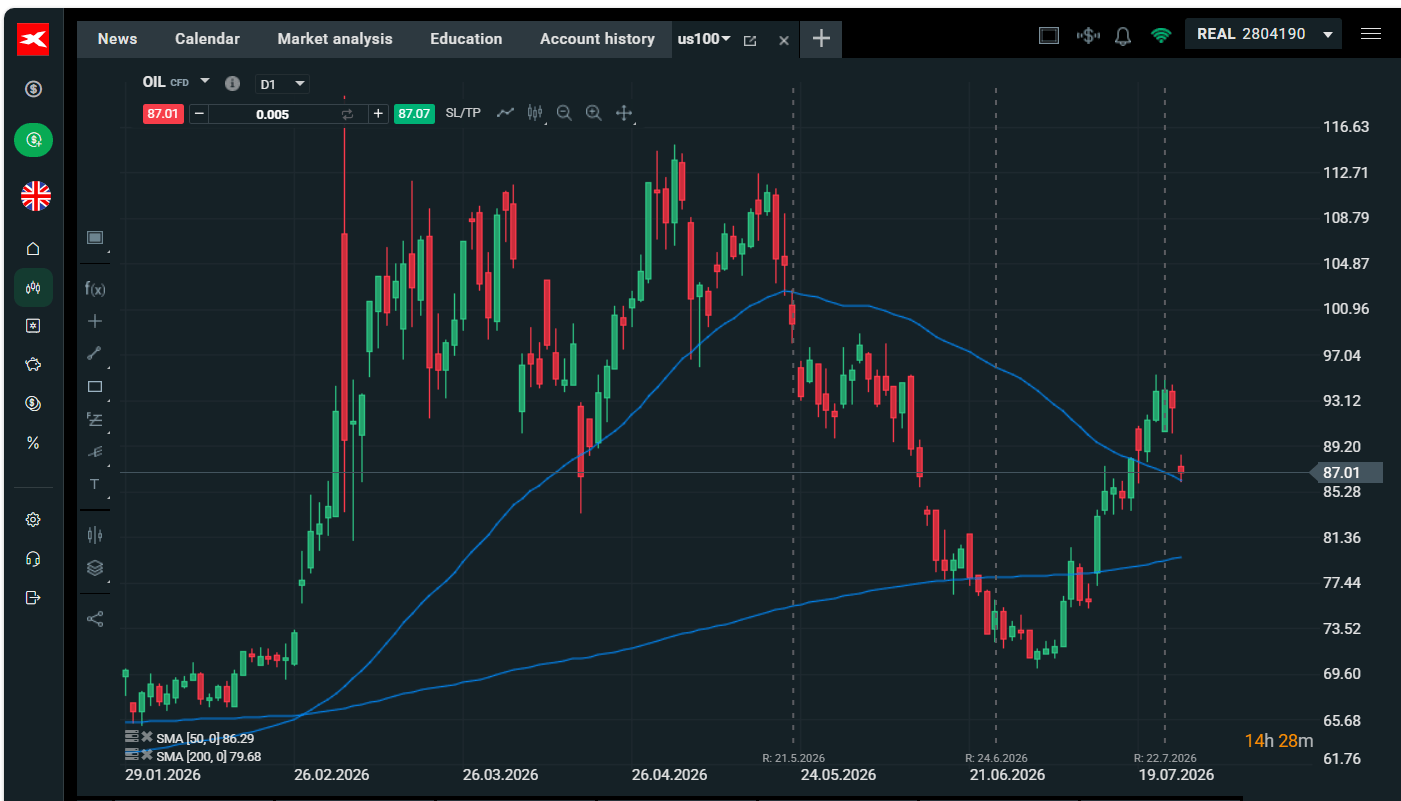
There has been a major shift in financial markets this morning. Reports that the US and Iran have agreed to a pause in hostilities after two weeks of relentless bombing by both sides, has been warmly welcomed by investors. This has dramatically reduced the geopolitical risk premium; the Brent crude oil price is down 10% and is trading at $86 per barrel. This is a big change from last week, when the oil price was knocking on the door of $100 per barrel.
Geopolitical risks retreat
The question now is, will the deescalation in tensions between Iran and the US have a longer-term dampening impact on the oil price, and will it lead to reduced inflationary concerns as we lead up to some key central bank meetings? Over the weekend there were no new strikes in Iran or the Strait of Hormuz for a second day in a row. This sudden calm, after two weeks of attacks, spurs hopes of a return to diplomacy.
Iran has said that it will halt strikes on the Gulf, and there are hopes that talks to ensure the safe passage of ships through the Strait of Hormuz will continue into this week. For now, the Strait of Hormuz is still under a blockade, and Houthi attacks in the Red Sea have also increased commodity supply risks, even if there are factors that could limit Houthi’s effectiveness now that they have entered the fray. Although the situation in the Middle East has calmed, it has not been resolved, and it could make a decline below $85b per barrel tricky at this stage.
Risk sentiment boosted at the start of the week
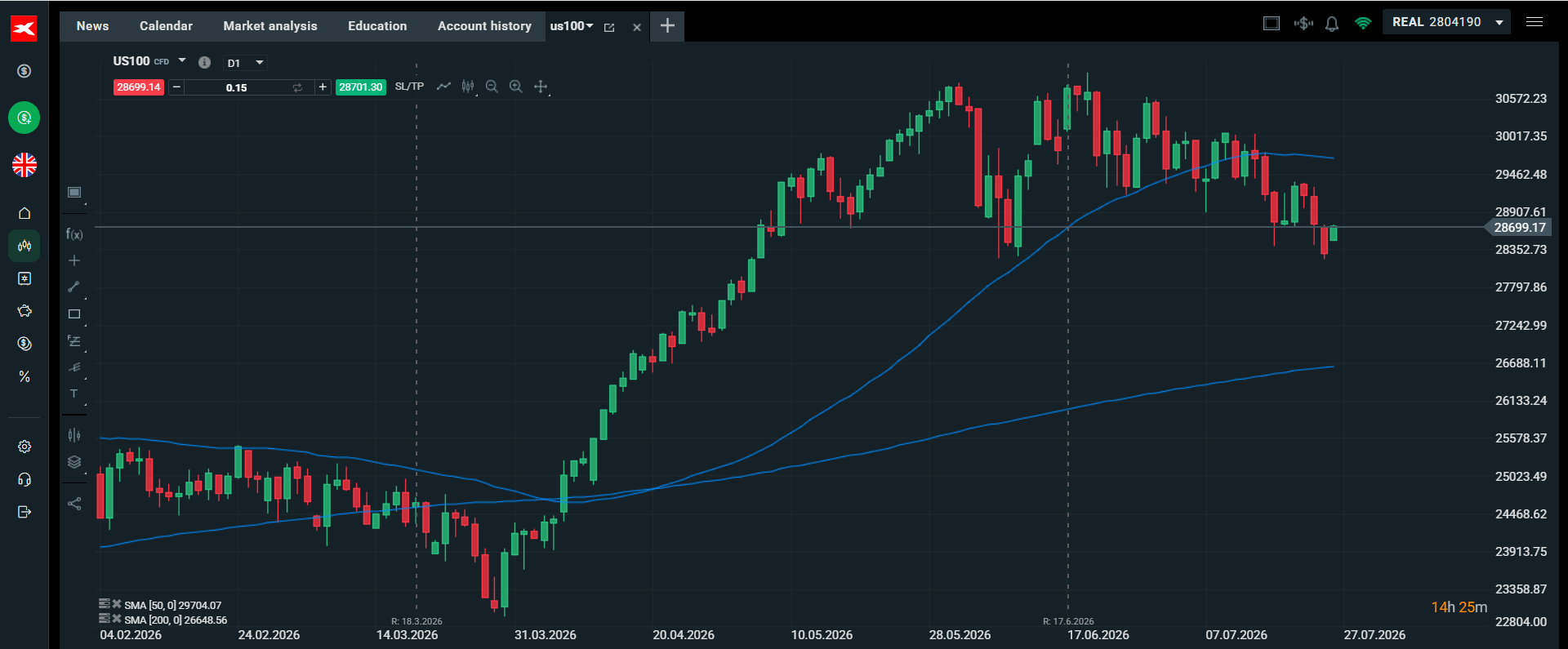
The decline in the oil price has seeped into other asset classes at the start of this week, and risk sentiment is surging. Equity index futures are rising sharply, the Nasdaq is predicted to rise 1.5% today as we lead up to some key earnings releases. The falling oil price is also adding downward pressure to yields, the UK 10-Year yield is lower by 13bps this morning. Asian equities rose overnight, with a 1.5% gain for the Kospi index in South Korea. SK Hynix rose 1.5%, as chip makers led Asian indices higher. This is expected to be replicated in the US and Europe later today.
The price action early on Monday suggests that the losing streak for US stocks is taking a pause, however, we have been here before. The events of the last 2 weeks have reminded us that geopolitical risks are never far away, and relations between the US and Iran remain incendiary. Added to this, although US indices are rising, there are still other hurdles for equities to pass in the coming days including earnings reports and a Fed rate decision.
Fed decision to take centre stage, as CBs expected to remain on hold
The FOMC decision is the centre point of the week, and events on Wednesday and Thursday could set the tone for financial markets over the coming weeks and months.
Yields surged last week across Europe and the US as oil prices rose sharply, we yields are falling sharply as we start the new week. Surprisingly, last week’s sharp rise in yields was less notable in the UK compared to the US. The 10-year yield rose 5bps and the 2-year yield was up 6bps. This compares to a 13bp increase in the 10-year US Treasury yield. Could hopes of North Sea gas fields coming back into production break the positive correlation between UK yields and rising commodity prices, and assuage the UK’s Gilt market? We shall have to see if yields fall further on the back of declining oil prices this week and also assess what the BOE will do next when they meet this Thursday.
Investors cautious about capex spenders, as semiconductors bounce back
Last week also saw the market digest the first of the Magnificent 7 earnings reports. Tesla and Alphabet saw their share prices fall 18% and 7% respectively last week, after they both announced increased capex spend as they expand their AI capabilities. This week will see four more Magnificent 7 companies report earnings. The dominant theme in the tech stock space is caution on capex spenders like Alphabet and Tesla, and optimism for their customers whose order books remain fat from hyperscaler demand. This is why the Magnificent 7 on aggregate saw its share price drop 5.8% last week, compared to a 2.9% gain for the Philadelphia semiconductor index.
Earnings season crucial for 2H US stock market outlook
Overall, the Nasdaq fell 2% last week, compared to a more modest 0.6% drop in the S&P 500. Real estate, industrials, energy and utilities all rose last week, as the rotation out of the Magnificent 7 got under way, and the negative correlation with the oil price persisted. The hyperscalers are facing growing scrutiny of their capex spend this earnings season, and we expect the same for Amazon, Microsoft and Meta when they report earnings this week. Apple also reports results; however, its AI investment has lagged rivals in recent years and it may fall under the radar of investors’ unforgiving gaze. The cost of money is getting more expensive, which could hurt those who are investing heavily using their balance sheets to fund their AI investments. This may continue to be a headwind to valuations as we move deeper into earnings season.
Event Watch:
This is a big week, and investors are looking for direction as we move deeper into the summer. The question is, are movements in financial markets already locked in, or is there room for a major shift in direction? There was an improvement in sentiment at the end of last week, as the oil price fell, however, this did not translate into a pickup for US stocks. Investors will be looking to see if this week’s earnings are drivers of more rotation out of US tech stocks and into European equities, or if the slide in major tech names like Tesla can be halted.
Below, we look at the major events that will drive markets this week.
- FOMC meeting: This is the main event for financial markets, especially since the market is still getting used to the new chair Kevin Warsh and his style of communication. The market is not expecting any change to rates on Wednesday; however, the Fed Fund Futures market is pointing to 2 rate hikes in the next 6-12 months. As Warsh has said himself, there are diverse views within then FOMC, and this meeting we could see a tussle between those who are concerned about sticky inflation and those who are more worried about the labour market. However, the robust US economic data of late, means that this could be the meeting where dovishness is put to bed at the Fed. As we lead up to this meeting, the spike in oil prices has seen investors increase their bets that the Fed could hike rates this week to 36%. However, we think that it is too premature for hikes at this stage. Central banks cannot control energy prices, geopolitical risks or supply issues, so a rate hike is likely to be ineffective at this stage. The US dollar was the best performing currency out of the majors last week; the dollar index rose 0.5% to more than 101.00. A new round of US tariffs did not hurt the dollar’s upward trajectory, and if the Fed continues to sound concerned about inflation risks, then we expect further upside for the greenback.
- BOE and BOJ meetings: Both central banks are expected to keep rates on hold, and the BOE decision could be finely balanced whether to pivot towards future rate hikes or wait to see how the growth picture pans out under new PM Andy Burnham. The market will be watching the USD/JPY’s reaction to the BOJ meeting after it rose to a fresh 40-year high last week rising towards 164.00. This meeting could spur more volatility in this pair, as the BOJ tries to stem further yen decline.
- Equity earnings are also key for this week. Google and Tesla had a rough ride after reporting their Q2 results last week. This week sees four more members of the Magnificent 7 report their key numbers for last quarter. Here are the details you should watch for:
- Meta: The good news in this report could be positive user engagement momentum created by the World Cup. Meta has come under scrutiny this year, and its share price is down 10% YTD. The company is set to invest up to $145bn on AI this year, and abandon investments elsewhere. The focus will be on return on investment, and Meta’s plan to sell some of its compute capability. Meta does not have a full stack AI offering, so how it can monetize its AI products will be key.
- Microsoft: The focus on AI cost control leaves Microsoft in a bind. Scaling back some of its investment could compromise sales of its co-pilot programme that is embedded in the Microsoft suite of products. Microsoft’s share price is already down 20% YTD, however, hyperscalers are damned if they do, damned if they don’t. Too much investment and the market punishes them, too little investment and the narrative shifts to them falling behind in the AI race. We are not expecting these results to change the dial for Microsoft’s share price.
- Amazon: Revenue estimates are high going into this report, which will be a tough bar to clear. Added to this, high oil prices in Q2 could increase the cost base of its logistics business for its ecommerce arm. However, shifting prime day to Q2 rather than Q3 could add a temporary boost to revenues.
- Apple: it has been the top performing Magnificent 7 stock this year and is higher by 20%. It has not been caught up in the hyperscaler race to invest in AI, and this strategy has paid off in 2026, as AI spend has come under more investor scrutiny. Any product updates, including the foldable iPhone, could also be welcomed by investors.
- Economic data watch: There is a data deluge this week including US Q2 GDP and GDP readings from the Eurozone. The economic data could highlight the divergence between the US and elsewhere. The Atlanta Fed GDPNow model is pointing to a 1.7% growth rate for Q2, down from 2.1% in Q1. However, we think that the risks are to the upside, as business investment continues to surge, due to AI investments, and consumer spending also held up well in Q2.
Chart 1: Brent crude oil price testing its 50-day sma support above $86 per barrel.
Source: XTB
Chart 2: Nasdaq 100 in focus ahead of big earnings week
Source: XTB



🔴European TTF gas prices fall by 7.5%



Economic Calendar: What you need to watch closely this week❓ (27.07.2026)



Morning Wrap: The weekend slump in oil prices is accelerating 💥 (27.07.2026)

When will the rise in oil prices reach us?
This content has been created by XTB S.A. This service is provided by XTB S.A., with its registered office in Warsaw, at Prosta 67, 00-838 Warsaw, Poland, entered in the register of entrepreneurs of the National Court Register (Krajowy Rejestr Sądowy) conducted by District Court for the Capital City of Warsaw, XII Commercial Division of the National Court Register under KRS number 0000217580, REGON number 015803782 and Tax Identification Number (NIP) 527-24-43-955, with the fully paid up share capital in the amount of PLN 5.869.181,75. XTB S.A. conducts brokerage activities on the basis of the license granted by Polish Securities and Exchange Commission on 8th November 2005 No. DDM-M-4021-57-1/2005 and is supervised by Polish Supervision Authority.
