

Could the inflation shock of 2022 happen again, given that the Strait of Hormuz still remains blocked?
By watching the right economic indicators, one can clearly see a creeping energy crisis, similar (though not identical) to the one we saw in 2022.
A return of inflation also seems, at this point, to be only a matter of time, but it will have a radically different structure and scale.
Turning Oil into fuel
Is it possible that strong demand for fuel is holding back oil prices? Partly, yes.
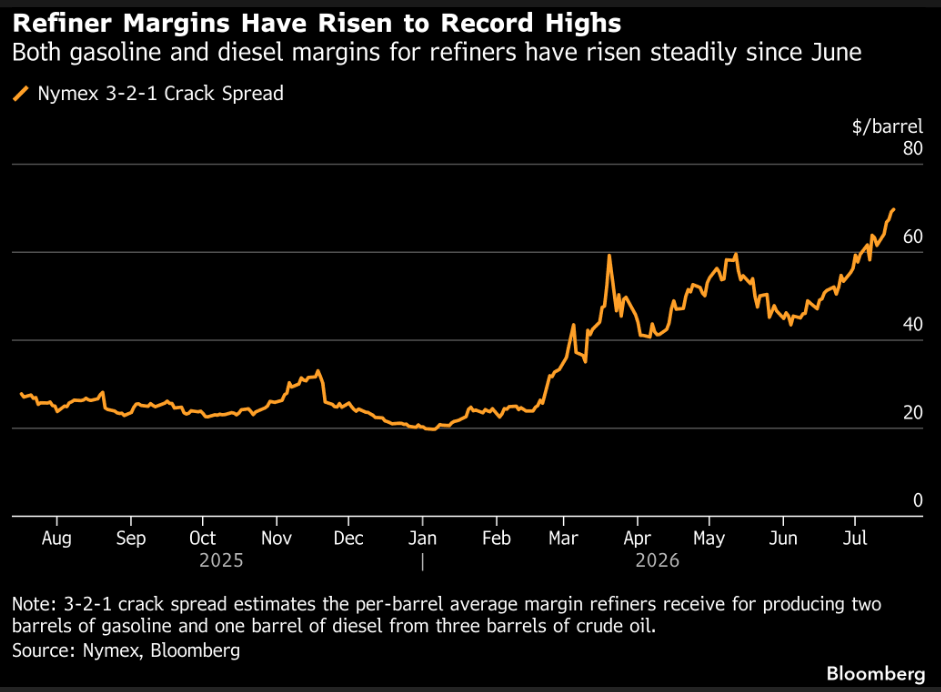
It is important to understand that today the biggest bottleneck in the global hydrocarbons market is not crude oil, but refining capacity. The data leave no doubt about this.
Refining margins (NYMEX 3-2-1) [2025-2026]
Source: Bloomberg Finance
The share of the refining margin in a barrel of oil is currently the highest in history, and nothing suggests this will change. Understanding the source of this phenomenon in the current context helps explain the so called supply elasticity.
Crude oil supply can be increased fairly quickly, if not through higher production rates then through releases from strategic reserves.
That pushes oil prices down, but we do not pump crude oil into the tanks of cars, planes, and ships.
That crude has to be processed, and unlike extraction, refineries cannot quickly ramp up output. This means that when oil reserves are released while fuel shortages persist, refineries get flooded with crude they cannot process and reduce purchases.
The result is an absurd situation in which crude becomes cheaper despite shortages, while fuel becomes more expensive despite cheaper crude.
The world has oil reserves and the ability to moderately increase production, but not refining.
Utilisation of the oil refining industry in the US, China, and Russia
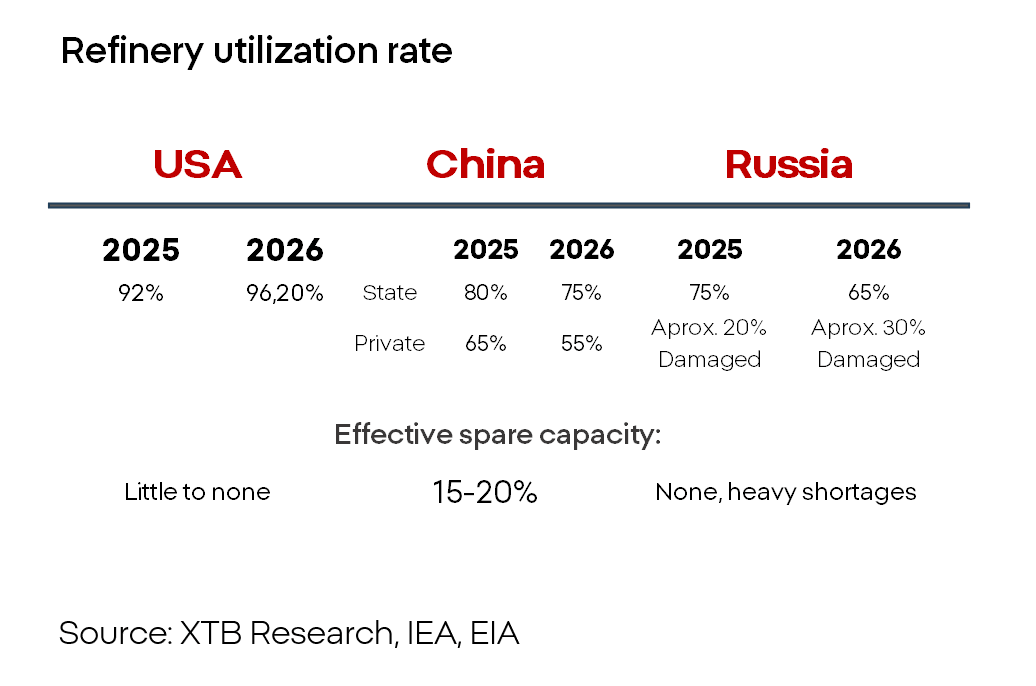
Currently, more than a dozen percent of global refining capacity is shut behind the Strait of Hormuz.
In the US and Europe, refineries are operating at full capacity and there is no visible prospect of expansion or investment.
Refineries in Russia had a huge production buffer, which has been reduced to zero by drone attacks.
Refineries in China remain a mystery, though they likely hold one of the keys to understanding the current situation in the market.
Is China steering the market from the shadows?
First, the facts:
- China’s oil and fuel inventories are unknown, but estimates and fragmentary publications suggest they are the largest in the world.
- China has cut oil imports by almost half since the beginning of the war in Iran. That means about 20 million tonnes of crude have disappeared from the market (around 5 to 10% of global demand).
- China has spent the last two years buying record amounts of oil from the market.
- The label “the world’s factory” did not come from nowhere. China alone accounts for about 30% of global industrial production (2025).
- China cannot meet its oil demand on its own, but its refining capacity now covers almost all of the country’s needs, with implied potential for exports.
China reduced imports, giving the oil market a huge safety margin, while at the same time using its oil and gasoline reserves to shield itself from price inflation. By doing so, it partly exports this “disinflation”, because it brings to market goods and products without the fuel cost mark up.
All of this is key to understanding why an event with such catastrophic implications as the blocking of the Strait of Hormuz has a relatively small impact on current data and valuations.
However, the forces suppressing prices are temporary, while the factors driving further inflation increases are unavoidable.
An inflationary fire?
Fire needs fuel, heat, and oxygen to burn. Inflation is similar.
The episode of an inflationary spiral we saw in 2022 had three main components. Remove one of them and the mechanism stops working.
- Supply factor: closed factories and ports, plus sanctions, destabilised the market and limited the amount of products available.
- Demand factor: fiscal stimulus, high consumer savings, and the strong financial position of firms created enormous room for prices to rise.
These two factors gave rise to a third factor:
- Pricing power, or the ability to set prices. Companies could not only pass costs onto the customer, but also expand margins, not because they had to, but because they could.
Today, two out of three are missing. How, why, and what does that mean?
The supply factor is doing reasonably well. The blockage of the Strait of Hormuz and the ongoing conflict in Ukraine keep commodity markets tense, but not yet in outright shortage.
Price action remains sluggish. A level of 90 USD per barrel is above average, but not a crisis level. At the same time, inflation in developed countries is “only” 3 to 4%.
This is happening because the demand factor and pricing power are largely absent. This market mechanism will affect inflation once fuel prices get closer to consumers. In this context, it becomes clear that rising inflation is a delayed but almost inevitable phenomenon. But can we suspect the scale of price increases will be the same as in 2022? Many signs suggest it will not.
Consumer weaknes & Pricing power
The demand factor is consumers’ willingness and ability to spend money. Consumer condition today is weak, and in places disastrous.
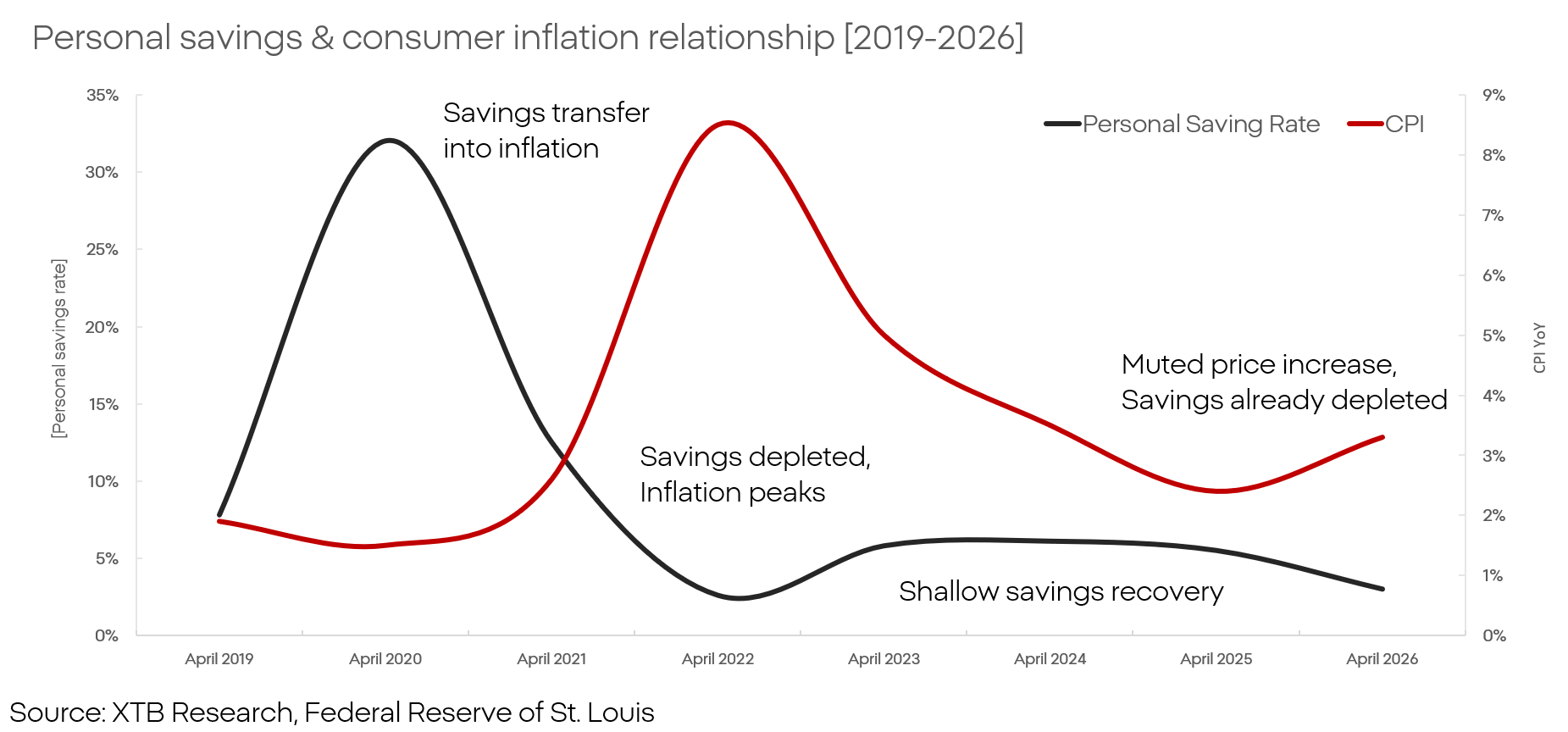
Consumers were already weakening in 2024 to 2025, and noticeably so. However, this was masked by savings and credit. Those sources have been exhausted, and economic growth is not translating into wages for most of the workforce.
On the contrary, we are seeing an episode of rising unemployment, whose scale is muted by low data quality, a falling labour force participation rate, and increasingly common gig work.
Pricing power under these conditions is significantly limited. Consumption is flat and in some places declining, reserves are gone, and the condition of the labour market is questionable. The aforementioned pressure from cheap production in China only worsens companies’ ability to control prices.
Market view
What happens, however, when production inputs, energy costs, and transport costs rise, but the end customer simply has no room in their budget for higher spending?
Margins get compressed.
Many companies have experienced an unprecedented rise in margins in recent years and theoretically have a buffer they can give back. The problem is that not all companies used the “inflation years” to raise margins, and the sectors that may lose the most this time, namely consumer sectors, do not handle margin expansion as well as energy, financials, or technology.
Who will gain and lose the most?
Not everyone will lose, at least not to the same degree. Different market segments and business models are adapted to the coming market conditions to different extents.
Companies with better cost control and a stronger ability to defend margins will do better. These will include:
- Retail focused on groceries and economies of scale (for example Walmart)
- Refineries (see Chevron, Valero)
- Used cars and their maintenance (for example AutoZone)
Worse off, meanwhile, will be companies with the largest and least flexible exposure to the segments most at risk. These will include:
- Low cost airlines, especially in the lower price segment (such as Frontier Group)
- Finance focused on so called subprime (CRMT)
- Restaurants, especially casual dining (for example Dine Brands)
However, a warning is needed: this is one scenario, which assumes no change in the macroeconomic context.
Kamil Szczepanski
Financial Markets Analyst, XTB



Daily Summary: Equities Diverge as Tech Lags, Europe Rallies on Earnings & PMIs (24.07.2026)


Three markets to watch next week (24.07.2026)


Oil Slides Ahead of the Weekend!



US OPEN: Nasdaq hits 1-month low! Geopolitics bring AI trade down!
This content has been created by XTB S.A. This service is provided by XTB S.A., with its registered office in Warsaw, at Prosta 67, 00-838 Warsaw, Poland, entered in the register of entrepreneurs of the National Court Register (Krajowy Rejestr Sądowy) conducted by District Court for the Capital City of Warsaw, XII Commercial Division of the National Court Register under KRS number 0000217580, REGON number 015803782 and Tax Identification Number (NIP) 527-24-43-955, with the fully paid up share capital in the amount of PLN 5.869.181,75. XTB S.A. conducts brokerage activities on the basis of the license granted by Polish Securities and Exchange Commission on 8th November 2005 No. DDM-M-4021-57-1/2005 and is supervised by Polish Supervision Authority.
