Wall Street is experiencing a classic geopolitical rollercoaster. Volatility is extreme and driven almost entirely by events surrounding the conflict in the Persian Gulf. Just a few hours ago, the market was preparing for an escalation following the expiration of a 48-hour ultimatum to Iran, only to suddenly learn that it had been extended by five days. This decision brought immediate relief and a sharp reversal across multiple asset classes.
Today’s market moves are essentially an accelerated version of “buy the rumor, sell the news.” Before the U.S. open, the market was pricing in a potential attack on energy infrastructure, which pushed oil prices higher and drove the volatility index up. Investors were simultaneously factoring in the risk of an inflation shock and a more hawkish stance from central banks, putting pressure on stocks, bonds, and other assets.
The situation reversed almost immediately after Donald Trump announced progress in talks with Iran. Futures on major indexes rebounded sharply, and oil prices fell dramatically, reflecting hopes for de-escalation. Notably, Trump’s statements and posts alone were enough to shift sentiment, sending the key U.S. indexes back up. At the start of the cash session on Wall Street, the S&P 500 is up over 1.5 percent, the Dow Jones has gained 1.6 percent, and the Nasdaq is up more than 1.5 percent.
This highlights how sensitive the market has become to individual headlines and how little stability there is in short-term trends. Rapid denials from Iran further underline the uncertainty. Investors are navigating between extreme scenarios, with every new signal capable of dramatically changing the market’s direction.
Oil remains at the center of attention as the primary channel for risk transmission. Concerns about disruptions in the Strait of Hormuz directly influence inflation expectations, interest rate valuations, and corporate performance. This explains why we occasionally see unusual situations in which stocks, bonds, and even gold are all under pressure simultaneously.
This episode resembles previous periods when U.S. political communication caused sudden and unpredictable market moves. The difference today is that the stakes include not only investor sentiment but also a real energy shock, which could feed into higher inflation and slower economic growth.
Source: xStation5
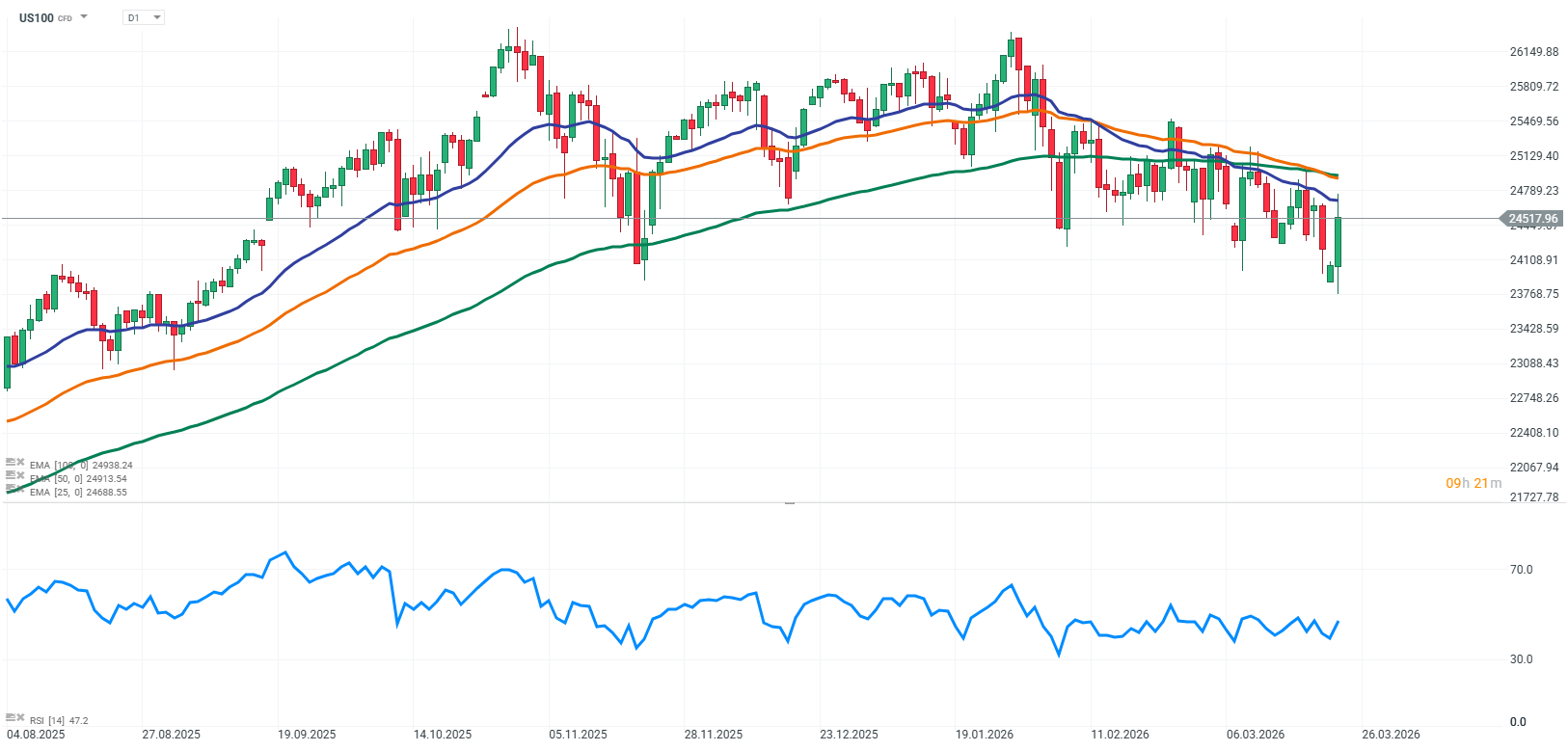
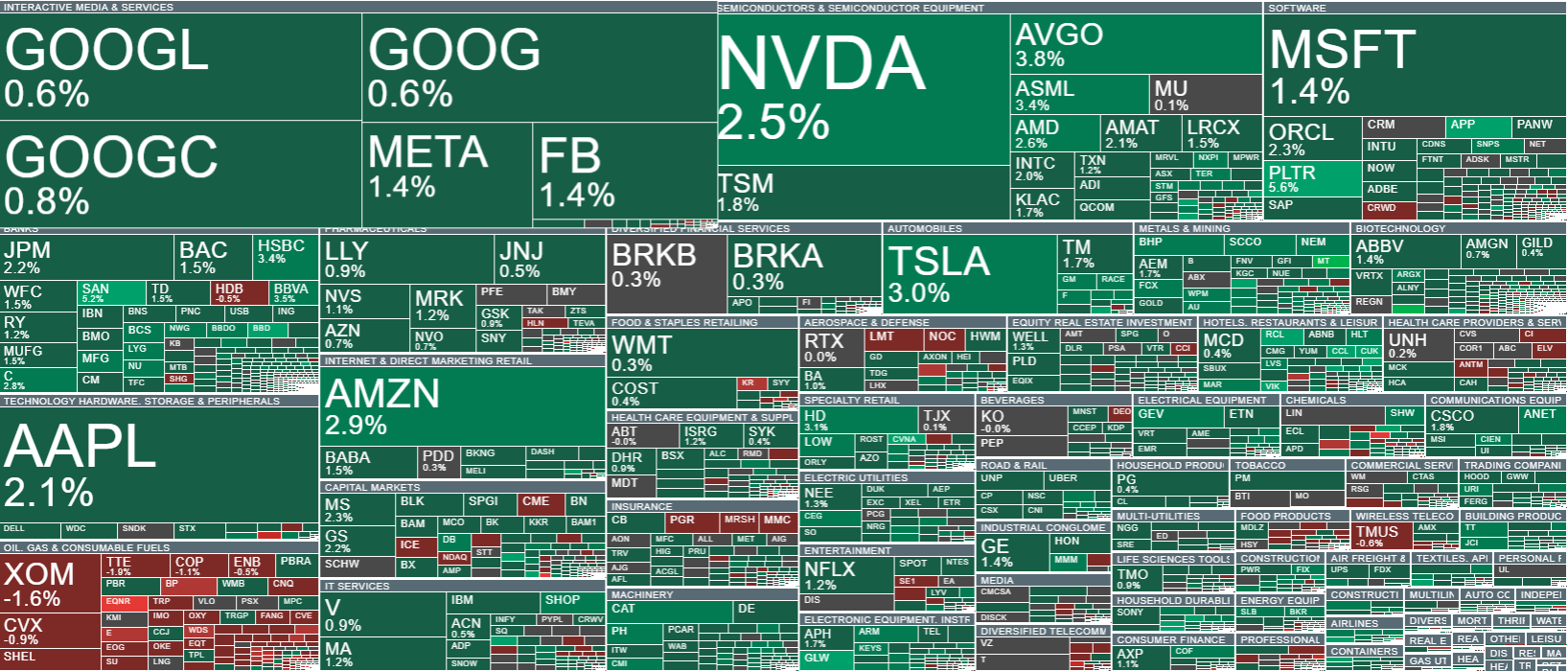
Today, contracts on the US500 (S&P 500) are showing a clear rebound. Markets are responding to the decision to extend the ultimatum to Iran, temporarily easing fears of an escalation in the Persian Gulf and the risk of a sudden energy shock. This momentary relief is quickly translating into higher risk appetite.
Source: xStation5
Company News
On Wall Street, technology and semiconductor stocks are gaining on signals of easing tensions in the Middle East, with NVIDIA (NVDA.US) and AMD (AMD.US) leading the rebound. Improving market sentiment has attracted investors interested in the long-term potential of AI, while short-term gains illustrate how sensitive tech companies are to geopolitical impulses and investor sentiment.
Apple (AAPL.US) shares are up around 1.5 percent at the start of the session. The market is reacting positively to strong iPhone sales and record device upgrade rates. In particular, users in China are rapidly updating their phones, signaling stable demand. Apple remains a pillar of the tech sector, attracting capital during periods of uncertainty and serving as a symbol of stability and innovation.
Berkshire Hathaway (BRKA.US) announced plans for a significant investment in the Japanese insurance company Tokio Marine, initially acquiring about a 2.5 percent stake.
Core Scientific (CORZ.US) shares are up around 1 percent at the open. The company secured an additional $500 million in credit, bringing total financing to $1 billion and supporting the development of HPC infrastructure and AI services. This is an important signal for investors interested in high-performance technology, showing the company is expanding operations and increasing long-term growth capacity.
Palantir (PLTR.US) shares are up more than 1.5 percent early in the session. The company’s Maven AI system will be officially deployed in the Pentagon, giving the military advanced tools for detecting and countering threats across all domains. This significant contract underscores Palantir’s importance in the defense sector and could positively influence the company’s reputation and valuation in the eyes of investors.



What’s next for Iran?


Is this the beginning of the end of the war?



Trump drops Iran ultimatum 🚨 TACO turns the markets around 📈

BREAKING: Breakthrough in the Iran case; Oil drops 10% ❗📉🚨
This content has been created by XTB S.A. This service is provided by XTB S.A., with its registered office in Warsaw, at Prosta 67, 00-838 Warsaw, Poland, entered in the register of entrepreneurs of the National Court Register (Krajowy Rejestr Sądowy) conducted by District Court for the Capital City of Warsaw, XII Commercial Division of the National Court Register under KRS number 0000217580, REGON number 015803782 and Tax Identification Number (NIP) 527-24-43-955, with the fully paid up share capital in the amount of PLN 5.869.181,75. XTB S.A. conducts brokerage activities on the basis of the license granted by Polish Securities and Exchange Commission on 8th November 2005 No. DDM-M-4021-57-1/2005 and is supervised by Polish Supervision Authority.