


Iran and the United States are beginning another round of talks, conducted through mediators in Geneva. Tensions between the United States and the Islamic Republic have been steadily rising to levels not seen in a long time, ever since protests erupted in Iran at the turn of December and January.
Iran is opening the negotiations with yet another escalation, closing part of the Strait of Hormuz and citing military exercises as the reason. As the day progressed, tensions were partially eased by statements, mainly from the Iranian side, signalling a willingness to compromise. However, no commitments were made, no concrete examples were provided, and no date was set for the next round of negotiations.
The market interpreted those comments as an upcoming resolution of the potential conflict. Geopolitical "premium" is fading:
OIL.WTI (D1)
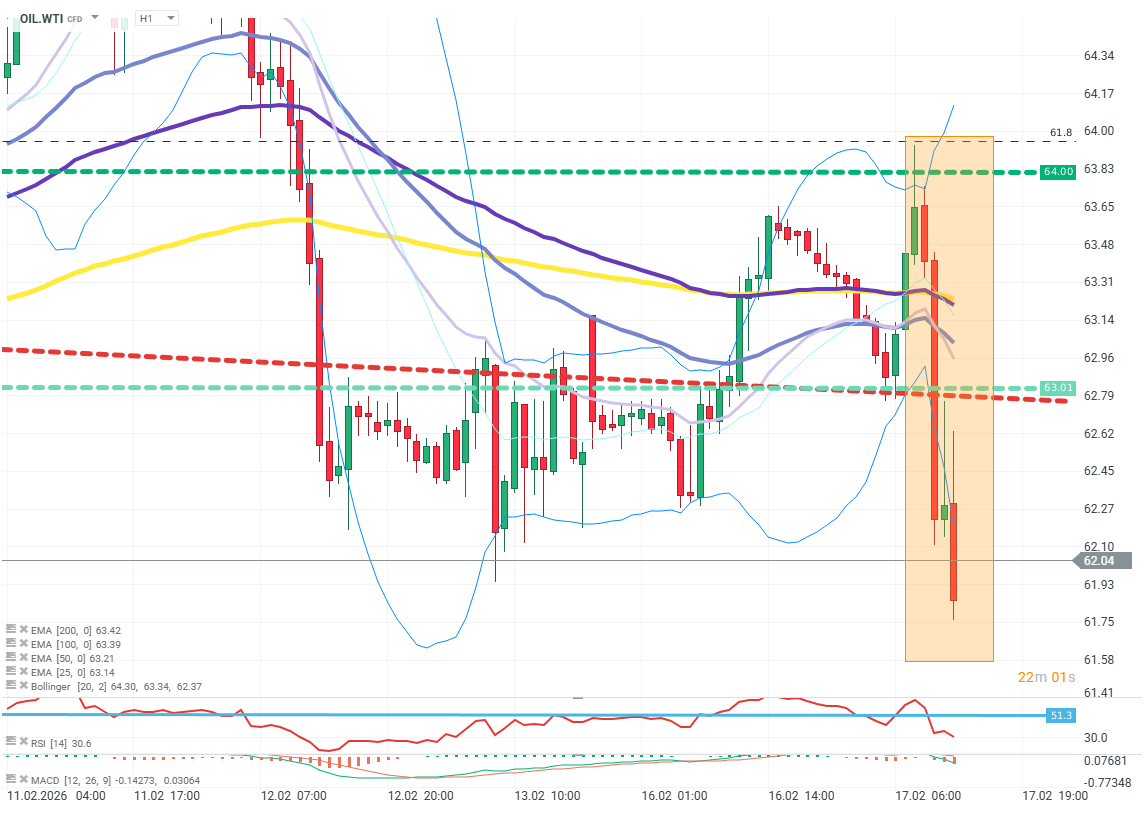
Source: xStation5
In the background, a number of questions remain:
- What are the negotiations meant to achieve?
- Is the risk of conflict real?
- If so, what could the consequences be for the market?
The objectives of all parties involved are fairly clear and, more often than not, mutually contradictory.
The U.S. wants Iran to be stripped of its nuclear program and, if possible, to limit its conventional missile and drone arsenal.
Iran, on the other hand, wants to preserve the status quo without making any real concessions, betting that if it drags out negotiations long enough and makes empty promises, some internal or external crisis will divert U.S. attention. The Islamic Republic would then be able to catch its breath, stabilize the situation at home, and rebuild part of its arsenal and nuclear program.
Donald Trump’s administration might have learned from the mistakes of President Barack Obama’s administration, which was responsible for the first “nuclear deal”, an agreement Iran increasingly violated more openly over the years. The new agreement is meant to be more comprehensive, and its provisions are to be subject to strict and continuous oversight. Despite Iran’s difficult situation and its desire to de-escalate, representatives of the Islamic Republic clearly state that fully giving up its uranium enrichment, is not on the table.
Commentators from many circles point to Donald Trump’s declared desire to “make a deal,” which is one of the characteristic traits of the new president. However, politics, especially foreign policy, should be judged by actions, not words. The actions of the U.S. administration point to an unprecedented concentration of armed forces in the Persian Gulf. Coincidentally, the troop buildup not only hasn’t stopped, it hasn’t even slowed, and additional military assets are being deployed to the region every day.
Regardless of how bad Iran’s internal situation is, its representatives do not want agreements. They want their strategy and weapons programs to succeed, no matter the cost.
The U.S. knows this, but Americans “play in a different league.” For the U.S., victory must be quick, relatively “clean,” and total. The U.S. has most likely already decided to strike. The current negotiations are mostly performative and are intended in part to lull Iran and the remaining proxies. The U.S. will strike when conditions are ideal; however, that requires substantial resources. Iran is a far more serious adversary than Libya, Iraq, or Venezuela.
Strikes on Iran would be “open-heart surgery” on the oil market. The region is densely packed with pipelines, production platforms, and ports. It also accounts for over 30% of global oil and gas volumes, and more than 20% of the world’s oil, and a similar volume of natural gas, passes through the Strait of Hormuz.
Even a short, localized exchange of fire could lead to a significant spike in oil prices. That, regardless of fundamentals, could frighten financial markets because central bank decision-makers are still fixated on disinflation.
At present, however, the market is seeing a significant oversupply of oil, although some analysts argue that its scale is overstated. Even if there is a temporary blockage in the Strait of Hormuz and damage to part of the region’s oil-and-gas infrastructure, it should not fundamentally change the macroeconomic situation, and price increases should remain short-lived.
If, however, a “deal” or some other agreement were reached against all odds, one could expect a significant collapse in oil prices and a temporary decline in gold prices. Without the geopolitical “risk premium,” oil might return to around $55 per barrel.
The base-case scenario remains that the negotiations are more of a rhetorical exercise than a genuine attempt to reach an agreement. A strike on Iran is therefore more a question of “when,” not “if.” Volatility in the oil market as a result could be high, but likely short-lived.


Geopolitical Briefing (06.02.2026): Is Iran Still a Risk Factor?


India: New battleground of the trade war?


Another US Gov. Shutdown: What can it mean this time?


Mercosur: Farmers’ fears are exaggerated, industry triumphs - facts vs. myths
This content has been created by XTB S.A. This service is provided by XTB S.A., with its registered office in Warsaw, at Prosta 67, 00-838 Warsaw, Poland, entered in the register of entrepreneurs of the National Court Register (Krajowy Rejestr Sądowy) conducted by District Court for the Capital City of Warsaw, XII Commercial Division of the National Court Register under KRS number 0000217580, REGON number 015803782 and Tax Identification Number (NIP) 527-24-43-955, with the fully paid up share capital in the amount of PLN 5.869.181,75. XTB S.A. conducts brokerage activities on the basis of the license granted by Polish Securities and Exchange Commission on 8th November 2005 No. DDM-M-4021-57-1/2005 and is supervised by Polish Supervision Authority.