


Statements from Austan Goolsbee of the Chicago Federal Reserve point to growing concerns within the Fed about a potential return of inflationary pressures, particularly in the context of rising oil prices.
- According to him, the current situation resembles a classic stagflationary shock, combining higher energy costs with the risk of economic slowdown. Especially concerning is the possibility of a stagflationary recession, which Goolsbee describes as the worst-case scenario. Rising fuel prices, particularly toward $5 per gallon, could further disrupt supply chains and translate into broad cost pressures across the economy.
- Goolsbee emphasizes that inflation could “come roaring back” if current supply-side factors persist. He also notes that the key risk lies in the accumulation of price shocks—both new ones stemming from the energy market and earlier ones linked, among others, to trade policy.
- From a monetary policy perspective, Goolsbee’s message is clearly cautious and points to high uncertainty regarding the future path of the economy. He stresses that the Fed is in an uncomfortable position, without clear historical guidance on the optimal response. The labor market remains stable, but does not provide strong support for growth, while low hiring and low firing rates increase uncertainty about future activity.
- At the same time, there is growing concern that persistent inflation may become entrenched in the economy, making it harder to control in the future. Goolsbee also highlights the importance of Fed independence, emphasizing that the institution should not be guided by market expectations or political pressure. Overall, his remarks fit into a broader narrative of increased sensitivity of the U.S. economy to supply-side shocks and limited room for quick and decisive monetary policy actions.
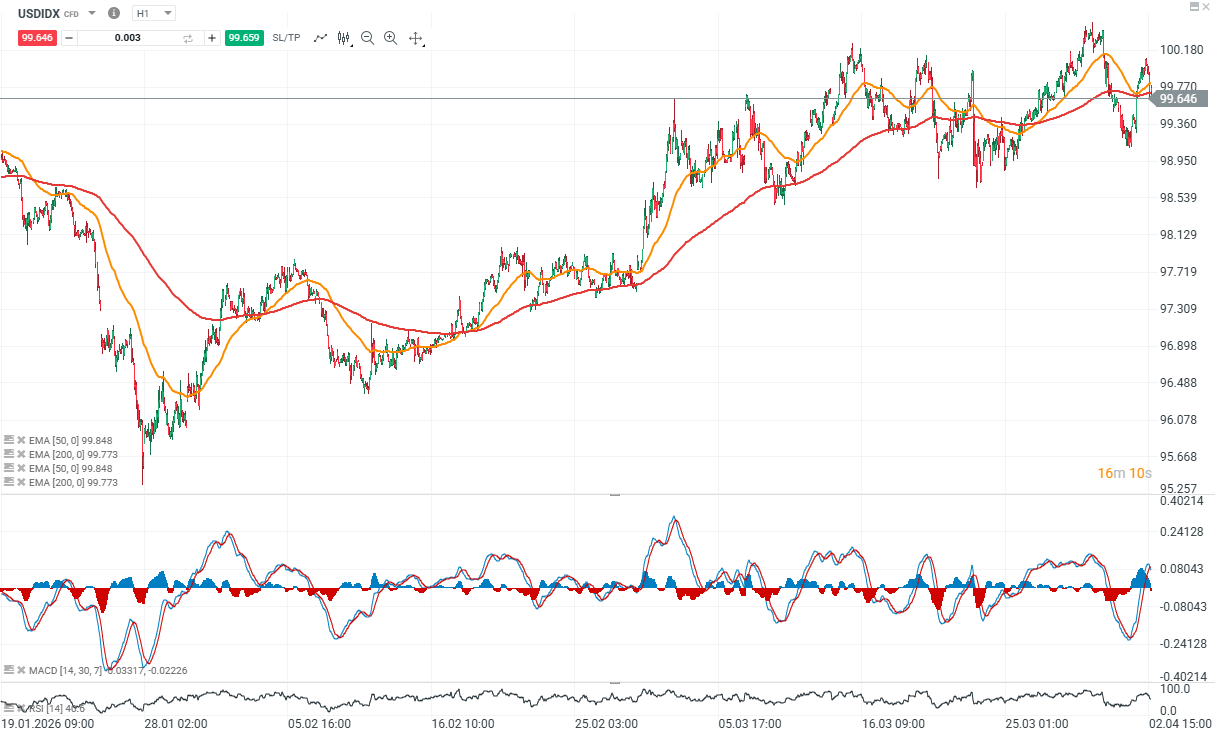
Given the risk of stagflation, prospects for an increase in the U.S. dollar index appear possible—but not certain. The trajectory may depend on the resilience (or lack thereof) of other global economies, as well as on how willing U.S. consumers are to absorb higher prices without significantly reducing consumption. If such a scenario gradually materializes and the economy once again proves resilient, the index could sustainably move back above 100.
Source: xStation5



Inflation: how to trade it and what to avoid

Daily summary: Wall Street pares early loses awaiting Trump's final decision on Iran strike 🗽(07.04.2026)


Cocoa slumps 7% amid stronger US dollar and weakening demand 📉

NY Fed survey signals inflation spike in the US🗽EURUSD at 15.7
This content has been created by XTB S.A. This service is provided by XTB S.A., with its registered office in Warsaw, at Prosta 67, 00-838 Warsaw, Poland, entered in the register of entrepreneurs of the National Court Register (Krajowy Rejestr Sądowy) conducted by District Court for the Capital City of Warsaw, XII Commercial Division of the National Court Register under KRS number 0000217580, REGON number 015803782 and Tax Identification Number (NIP) 527-24-43-955, with the fully paid up share capital in the amount of PLN 5.869.181,75. XTB S.A. conducts brokerage activities on the basis of the license granted by Polish Securities and Exchange Commission on 8th November 2005 No. DDM-M-4021-57-1/2005 and is supervised by Polish Supervision Authority.
