


Ams OSRAM may be associated by most investors with selling light bulbs. However, recent events and changes at the company are forcing the market to look at it differently. The company has real potential to become another bottleneck for the AI industry.
The situation at ams OSRAM is complex. On one hand, it has technology, experience, a broad portfolio, and extremely interesting growth options. On the other hand, it remains a company coming out of a difficult restructuring, with high debt, net losses, and a range of risks to its strategy.
Yet the opportunities in front of the company and the potential upside in valuation are so impressive that it is hard to ignore.
What does ams OSRAM actually do?
AMS OSRAM is a European manufacturer of optical and sensor solutions. Its products go to, among others, the automotive sector, consumer electronics, industry, and medical applications. The most important new thread, however, concerns AI data centers.
Company is undergoing a gradual transformation toward a model more focused on Digital Photonics (DP), meaning the use of light to transmit and process information.
This is a market with enormous potential. It may turn out to be a dead end, or the foundation of another technological revolution. The company is not entering new areas without experience. Its technological base includes more than 12,000 patents.
A breakthrough hire
The core of the investment thesis is the application of digital photonics in AI.
In large AI systems, the problem is no longer only the number of GPU chips. An increasingly important constraint is how fast and how energy efficiently data can be moved between them. Traditional cable connections have limitations: the larger the compute cluster and the longer the distance, the greater the energy losses, the more heat, and the higher the complexity of the entire system. This is important and promising
in the context of historical precedents. Revolutions and breakthrough inventions were not based on single discoveries, but on a series of innovative mechanisms and methods combined into one system.
That is why the industry has started looking for other solutions, including optical ones. Instead of transmitting signals electrically, part of the communication can be done using light. This can potentially reduce energy consumption and improve throughput.
A piece of news from the last few days that turns speculative investment theses into a new business model being built before our eyes is the transfer of one of Nvidia Networking’s managers to ams OSRAM. Hiring elite personnel from the very forefront of the AI and semiconductor revolution does not guarantee success, but it clearly brings it closer.
A bright future (?)
Based on current data, investment banks estimate DP-AI revenue at around EUR 200 million per year around 2030. These are meaningful amounts, but today the company’s revenue is EUR 3 billion, so institutional enthusiasm is currently limited. What could change that?
To answer this question, you have to look inside the data centers being built around the world:
- First, compute centers are evolving toward ever larger numbers of specialized GPUs per AI cluster. More GPUs mean the need for more switches and cables. That means latency, throughput problems, and energy loss through excessive heat generation, which then has to be removed. Photonics can reduce two cost factors at once while improving performance.
- These are not speculations. Nvidia itself, in its research articles, indicates that proper use of existing solutions can reduce energy consumption by 350% versus traditional switches. In addition, billions of switches, cables, and sockets mean billions of opportunities for mechanical failures. Light-based solutions remove most materials and moving parts from the infrastructure.
- Moreover, research also shows that the compute power of AI infrastructure increased by 300% in two years. At the current growth rate, which is expected to rise, we can quickly find ourselves in a situation where HBM memory becomes a bottleneck, because in that industry throughput increased by “only” around 150% over the same period. At that point, photonics stops being a curiosity and becomes a necessity.
Beyond a completely new market driven by potential bottlenecks, the company has a number of “old” and more down to earth businesses. One of them is VR/AR glasses, where the company is also an important player. Jefferies estimates the company could supply components worth more than EUR 50 per device, and with an assumed volume of about 5 million units in 2028, this could mean around EUR 375 million in revenue.
The balance sheet weighs on the growth thesis
The biggest problem for ams OSRAM is not a lack of technology, but finances. The company still reports net losses, and according to the report in Q1 2026 the net loss was about EUR 154 million. Analysts expect earnings per share to remain negative throughout 2026, with positive results expected only in 2027.
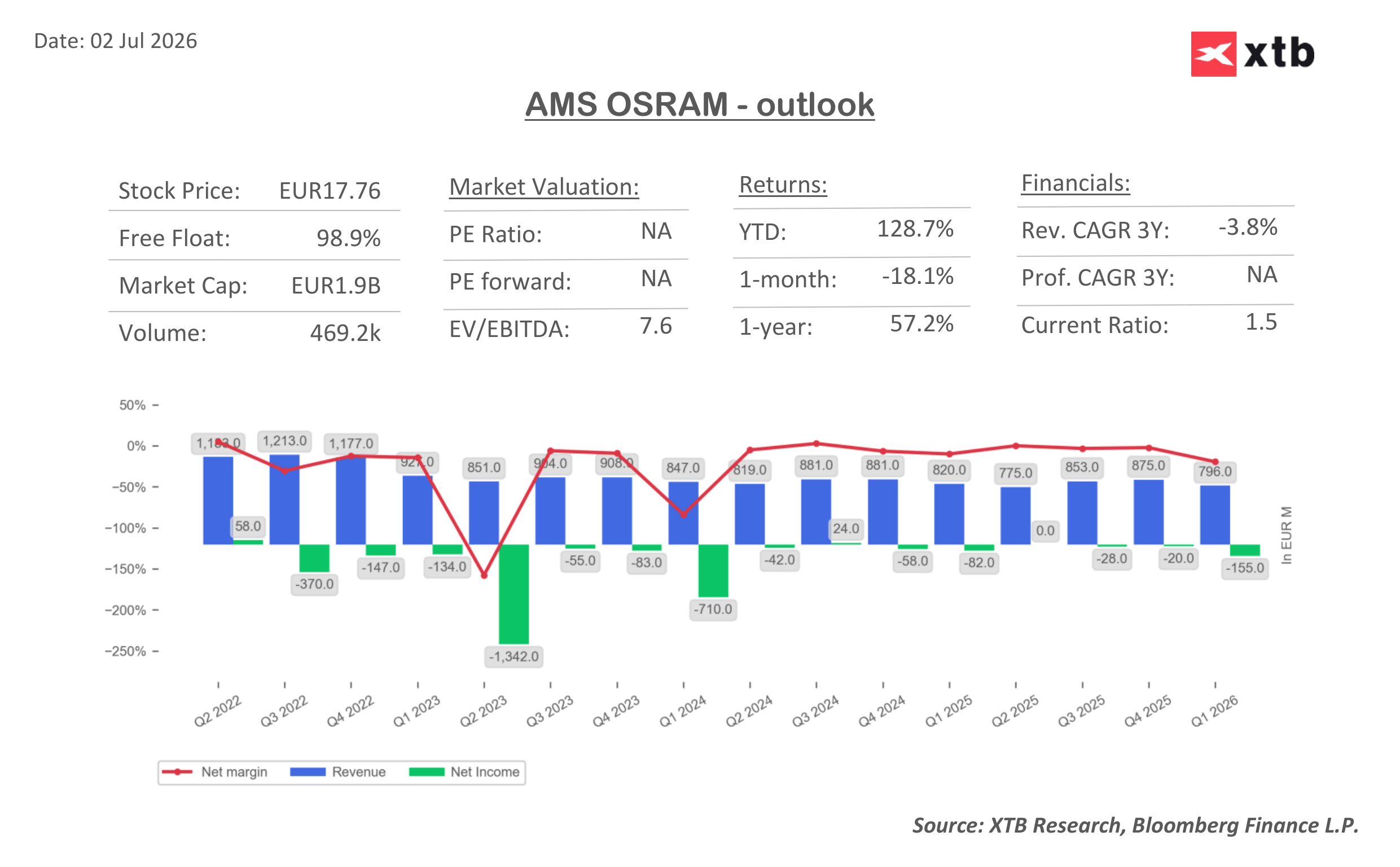
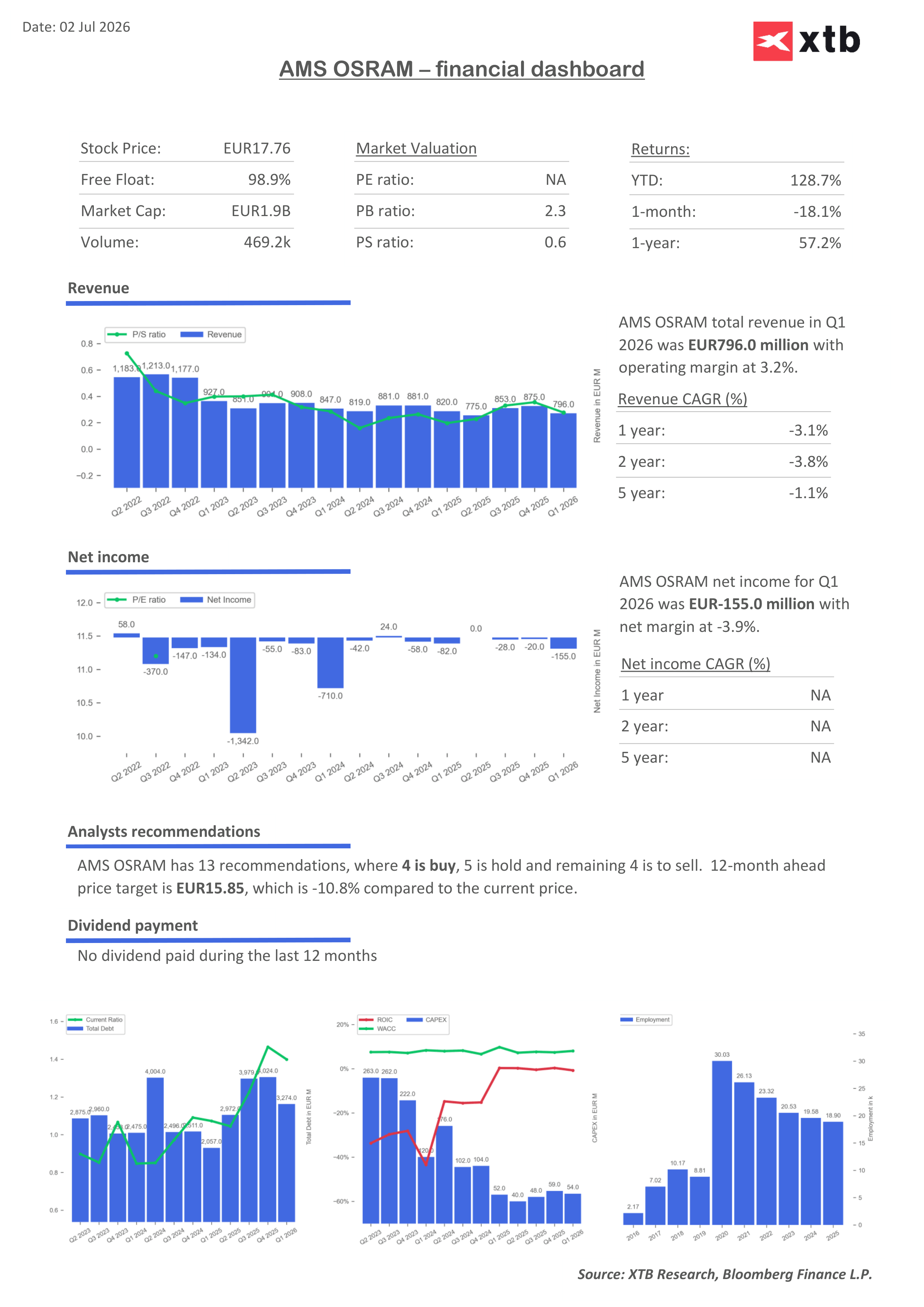
That means the market is buying mainly the future today, not the present. This is a risk, but it also implies a huge discount to profits, which may realistically never appear or may turn out to be much lower.
Revenues are large and EBITDA remains positive, but net income and free cash flow are weak. The report also points to high financial leverage, with EBITDA leverage according to Fitch at 6.3x at the end of 2025.
These numbers cool the growth narrative. The company may have attractive technology, but if the transformation takes longer and cash flows remain weak, financial risk will constantly limit its room to operate.
Mitigation measures
AMS OSRAM is trying to improve the situation through restructuring and asset sales. The “Simplify” program is expected to deliver around EUR 200 million in annual savings by 2028, and divestments are expected to generate about EUR 670 million in proceeds. According to the report, this is intended to support debt reduction and the path to positive free cash flow in 2027.
This is an important piece of the puzzle. If the savings, asset sales, and an improvement in the automotive cycle coincide with the first signals of commercialization in AI photonics or AR, ams OSRAM may start to look like a company after a successful restructuring. If, however, any of these elements fails, the market may quickly return to questioning the company’s future.
AMS.CH (D1)
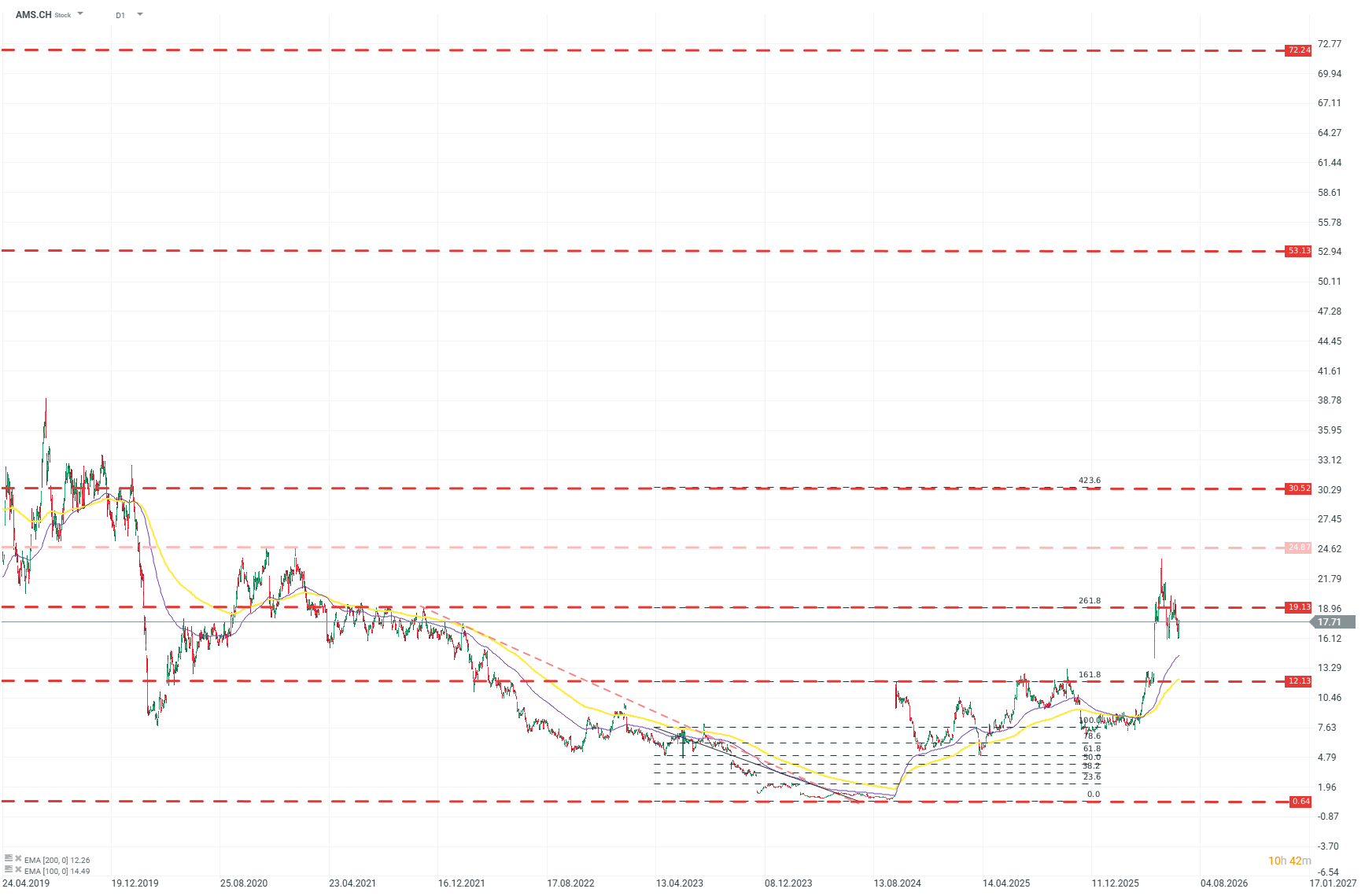
Company has already seen substatincial growth from its bottom, of aprox. 2000%, with over 100% growth in last 3 months. Despite that, company has still a long way to recover its pre-2022 valuations. Source: xStation5
Kamil Szczepański
Financial Markets Analyst, XTB



⬆️US100 rises 1.6% at end of Q2


US OPEN: Nasdaq seals best quarter in years

"Rammmagedon” ends up in court: Antitrust lawsuit and investments in Korea


Daily summary: Semiconductors are swallowing Wall Street
This content has been created by XTB S.A. This service is provided by XTB S.A., with its registered office in Warsaw, at Prosta 67, 00-838 Warsaw, Poland, entered in the register of entrepreneurs of the National Court Register (Krajowy Rejestr Sądowy) conducted by District Court for the Capital City of Warsaw, XII Commercial Division of the National Court Register under KRS number 0000217580, REGON number 015803782 and Tax Identification Number (NIP) 527-24-43-955, with the fully paid up share capital in the amount of PLN 5.869.181,75. XTB S.A. conducts brokerage activities on the basis of the license granted by Polish Securities and Exchange Commission on 8th November 2005 No. DDM-M-4021-57-1/2005 and is supervised by Polish Supervision Authority.
