


The largest DRAM memory manufacturers have come under legal pressure in the United States. Samsung Electronics, SK Hynix, and Micron Technology have been sued in a federal court in California by a group of consumers and small businesses alleging price-fixing and artificial supression of memory supply. The case could become one of the more important tests for the market at a time of extreme valuations and shortages.
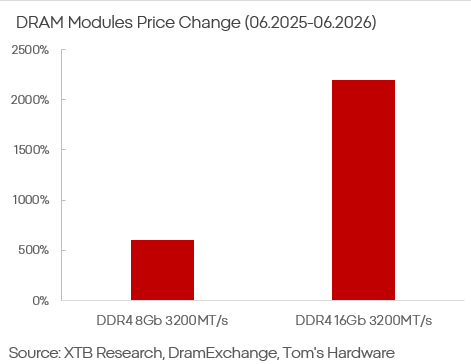
According to the lawsuit, the manufacturers allegedly coordinated restrictions on the supply of traditional DRAM modules, including DDR3 and DDR4, while at the same time redirecting a larger share of production capacity toward HBM. The plaintiffs claim these actions led to market shortages and a sharp rise in memory component prices.
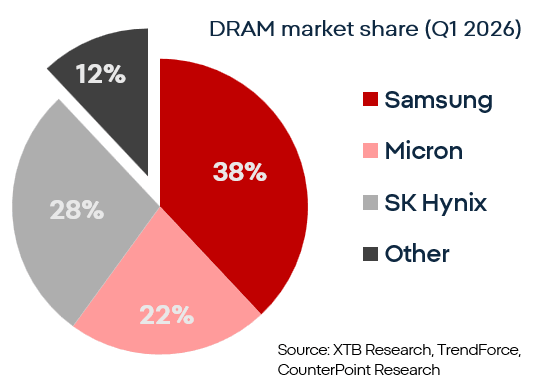
Samsung, SK Hynix, and Micron control the vast majority of the global DRAM supply. This means that any coordinated production cuts would have a much greater impact on the market than similar actions in less specialized industries.
In recent weeks, makers of electronics, consoles, and computer hardware have increasingly pointed to higher component costs as a reason for price increases. For consumers, the problem is therefore not limited to the PC parts market, but also affects computers, consoles, smartphones, and other devices that use DRAM.
At this stage, however, these are still only allegations. The case will require proving that the observed supply constraints were not solely the result of a rational response by manufacturers to the AI boom, but stemmed from coordinated conduct that restricted competition.
Potentially most significant is the fact that RAM makers, including Samsung and SK Hynix, which are named now, were once already found guilty of exactly this kind of behavior in the 1998–2002 period. On the other hand, a nearly identical lawsuit reached court in 2018, in which Samsung, Hynix, and Micron were again accused of price-fixing, but the court then deemed the evidence insufficient.
At the same time, Samsung and SK Hynix are announcing massive investment plans in South Korea, putting considerable pressure on valuations of companies in the sector, which are currently supported by expectations of prolonged shortages.
As part of a government program to expand the semiconductor ecosystem, both companies are to build new fabs, with the total scale of the project counted in the hundreds of billions of dollars.
Any margin pressure from additional supply, if it materializes, will be significantly delayed, however, because building and bringing advanced manufacturing capacity online takes years.
MU.US (D1)
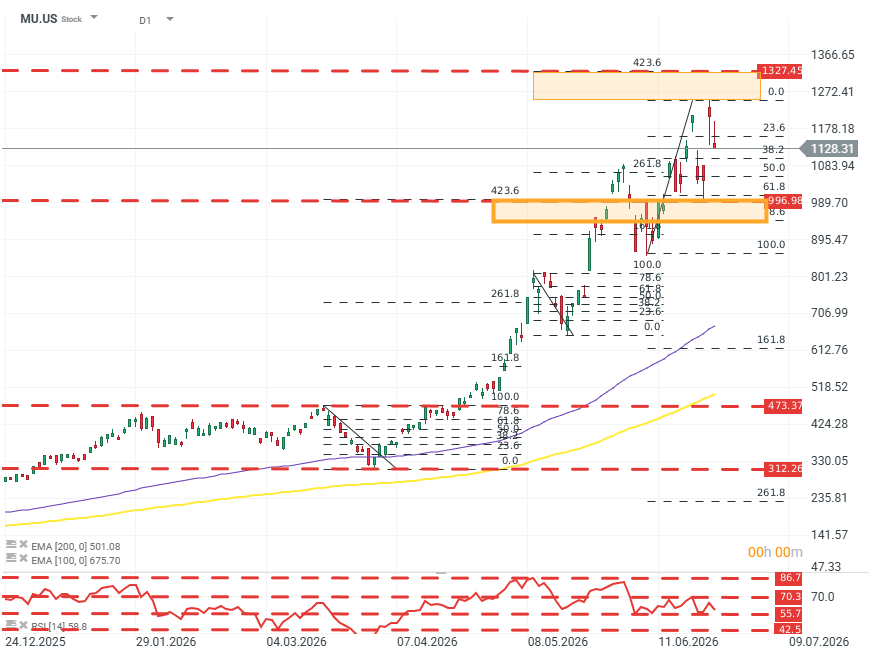
The company’s uptrend is very strong and steep, but the FIBO level helps identify potential resistance and support zones. If, for some reason, supply were to take the initiative, strong resistance would most likely be the (also psychological) $1,000 level. For buyers, the next target is a broad resistance zone around $1,300. Source: xStation5


US OPEN: Oil reverses declines despite Trump's assurances, while Wall Street awaits Nvidia's judgment report



Morning Wrap: Oil Brent surpasses 91 USD (18.08.2026)


Lumentum earnings: The photonics industry is accelerating thanks to AI


CoreWeave earningis: Reassured shareholders, double-digit gains
This content has been created by XTB S.A. This service is provided by XTB S.A., with its registered office in Warsaw, at Prosta 67, 00-838 Warsaw, Poland, entered in the register of entrepreneurs of the National Court Register (Krajowy Rejestr Sądowy) conducted by District Court for the Capital City of Warsaw, XII Commercial Division of the National Court Register under KRS number 0000217580, REGON number 015803782 and Tax Identification Number (NIP) 527-24-43-955, with the fully paid up share capital in the amount of PLN 5.869.181,75. XTB S.A. conducts brokerage activities on the basis of the license granted by Polish Securities and Exchange Commission on 8th November 2005 No. DDM-M-4021-57-1/2005 and is supervised by Polish Supervision Authority.
