


A CFD (Contract For Difference) is a financial derivative that allows you to gain exposure to price movements of an asset without owning it. For someone new to the term, the simplest way to think about it is this: instead of buying a share or a commodity, you make an agreement based on whether its price goes up or down - and that difference is what settles the result. Understanding how that works in practice, including what it costs and what risks it involves, is what this guide covers from the beginning.
[updated June 2026]
A CFD (Contract For Difference) is a financial derivative that allows you to gain exposure to price movements of an asset without owning it. For someone new to the term, the simplest way to think about it is this: instead of buying a share or a commodity, you make an agreement based on whether its price goes up or down - and that difference is what settles the result. Understanding how that works in practice, including what it costs and what risks it involves, is what this guide covers from the beginning.
[updated June 2026]
What Is a CFD?
A CFD (contract for difference) is a financial derivative that allows you to speculate on price movements without owning the underlying asset. Instead of buying shares, commodities, or currencies directly, you enter into an agreement with a broker to exchange the difference in price between the opening and closing of a position. This is the core meaning of CFDs in trading.
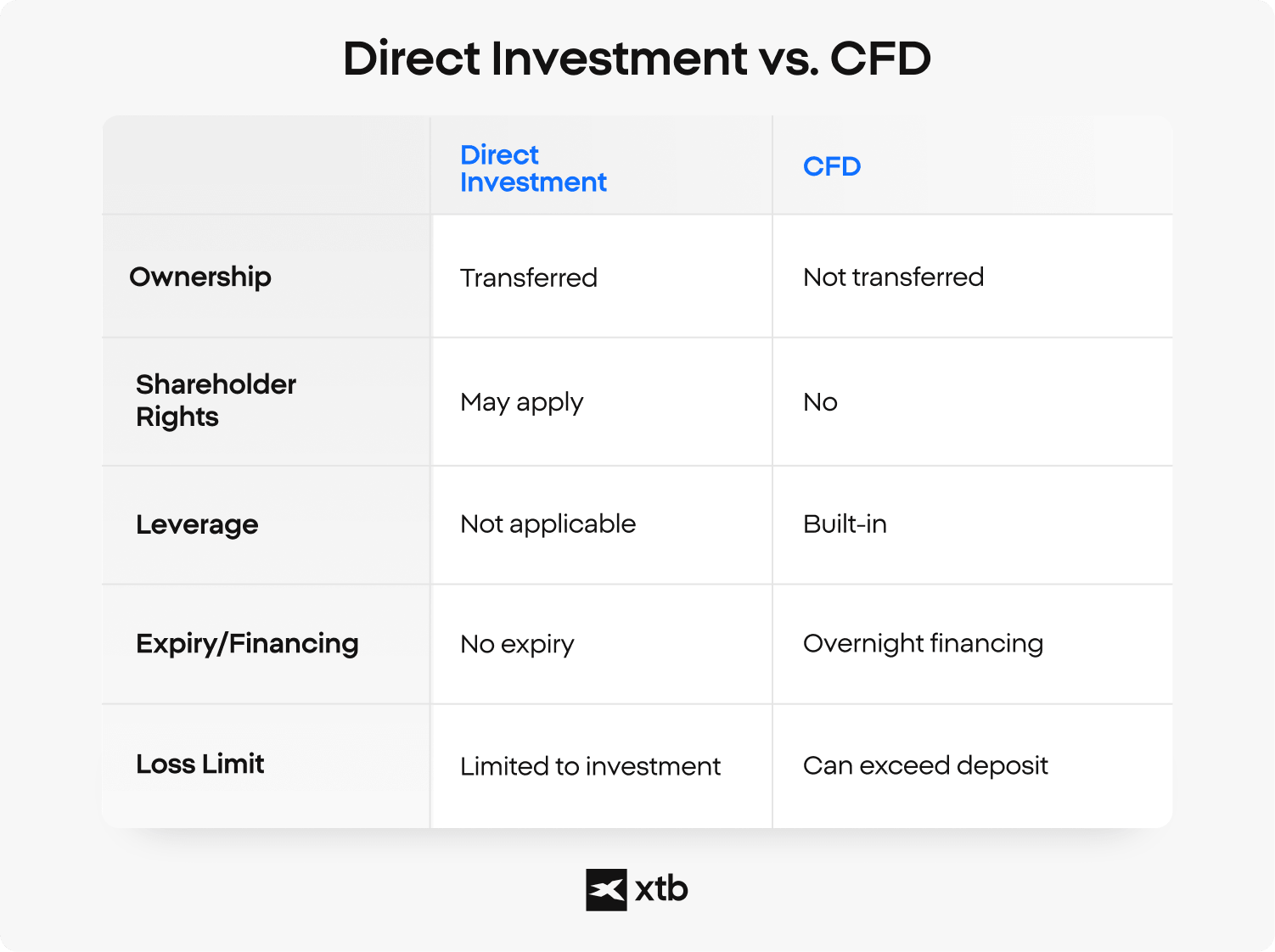
A CFD is based on an underlying asset, such as a stock, index, or commodity, but ownership is not transferred at any point. The contract reflects the price of that asset, and its value changes as the underlying market price changes. This structure distinguishes CFDs from traditional investing, in which ownership rights, such as dividends or voting rights, may apply.
Because CFDs are derivative instruments, their value depends entirely on the performance of the underlying market. This means that price movements - both upward and downward directly affect the outcome of the contract. Understanding this dependency is essential before moving on to how the mechanism works in leverage trading.
How Does a CFD Work?
A CFD works as a contract between the client and the broker to settle the difference between two prices: the price when the contract is opened and the price when it is closed. In this structure, the contract reflects the change in price of the underlying asset rather than ownership of the asset itself. The underlying asset can be a stock, index, currency pair, commodity, or another market instrument, but the CFD remains a separate derivative contract whose value is linked to price movement alone.
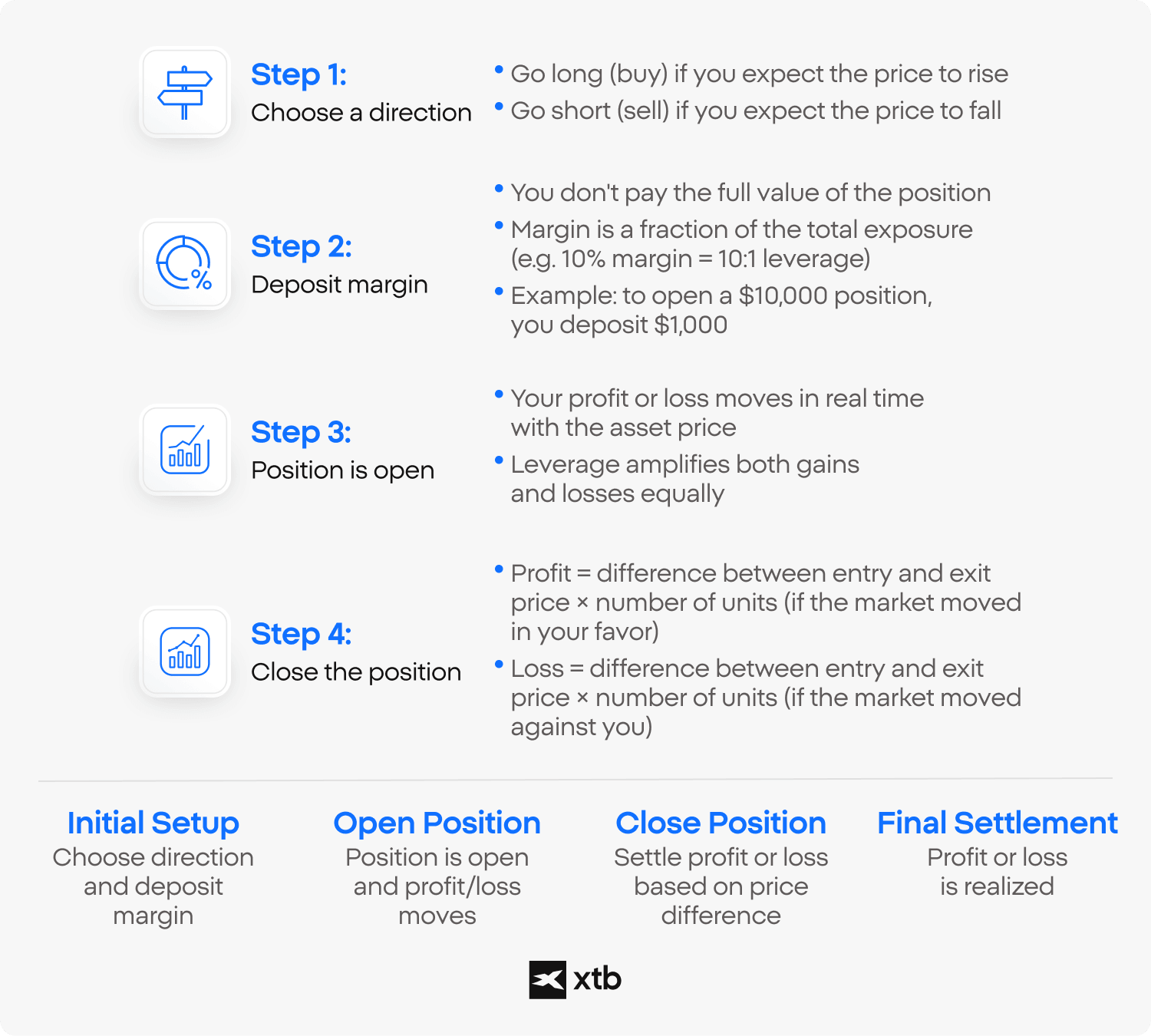
A margin is required to open and maintain a CFD contract. Margin is the deposit that secures the position and represents only part of the total exposure created by the contract, which means the full notional value does not have to be provided upfront. Leverage determines how much market exposure is created relative to that margin deposit, so a smaller deposit can control a larger position in the underlying market.
It is also important to understand that the CFD structure can reflect both upward and downward price movements in the underlying market. This is a built-in feature of the instrument itself, not a form of ownership or transfer of the asset. Because leverage increases exposure, it also increases the speed at which gains or losses can accumulate, even when the underlying market moves by a relatively small amount. Traders implement multiple CFD strategies using technical, fundamental analysis, and mathematical modelling.
CFDs Explained in Simple Terms
To make the mechanism easier to understand, it helps to reduce it to a few simple ideas that beginners can remember:
A CFD gives price exposure, not ownership. You are not buying the actual stock, gold, or currency. You are using a contract whose value changes with the price of that market.
A CFD settles the difference between the entry and the exit price. If the price changes after the contract is opened, that change determines the result. The instrument is built around price movement, not around holding the asset itself.
Margin is only a fraction of the full exposure. For example, if a broker requires 10% margin, a deposit of 1,000 can provide exposure to a position worth 10,000. This makes the contract accessible with less capital, but it does not reduce the size of the market exposure.
Leverage increases both potential gains and potential losses. Because the contract can control a larger position than the initial deposit, even relatively small market moves can have a significant effect on the result. This is one of the main reasons CFDs involve elevated risk.
A CFD can reflect both rising and falling markets. The contract is designed to follow price movement in either direction, which means the mechanism itself is flexible. At the same time, the outcome still depends entirely on how the market moves after the contract is opened.
CFD Example: How Profit and Loss Are Calculated
A CFD example helps translate the abstract mechanism into concrete numbers by showing how price changes affect the outcome of a contract. The key idea is that the result depends on the difference between the opening and closing price, multiplied by the position size. Consider a simplified scenario.
A CFD is opened by market order on an index at a price of 1,000 points, with a position size of 10 units. If the price increases to 1,010 points, the difference is 10 points. Multiplied by the position size, the result is a positive change of 100 units.
If the price instead decreases to 990 points, the difference is -10 points, resulting in a negative change of 100 units. This illustrates that profit and loss are symmetrical and depend solely on price movement. Stop loss and take profit are set on 990 and 1010 respectively, which lead to capital loss or gain - depending on the price action.
Remember that in a high-volatility or low-liquidity environment, slippage may lead to opening or closing the position at a different level. Margin and leverage do not change how profit or loss is calculated, but they affect how much capital is required to open the position. This means that even relatively small price changes can represent a large percentage change relative to the initial deposit.
📌 EXAMPLE
Long and short CFD positions in practice
Long position (price increase scenario)
A CFD is opened on a company stock priced at 50. The position size is 100 units. The total exposure is therefore 5,000, but only a fraction of this amount is required as margin.
If the price rises to 55, the difference is +5 per unit. Multiplied by 100 units, the result is +500.
If the price instead falls to 45, the difference is -5 per unit, resulting in -500.
This shows that in a long position, the result depends on the price moving upward relative to the entry level.
Short position (price decrease scenario)
A CFD is opened on the same stock at 50, again with a position size of 100 units. In this case, the position reflects a price decrease.
If the price falls to 45, the difference is -5 per unit. Because the position reflects a decline, this results in +500.
If the price rises to 55, the difference is +5 per unit, resulting in -500.
This shows that in a short position, the result depends on the price moving downward relative to the entry level.
These two scenarios demonstrate that CFDs can reflect both directions of the market, but in each case, the outcome is directly tied to how the price changes after the contract is opened.
What Assets Can You Trade with CFDs?
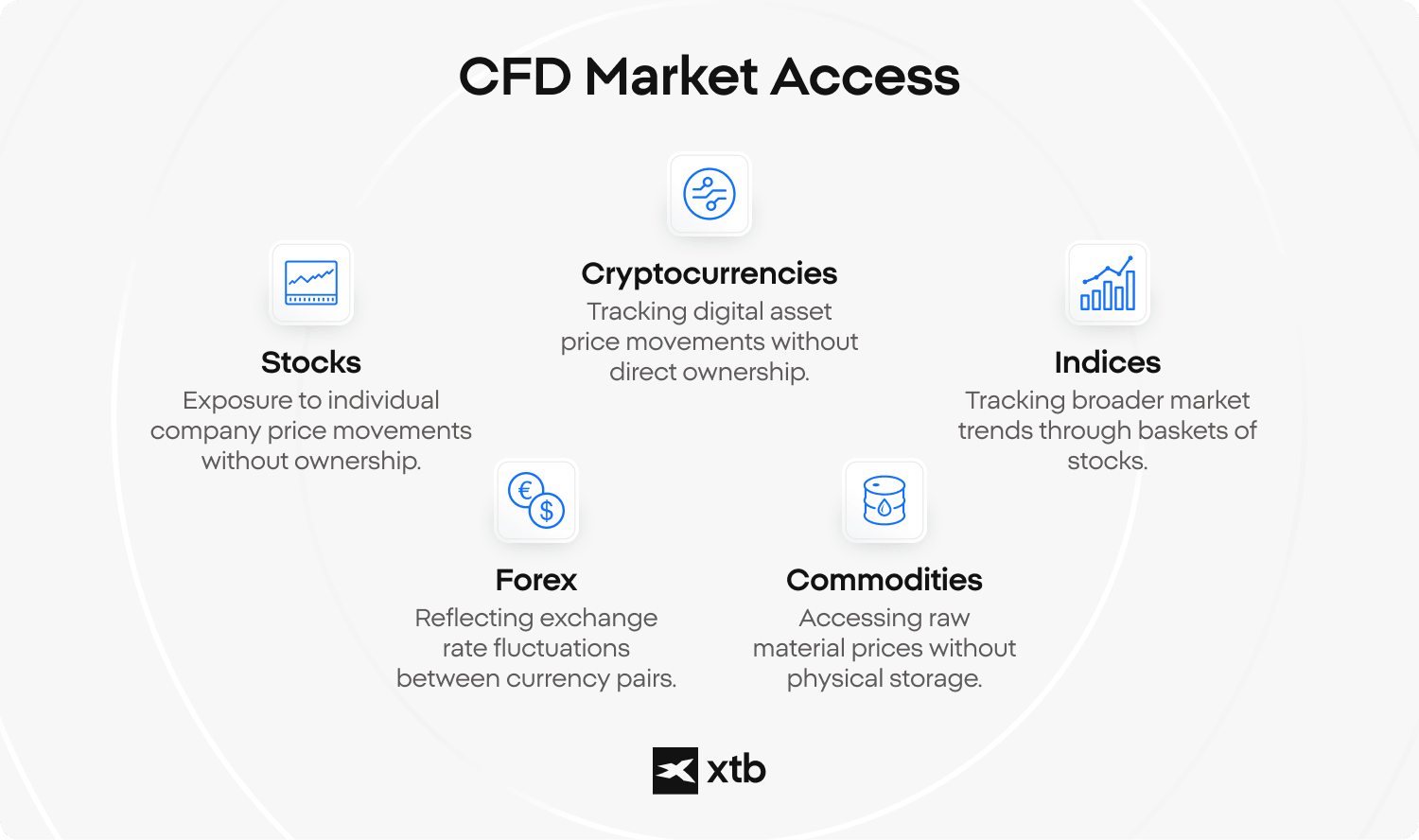
CFDs are available across a broad range of global financial markets, which means a single instrument type can provide exposure to very different underlying assets. Instead of owning these markets directly, the CFD tracks their price movements. The main asset classes available include shares, forex pairs, indices, commodities, cryptocurrencies, and other instruments such as ETFs and bonds.
Each category works differently in terms of what drives its price, but the CFD structure remains the same across all of them:
Shares (Equities) give exposure to the price of individual publicly listed companies — such as Apple, Amazon, or BP — without transferring ownership or shareholder rights like dividends. CFDs on stocks allow traders to speculate on the performance of specific firms across multiple international exchanges.
Forex (Currency Pairs) track the exchange rate between two currencies. CFDs cover major pairs such as EUR/USD or GBP/USD, as well as minor and exotic pairs, making it one of the most liquid markets accessible through this instrument.
Indices reflect the collective performance of a basket of stocks from a specific market, such as the S&P 500, Nasdaq 100, DAX, or FTSE 100. Rather than speculating on a single company, index CFDs provide exposure to broader market trends.
Commodities cover raw materials including energy resources such as oil and natural gas, precious metals such as gold and silver, and agricultural products. CFDs on commodities provide price exposure without the need for physical delivery or storage.
Cryptocurrencies track the price of digital assets such as Bitcoin, Ether, or Litecoin. Because these markets operate continuously and are known for high volatility, the CFD structure — which does not require direct ownership of the token — is one of the more common ways to access them.
Other Markets, including ETFs, government bonds, and interest rates, are also available through certain providers. These extend the range of accessible instruments while maintaining the same derivative structure.
What Are the Costs and Fees of CFDs?
CFDs involve several types of costs that are applied depending on how the contract is structured and how long it is held. Understanding these costs is important because they are part of how CFD providers price access to the market, even though they may not always appear as a separate charge.
One of the most common costs is the spread. The bid-ask spread is the difference between the buy price (ask) and the sell price (bid) of a CFD at a given moment. This difference represents an implicit cost, as the position starts slightly below or above the current market level, depending on the direction.
Another cost is overnight financing, often referred to as a swap. This applies when a CFD position is held beyond a single trading day. The cost reflects the financing of the leveraged exposure over time and is typically calculated on a daily basis. It does not apply to all instruments in the same way, as conditions may vary depending on the market.
In some cases, commissions may also be charged. These are explicit fees applied when opening or closing a position, particularly for certain asset classes such as stocks. Additionally, currency conversion fees may apply when the CFD is denominated in a different currency than the account base currency, meaning that exchange rates can influence the final cost. Traders should choose the right brokerage services, looking for limited costs of opening and maintaining the position.
⚠️ CAUTION
Why CFD costs can be less visible but affect the result
Some CFD costs, such as spreads, are built into the price rather than charged separately. This means that the total cost of a position may not always be immediately apparent, especially for beginners unfamiliar with how pricing works.
What Are the Risks of CFDs?
CFDs carry several key risks related to leverage, market volatility, and pricing conditions. These risks arise from the structure of the instrument itself, not from how it is used, which makes understanding them essential before considering how CFDs function in practice. Because CFDs combine market exposure with leverage, even relatively small price changes can have a significant impact on the value of a contract.
One of the primary risks is leverage, which increases exposure relative to the initial deposit. While margin represents only a fraction of the total position size, profit and loss are calculated based on the full exposure. This means that losses can develop quickly and may exceed the initial deposit if the market moves significantly against the position, depending on the protections available on the account.
Market volatility is another significant source of risk in CFD trading. Financial markets can move rapidly, especially during major news events or periods of uncertainty, and prices may gap between levels without gradual transitions. In such situations, the execution price may differ from the expected price, directly affecting the final outcome of the contract.
CFDs are agreements with a broker rather than exchange-traded instruments, which means pricing and execution depend on the provider's infrastructure and conditions. This introduces a layer of counterparty dependency that is not present in traditional exchange-traded products, and it is an additional dimension of risk that should be understood before trading.
📌 EXAMPLE
Real-world example of large CFD-related losses
One of the most widely cited cases of significant losses linked to leveraged derivative trading involved Jerome Kerviel, a trader at Societe Generale. In 2008, unauthorized positions in equity index derivatives led to losses of approximately 4.9 billion EUR. While not limited strictly to retail CFDs, the case illustrates how highly leveraged exposure to market movements can result in losses that far exceed initial capital, especially when risk controls fail or positions are not properly monitored.
FAQ
CFDs are financial instruments different from shares, indexes or bonds. However, the main difference lies in the access to short selling, leverage and specific orders such as stop loss, take profit or trailing stop loss, as well as in the functioning of the stop out mechanism.
CFDs are designed for traders accepting high risk. Thanks to financial leverage, market volatility can cause both rapid and significant losses, as well as profits. If market volatility is not a problem for you and you are looking for short term advantage or trends, CFDs may be right for you.
The loss from CFD trading is limited by the automatic stop out defence mechanism. Your account balance cannot be negative because of negative balance protection, so you can’t lose more money than you deposited on your account.
If you want to keep a loss-making position open, you will have to deposit additional funds into your account to increase your 'Margin Level'. This solution may be suitable if the price starts moving in your direction and the position will eventually bring you a profit. If, on the other hand, the price continues to move in the wrong direction, all the money you deposit may be lost in order to hedge the losing position. Before you start trading, familiarise yourself with how CFD trading is done by using a DEMO account, which you can open here, and familiarise yourself with our Knowledge Base.
If you trade on Stock CFDs, you are entitled to the dividend equivalent. Familiarise yourself with what is the ex-dividend date and the pay date. The dividend equivalent is paid on the ‘ex dividend date’ also known as the 'dividend cut off date'. The day of ‘ex-date’ is each listed company decision.
For BUY positions, when you bet on price increases (long) you will receive a positive dividend equivalent. At the same time, on the ExDate the dividend amount is cut off from the share price, meaning that this will result in a loss on the position. This loss will be offset by the positive dividend equivalent you receive.
For a SELL position, if you bet on falling prices (short), you will receive a negative dividend equivalent. At the same time, on the ExDate the dividend amount is cut from the share price, resulting in a profit on your position. This profit will be offset by the negative dividend equivalent awarded to you.
Both of these situations are strictly technical and do not directly affect the outcome of the position.
No. Leverage is assigned to an instrument and you cannot change it by yourself. Thus, for major currency pairs such as EURUSD you will have access to a leverage of 1:30, while trading shares you may encounter a lower leverage of 1:2.
It is also possible to get access to high leverage of 1:100 or 1:200 by going through the appropriate procedures to become a Professional Customer. You can contact your Sales Department or your Account Manager directly, who will explain the process to you.
The prices of CFDs are based on the prices of the underlying instruments. For instruments such as Stock CFDs, the underlying asset is always the current price of a listed company stock. The prices of the indices are real and up-to-date, however, it is the prices of the underlying instruments, which the CFDs 'track', that play an important role.
In other instruments such as the US500, OIL or NATGAS the underlying is a futures index or commodities quote. In this way the US500 is based on futures prices, which may be different from the actual S&P500 index ‘spot’ valuation. This is due to the different maturity dates of the contracts, as investors expect different valuations depending on the month of the quote, so there may be small differences. A similar situation occurs in the case of oil and natural gas, for which the underlying instruments are also the prices of futures contracts traded on the Chicago Mercantile Exchange exchange.
We always provide prices in real time with the best interest of our clients in mind.

CFD Trading for Beginners: How to Start Smart and Avoid Common Traps

Best Stocks to Watch During the FIFA World Cup in 2026

England vs Croatia: Markets to Watch Ahead of the World Cup Clash
This content has been created by XTB S.A. This service is provided by XTB S.A., with its registered office in Warsaw, at Prosta 67, 00-838 Warsaw, Poland, entered in the register of entrepreneurs of the National Court Register (Krajowy Rejestr Sądowy) conducted by District Court for the Capital City of Warsaw, XII Commercial Division of the National Court Register under KRS number 0000217580, REGON number 015803782 and Tax Identification Number (NIP) 527-24-43-955, with the fully paid up share capital in the amount of PLN 5.869.181,75. XTB S.A. conducts brokerage activities on the basis of the license granted by Polish Securities and Exchange Commission on 8th November 2005 No. DDM-M-4021-57-1/2005 and is supervised by Polish Supervision Authority.
