



US stock index futures are falling sharply following reports from The Wall Street Journal that the Trump administration is preparing another round of tariffs targeting China, the European Union, and 14 other economies. The proposed measures are intended to address excess industrial production capacity outside the United States, which Washington argues creates unfair competition and undermines American manufacturers. US Trade Representative Jamieson Greer could release the findings of a months-long investigation as early as this week, although the exact timing remains uncertain. S&P 500 futures have reacted with a sharp sell-off and are currently down nearly 1.5%.
-
The new tariffs could target a broad range of industrial goods imported from several major economies, including China, the European Union, Japan, South Korea, India, and Vietnam. Certain products, such as steel, aluminum, and automobiles, could be exempt because they are already subject to separate tariffs.
-
The Trump administration argues that foreign industrial subsidies contribute to overproduction, allowing companies to export goods at prices that make it difficult for American manufacturers to compete. The investigation is being conducted under Section 301 of the US Trade Act of 1974.
-
The exact tariff rates have not yet been officially determined. According to the WSJ, countries with existing trade agreements with the United States, including the EU, Japan, and South Korea, could face tariffs of no more than 15%, while China, India, and Vietnam may be subject to more restrictive measures.
-
The new tariffs could be imposed on top of existing import duties, increasing costs and complicating operations for businesses dependent on international supply chains. However, the final scope of the restrictions remains subject to decisions by the administration.
Could tariffs threaten inflation and Wall Street?
From a financial market perspective, the biggest concern could be the combination of higher import costs and persistent inflationary pressures in the United States. Additional tariffs could raise prices for components and finished goods, squeeze corporate profit margins, and complicate the Federal Reserve's efforts to bring inflation down. Industrial companies, electronics manufacturers, and retailers dependent on global supply chains would be particularly vulnerable.
For Wall Street, this raises the risk of a scenario in which slowing economic growth coincides with persistently elevated inflation. The extent of the threat will depend on the final tariff rates, the scope of exemptions, and the response from US trading partners. Today's WSJ reports do not mean that new tariffs have been formally introduced, but they are already increasing uncertainty surrounding the outlook for American businesses and global trade.
US500 chart (1H and 1D timeframes)
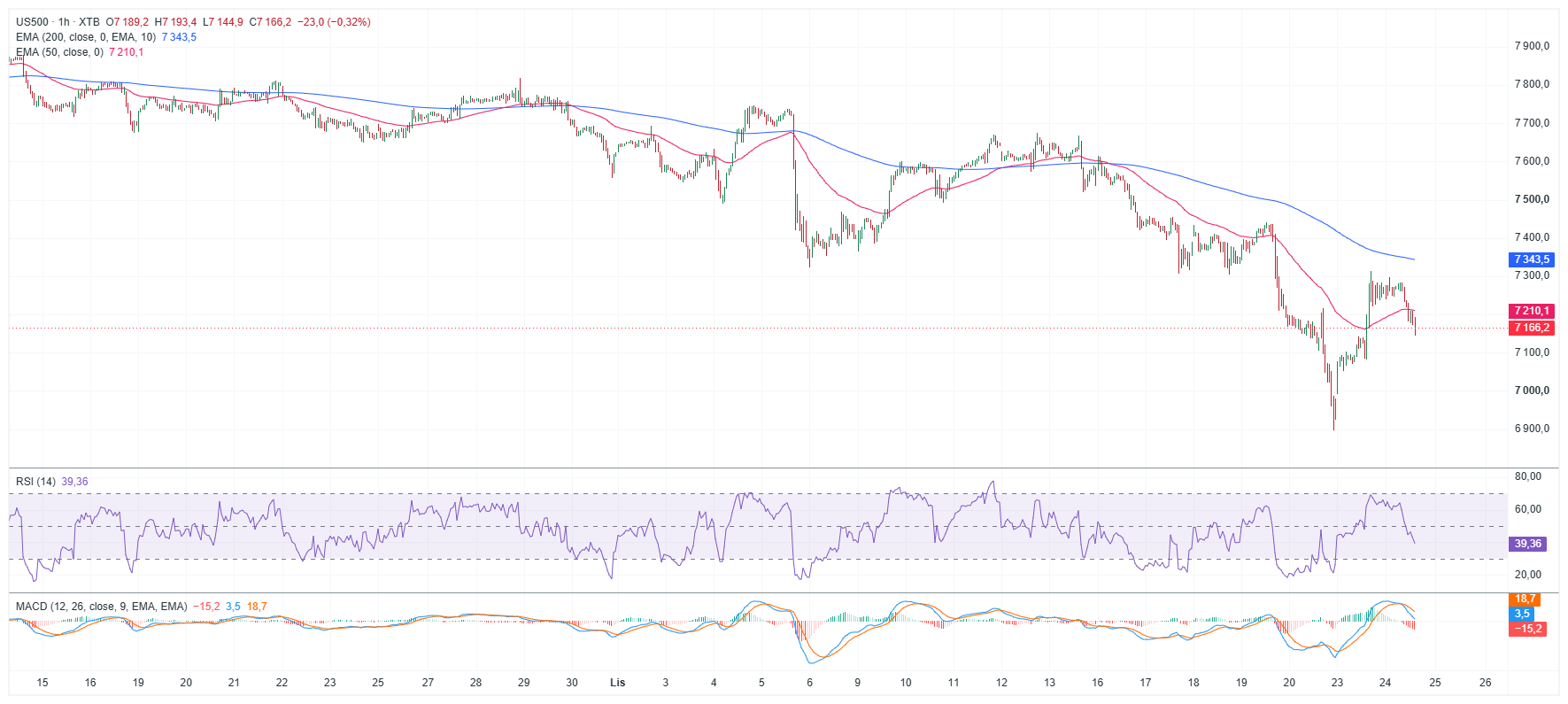
On the hourly chart, US500 has given back roughly one-third of yesterday's strong rebound. The sharp negative reaction highlights persistent nervousness across financial markets, while reports of potentially higher tariffs, including measures targeting China, appear to have introduced another source of risk for investors.
 Source: XTB
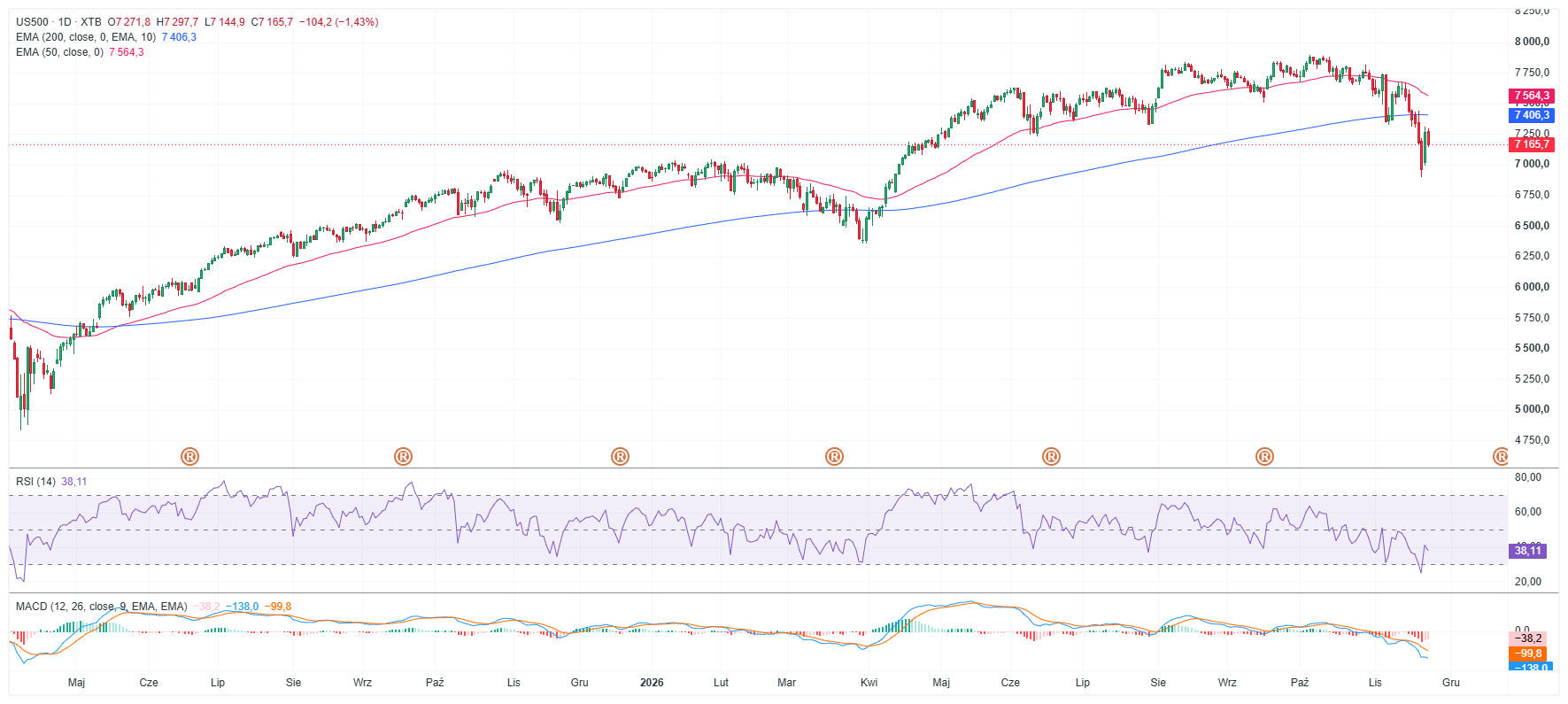
On the daily chart, a recovery above 7,400 points appears crucial for US500, as the 200-session exponential moving average (EMA200) is located near this level. For now, however, the index is struggling to generate sufficient buying momentum to initiate a sustained recovery. As long as it remains below this area, the risk of a continued downtrend persists. The key support zone lies between 6,900 and 7,000 points. A decisive breakdown below this range could expose the index to a deeper decline toward 6,300 points, corresponding to the lows recorded in spring 2026. Such a move would represent a correction of more than 20% from its all-time high.
 Source: XTB



Daily Summary: Fleeting gains and chronic fear



US OPEN: Market gives back some of the gains, the dollar extends losses


Markets cool down after yesterday's surge 💥


Economic Calendar: After Wall Street’s Rally, Markets Turn Their Attention to Ifo and US Consumer Confidence
The content of this report has been created by XTB S.A., with its registered office in Warsaw, at Prosta 67, 00-838 Warsaw, Poland, (KRS number 0000217580) and supervised by Polish Supervision Authority ( No. DDM-M-4021-57-1/2005). This material is a marketing communication within the meaning of Art. 24 (3) of Directive 2014/65/EU of the European Parliament and of the Council of 15 May 2014 on markets in financial instruments and amending Directive 2002/92/EC and Directive 2011/61/EU (MiFID II). Marketing communication is not an investment recommendation or information recommending or suggesting an investment strategy within the meaning of Regulation (EU) No 596/2014 of the European Parliament and of the Council of 16 April 2014 on market abuse (market abuse regulation) and repealing Directive 2003/6/EC of the European Parliament and of the Council and Commission Directives 2003/124/EC, 2003/125/EC and 2004/72/EC and Commission Delegated Regulation (EU) 2016/958 of 9 March 2016 supplementing Regulation (EU) No 596/2014 of the European Parliament and of the Council with regard to regulatory technical standards for the technical arrangements for objective presentation of investment recommendations or other information recommending or suggesting an investment strategy and for disclosure of particular interests or indications of conflicts of interest or any other advice, including in the area of investment advisory, within the meaning of the Trading in Financial Instruments Act of 29 July 2005 (i.e. Journal of Laws 2019, item 875, as amended). The marketing communication is prepared with the highest diligence, objectivity, presents the facts known to the author on the date of preparation and is devoid of any evaluation elements. The marketing communication is prepared without considering the client’s needs, his individual financial situation and does not present any investment strategy in any way. The marketing communication does not constitute an offer of sale, offering, subscription, invitation to purchase, advertisement or promotion of any financial instruments. XTB S.A. is not liable for any client’s actions or omissions, in particular for the acquisition or disposal of financial instruments, undertaken on the basis of the information contained in this marketing communication. In the event that the marketing communication contains any information about any results regarding the financial instruments indicated therein, these do not constitute any guarantee or forecast regarding the future results.