


Bitcoin failed to hold above the USD 80,000 level, raising legitimate concerns among investors about whether the cryptocurrency bear market could enter a more aggressive phase and potentially push BTC back below USD 60,000. Despite record inflows into equity markets and fresh all-time highs on Wall Street, Bitcoin has struggled to regain momentum toward the USD 100,000 mark.
Key informations
- At the same time, the market is entering a historically weaker seasonal period for Bitcoin. The months between May and September have often brought corrections across crypto markets, particularly during US midterm election years. Combined with a stronger US dollar and rising Treasury yields, this increases pressure on risk assets.
- The US dollar and Treasury yields continue to move higher, weighing on both cryptocurrencies and precious metals. Equity markets remain relatively resilient thanks to solid global economic conditions and the ongoing AI-driven rally. However, investors are increasingly concerned that persistent inflation could force the Federal Reserve to maintain a more hawkish stance.
- Tensions surrounding the Strait of Hormuz remain one of the key macro risks for markets. If the conflict involving Iran continues over the coming months, elevated oil prices could push CPI inflation higher again. Such a scenario would likely strengthen the dollar further and increase pressure on speculative assets, including Bitcoin.
ETF funds are taking profits on Bitcoin
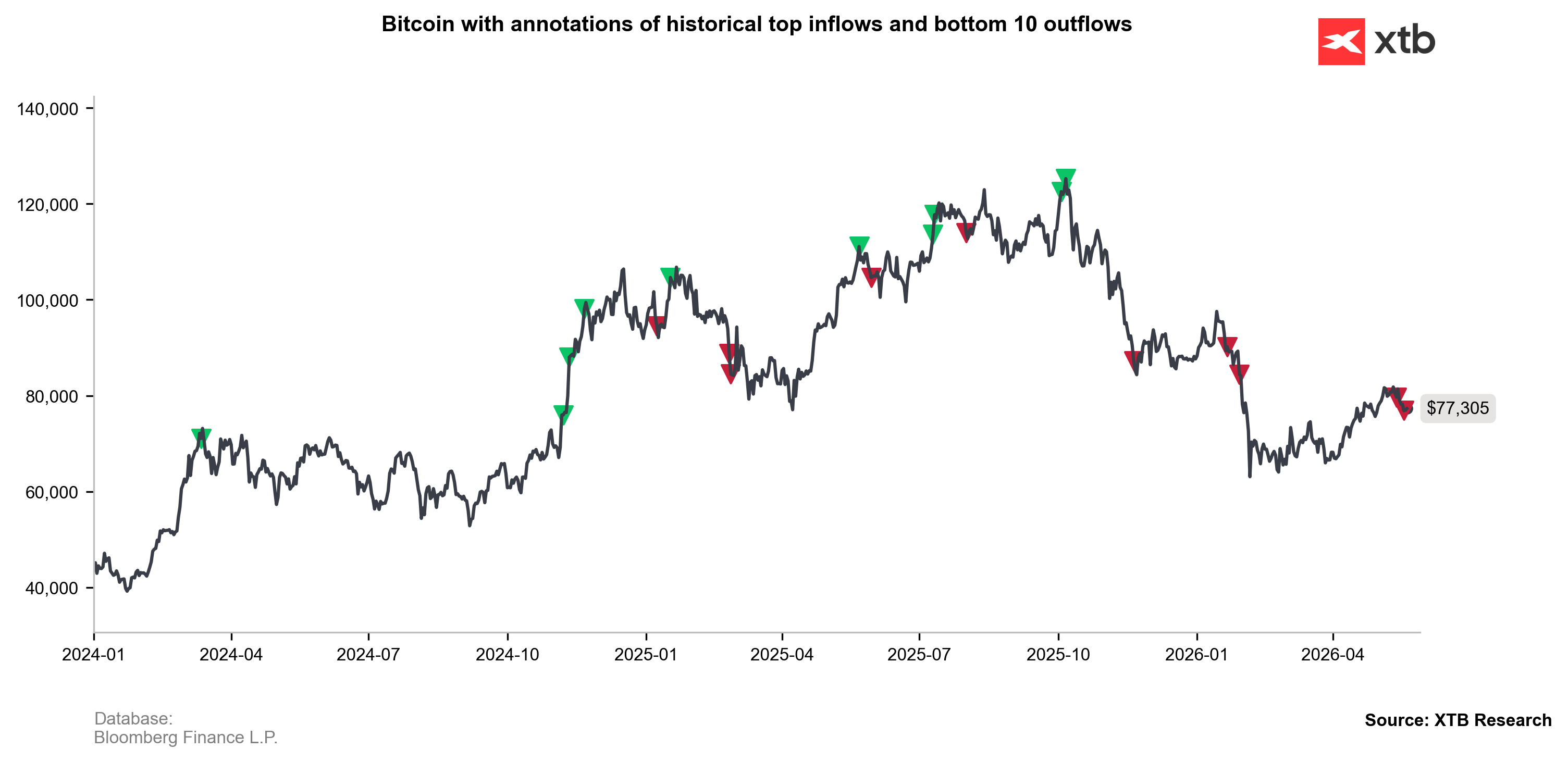
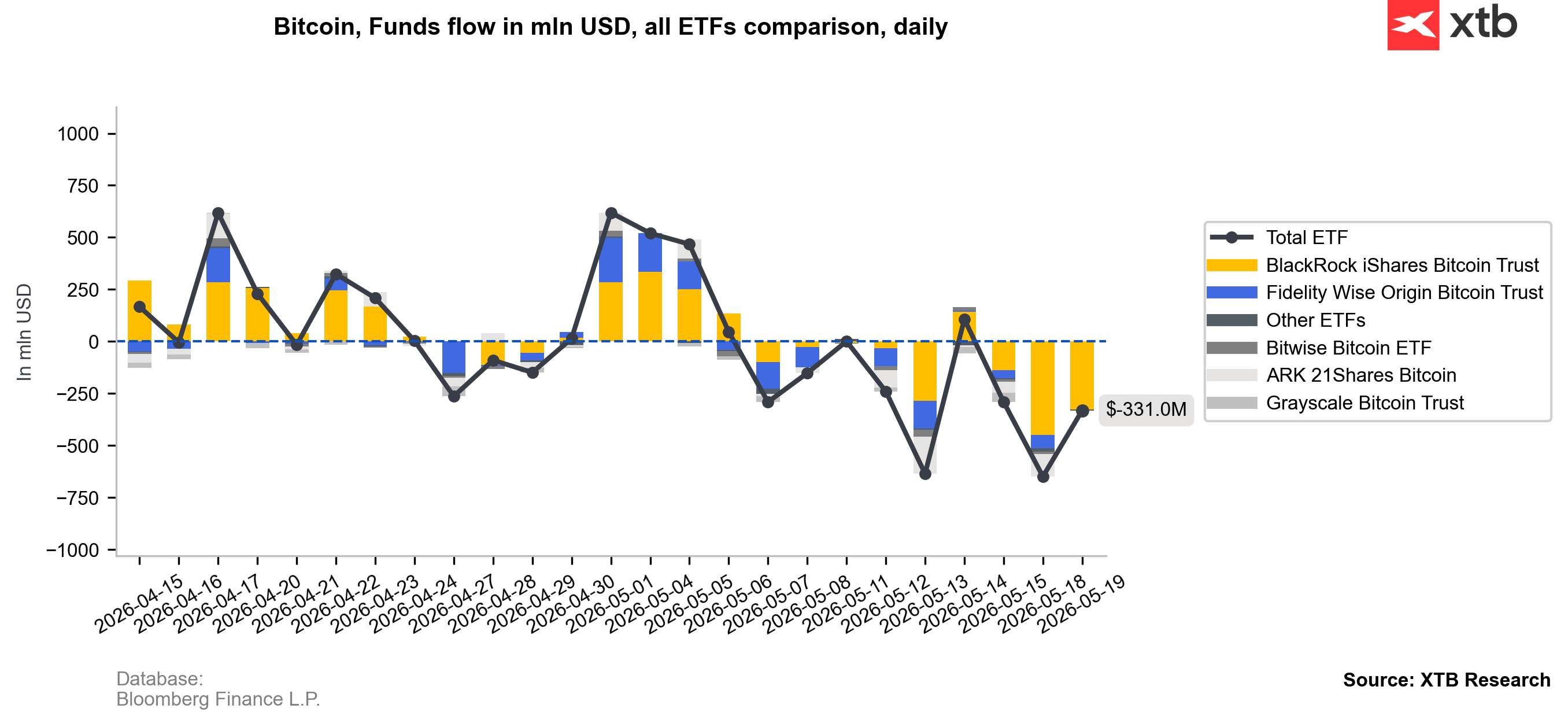
ETF flow data since May 12 shows a noticeable wave of BTC selling by institutional funds. Importantly, the profit-taking emerged while the Nasdaq 100 and S&P 500 were reaching fresh all-time highs. A similar pattern of ETF selling, including activity from BlackRock iShares products, appeared ahead of the major correction during the winter of 2025/2026. Despite the recent selling pressure, ETFs still hold more than USD 56.7 billion worth of Bitcoin and remain one of the most important long-term sources of demand for the market.
 Source: Bloomberg Finance L.P. XTB Research
Source: Bloomberg Finance L.P. XTB Research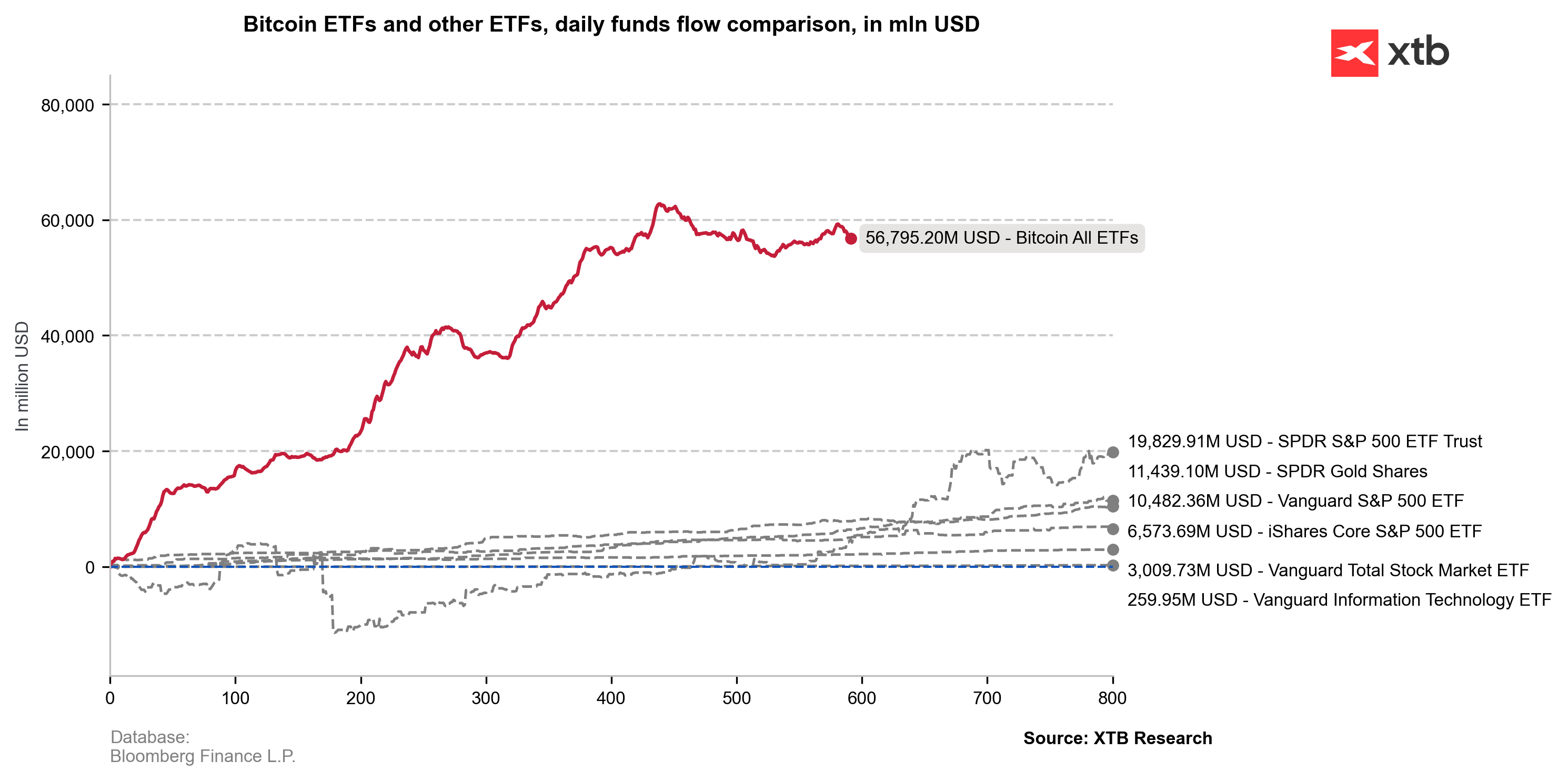 Source: Bloomberg Finance L.P. XTB Research
Technical analysis: history may be rhyming again
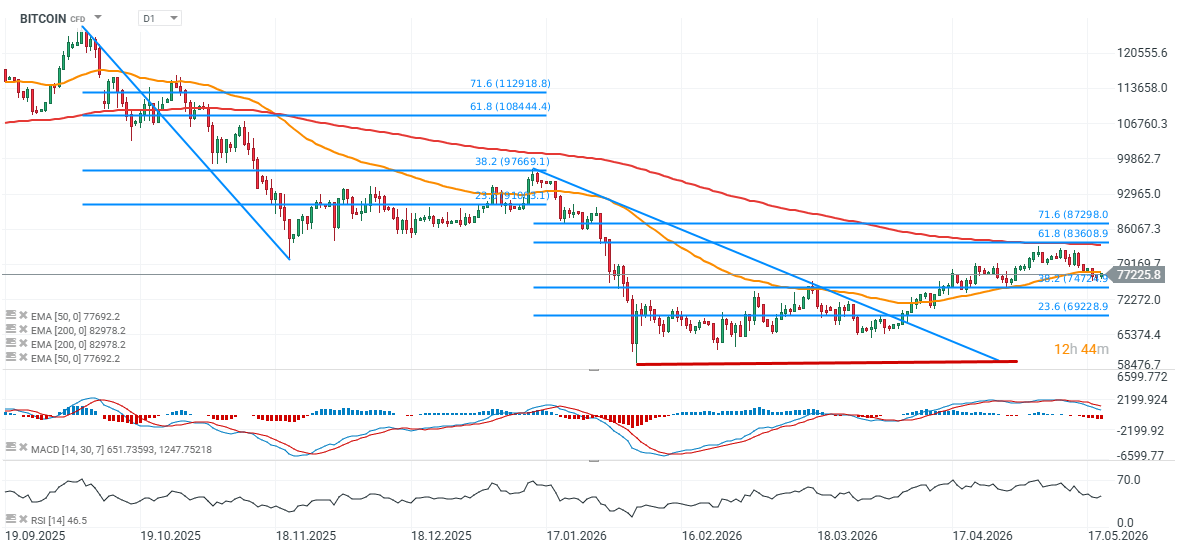
The current corrective structure increasingly resembles previous Bitcoin sell-offs. This time, however, the rebound proved significantly stronger than the one seen in late 2025 and early 2026, when BTC stalled near the 38.2% Fibonacci retracement before collapsing from around USD 97,000. The latest rally faced strong resistance near the 61.8% Fibonacci retracement around USD 83,600, where the 200-session EMA200 is also located. Since then, Bitcoin has fallen back below the EMA50, signaling weakening short-term momentum.
Source: xStation5
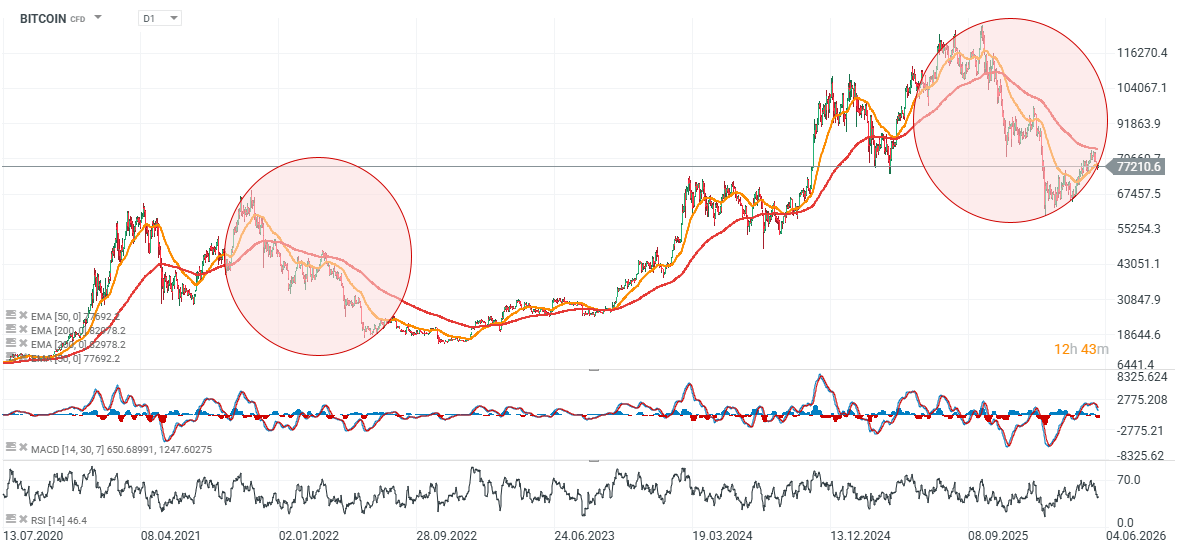
Could the market repeat the 2021 - 2022 scenario?
Comparing the current cycle to the 2021–2022 bear market reveals several similarities in the structure of the correction. It is important to note, however, that the current drawdown remains significantly shallower — even at the lows near USD 60,000, Bitcoin had declined roughly 50% from its highs, compared with nearly 80% during the 2022 collapse. Bitcoin’s growing market capitalization may gradually reduce its long-term volatility compared with previous cycles. Still, summer months have historically been difficult for Bitcoin, meaning the coming weeks could continue to bring elevated volatility and downside risk.
Source: xStation5
Eryk Szmyd, Financial Markets Analyst at XTB



US OPEN: Dell soars and keeps pushing tech stocks higher 🚀



RBNZ Regime Change: The Ultimate Hard-Hawk Pivot 🦅 Time to shine for NZD 🇳🇿


BREAKING: Sharp drop of the CAD; Canadian GDP data spooked investors 🚨


German inflation data well below expectations. A dovish signal for ECB?
The content of this report has been created by XTB S.A., with its registered office in Warsaw, at Prosta 67, 00-838 Warsaw, Poland, (KRS number 0000217580) and supervised by Polish Supervision Authority ( No. DDM-M-4021-57-1/2005). This material is a marketing communication within the meaning of Art. 24 (3) of Directive 2014/65/EU of the European Parliament and of the Council of 15 May 2014 on markets in financial instruments and amending Directive 2002/92/EC and Directive 2011/61/EU (MiFID II). Marketing communication is not an investment recommendation or information recommending or suggesting an investment strategy within the meaning of Regulation (EU) No 596/2014 of the European Parliament and of the Council of 16 April 2014 on market abuse (market abuse regulation) and repealing Directive 2003/6/EC of the European Parliament and of the Council and Commission Directives 2003/124/EC, 2003/125/EC and 2004/72/EC and Commission Delegated Regulation (EU) 2016/958 of 9 March 2016 supplementing Regulation (EU) No 596/2014 of the European Parliament and of the Council with regard to regulatory technical standards for the technical arrangements for objective presentation of investment recommendations or other information recommending or suggesting an investment strategy and for disclosure of particular interests or indications of conflicts of interest or any other advice, including in the area of investment advisory, within the meaning of the Trading in Financial Instruments Act of 29 July 2005 (i.e. Journal of Laws 2019, item 875, as amended). The marketing communication is prepared with the highest diligence, objectivity, presents the facts known to the author on the date of preparation and is devoid of any evaluation elements. The marketing communication is prepared without considering the client’s needs, his individual financial situation and does not present any investment strategy in any way. The marketing communication does not constitute an offer of sale, offering, subscription, invitation to purchase, advertisement or promotion of any financial instruments. XTB S.A. is not liable for any client’s actions or omissions, in particular for the acquisition or disposal of financial instruments, undertaken on the basis of the information contained in this marketing communication. In the event that the marketing communication contains any information about any results regarding the financial instruments indicated therein, these do not constitute any guarantee or forecast regarding the future results.
