


Adobe’s quarterly results show that its subscription model continues to generate revenue effectively and provides relatively stable growth. At the same time, concerns are growing that sustaining this growth could become challenging amid increasing competition and the emergence of new AI models. Markets are now asking whether Adobe can maintain its edge in the SaaS sector and how the departure of its long-standing CEO will affect the company’s strategic direction and pace of development.
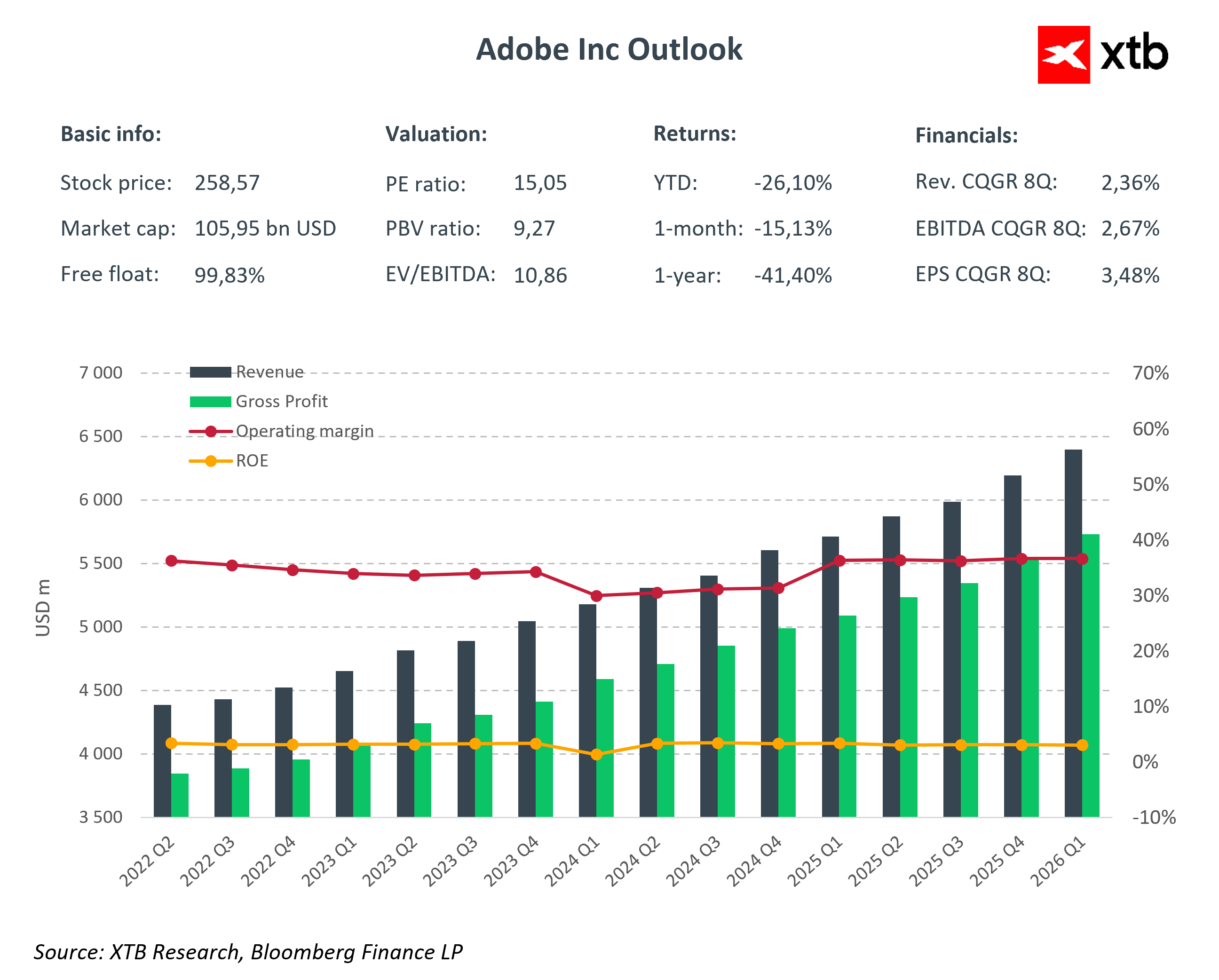
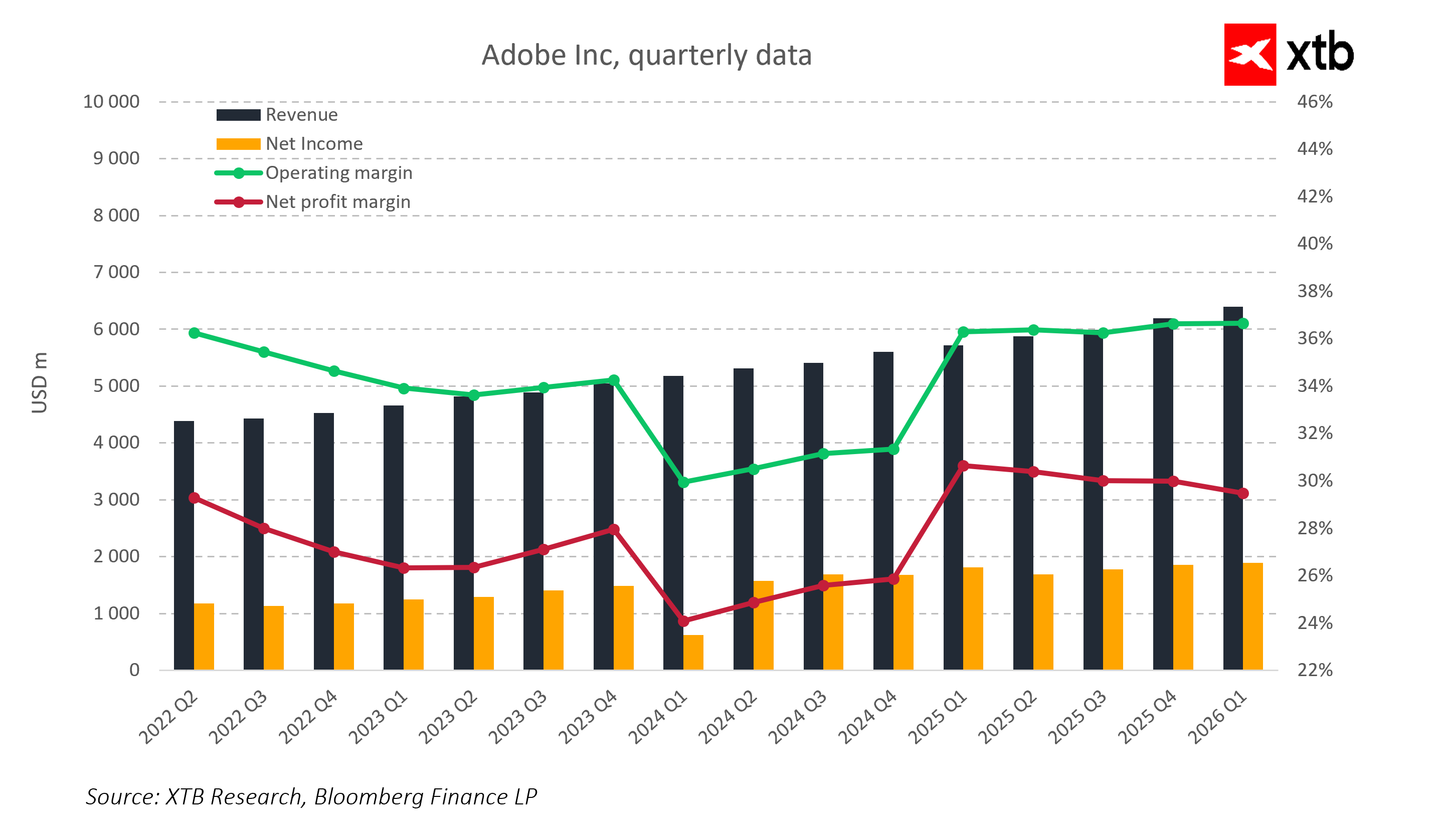
Adobe reported its results for the first quarter of fiscal year 2026, clearly demonstrating growth across key business segments. Revenue reached approximately 6.40 billion USD, representing a 12 percent year-over-year increase and surpassing analysts’ consensus of 6.28 billion USD. Non-GAAP earnings per share came in at 6.06 USD versus an expected 5.87 USD, and the company’s operating cash flow reached a record 2.96 billion USD. These results confirm that subscriptions and dynamically developed AI products, including solutions from the Creative Cloud and Document Cloud, continue to provide solid financial foundations and steadily growing revenue.
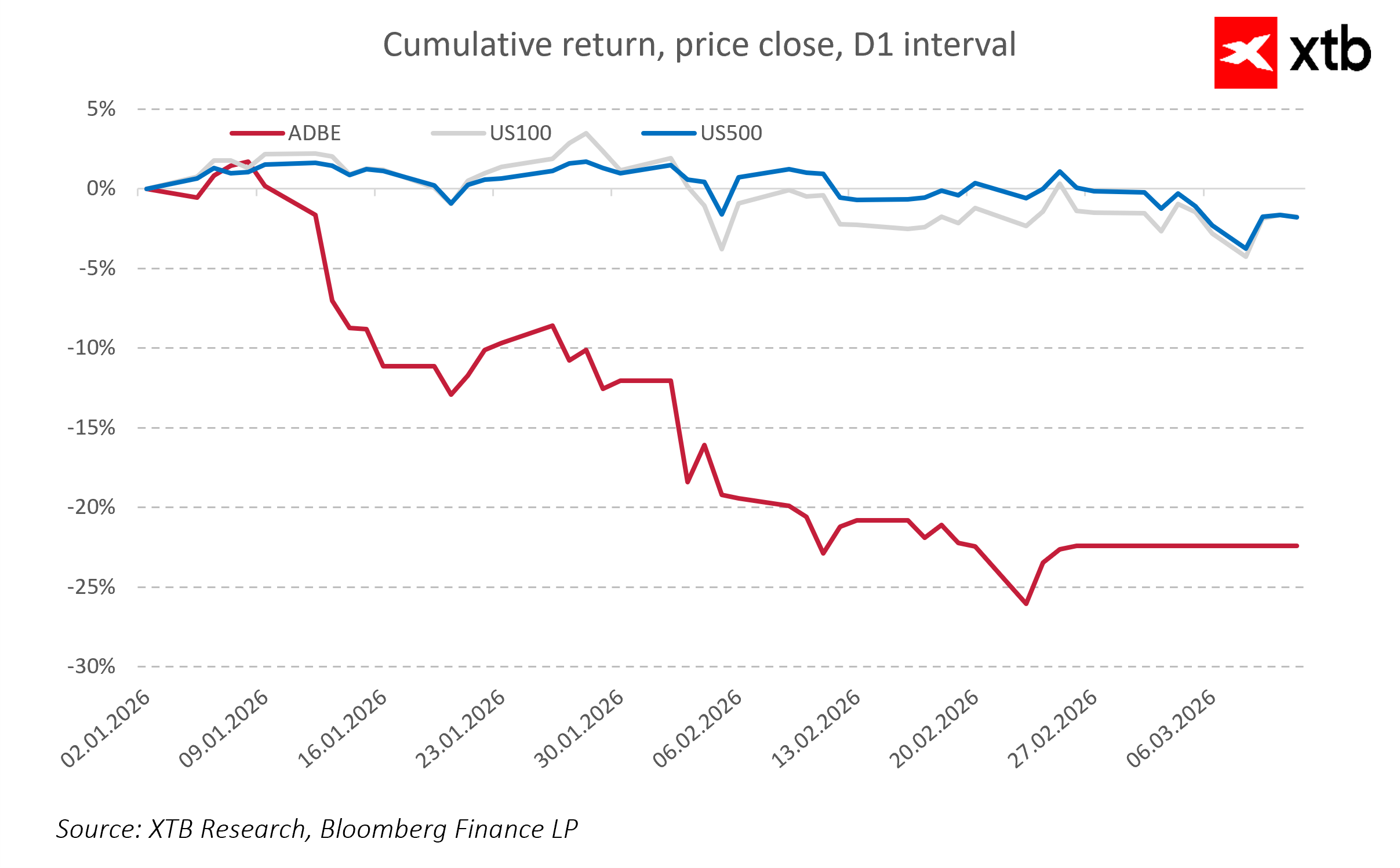
At the same time, the market reacted with a 7-8 percent decline in Adobe’s stock after the close, primarily due to Shantanu Narayen’s announced departure as CEO after eighteen years of leading the company and guiding its transformation toward SaaS and AI-focused products. In a moment when markets are closely analyzing AI’s impact on SaaS companies, this leadership change increases uncertainty regarding the pace of future growth and the effectiveness of strategic initiatives, as well as the CEO’s own confidence in the company’s future.
Adobe highlighted that in the coming quarters, margin pressure is expected to intensify with the emergence of new AI models, which, combined with the departure of its long-standing CEO, helps explain the market’s negative reaction. Investors note that the company faces the challenge not only of sustaining revenue growth but also of managing profitability in an increasingly competitive and dynamic technological environment.
Key Financial Results Q1 FY26
- Revenue: 6.40 billion USD, +12% YoY, above market consensus of 6.28 billion USD
- EPS (non-GAAP): 6.06 USD vs. expected 5.87 USD
- Annual Recurring Revenue and subscription revenues growing, particularly in AI and Creative Cloud segments
- Operating Cash Flow: 2.96 billion USD
Guidance and Risks
Adobe provided a cautious outlook for the coming quarters. For Q2 FY26, revenue is projected in the range of 6.43–6.48 billion USD, with EPS between 5.80–5.85 USD. The market interprets these figures as a signal of caution, indicating that some of the risks related to AI, SaaS competition, and leadership change may materialize.
Key risk factors include margin pressure, as the development and integration of new AI features may increase costs faster than revenues, reducing short-term profitability. The leadership transition following the long-term CEO’s departure at a critical point in the company’s transformation adds uncertainty regarding strategy execution and the effectiveness of AI and SaaS initiatives. In addition, growing competition in AI and SaaS could limit Adobe’s market share, particularly in creative and marketing segments. Despite record-high Annual Recurring Revenue, sustaining subscription growth may become more difficult amid intensifying competition and evolving customer expectations. These risk factors, combined with the cautious guidance for Q2, help explain why Adobe’s stock experienced a significant decline despite record financial results.
Business Segments
Creative Cloud and Document Cloud remain Adobe’s primary revenue drivers, accounting for more than seventy percent of total revenue. This segment is growing 10–13 percent year-over-year, driven by an expanding subscriber base and the implementation of AI-powered features such as Firefly and automation of creative workflows.
Marketing and Experience Cloud, although smaller than the creative segment, shows stable revenue growth but is more sensitive to competition and cost pressures. Rising investment in AI integration and intense competition in the marketing segment make investors approach forecasts cautiously.
AI-first products are contributing to an increasing portion of subscription revenue, and Annual Recurring Revenue has reached record levels, demonstrating the scalability of the SaaS model combined with new AI capabilities. At the same time, the growing number of competitive AI solutions in the SaaS space and concerns over potential value compression for SaaS companies lead the market to price growth more conservatively.
Outlook and Conclusions
Adobe demonstrates that its SaaS model and AI monetization remain solid, providing a foundation for continued revenue growth. The company’s success in the coming quarters will heavily depend on the effective adoption of AI solutions in its products, both in Creative Cloud and Document Cloud, to maintain technological leadership and increase value for customers.
At the same time, the market continues to monitor the impact of the CEO change and the company’s ability to execute its strategy in a rapidly evolving technological environment. Entering the coming quarters, Adobe remains in a phase where financial results are strong, but short-term risks related to leadership, rising AI competition, and margin pressure may lead to greater stock price volatility.
In the long term, Adobe’s fundamentals remain solid, but maintaining a leading position in SaaS and creative technology will largely depend on the successful integration of AI solutions in products and the company’s ability to adapt to growing competition and market changes. Success in this area will determine the continuation of revenue growth and shareholder value.


Market wrap: European stocks attempt to stabilize despite the surge in oil prices 🔍


Chubb to insure ships crossing the Strait of Hormuz 🗽 What does it mean for the company?

Rheinmetall earnings: Formidable growth, but the market expected more



From Dependence to Control. Meta’s Development of Proprietary AI Chips
The content of this report has been created by XTB S.A., with its registered office in Warsaw, at Prosta 67, 00-838 Warsaw, Poland, (KRS number 0000217580) and supervised by Polish Supervision Authority ( No. DDM-M-4021-57-1/2005). This material is a marketing communication within the meaning of Art. 24 (3) of Directive 2014/65/EU of the European Parliament and of the Council of 15 May 2014 on markets in financial instruments and amending Directive 2002/92/EC and Directive 2011/61/EU (MiFID II). Marketing communication is not an investment recommendation or information recommending or suggesting an investment strategy within the meaning of Regulation (EU) No 596/2014 of the European Parliament and of the Council of 16 April 2014 on market abuse (market abuse regulation) and repealing Directive 2003/6/EC of the European Parliament and of the Council and Commission Directives 2003/124/EC, 2003/125/EC and 2004/72/EC and Commission Delegated Regulation (EU) 2016/958 of 9 March 2016 supplementing Regulation (EU) No 596/2014 of the European Parliament and of the Council with regard to regulatory technical standards for the technical arrangements for objective presentation of investment recommendations or other information recommending or suggesting an investment strategy and for disclosure of particular interests or indications of conflicts of interest or any other advice, including in the area of investment advisory, within the meaning of the Trading in Financial Instruments Act of 29 July 2005 (i.e. Journal of Laws 2019, item 875, as amended). The marketing communication is prepared with the highest diligence, objectivity, presents the facts known to the author on the date of preparation and is devoid of any evaluation elements. The marketing communication is prepared without considering the client’s needs, his individual financial situation and does not present any investment strategy in any way. The marketing communication does not constitute an offer of sale, offering, subscription, invitation to purchase, advertisement or promotion of any financial instruments. XTB S.A. is not liable for any client’s actions or omissions, in particular for the acquisition or disposal of financial instruments, undertaken on the basis of the information contained in this marketing communication. In the event that the marketing communication contains any information about any results regarding the financial instruments indicated therein, these do not constitute any guarantee or forecast regarding the future results.