

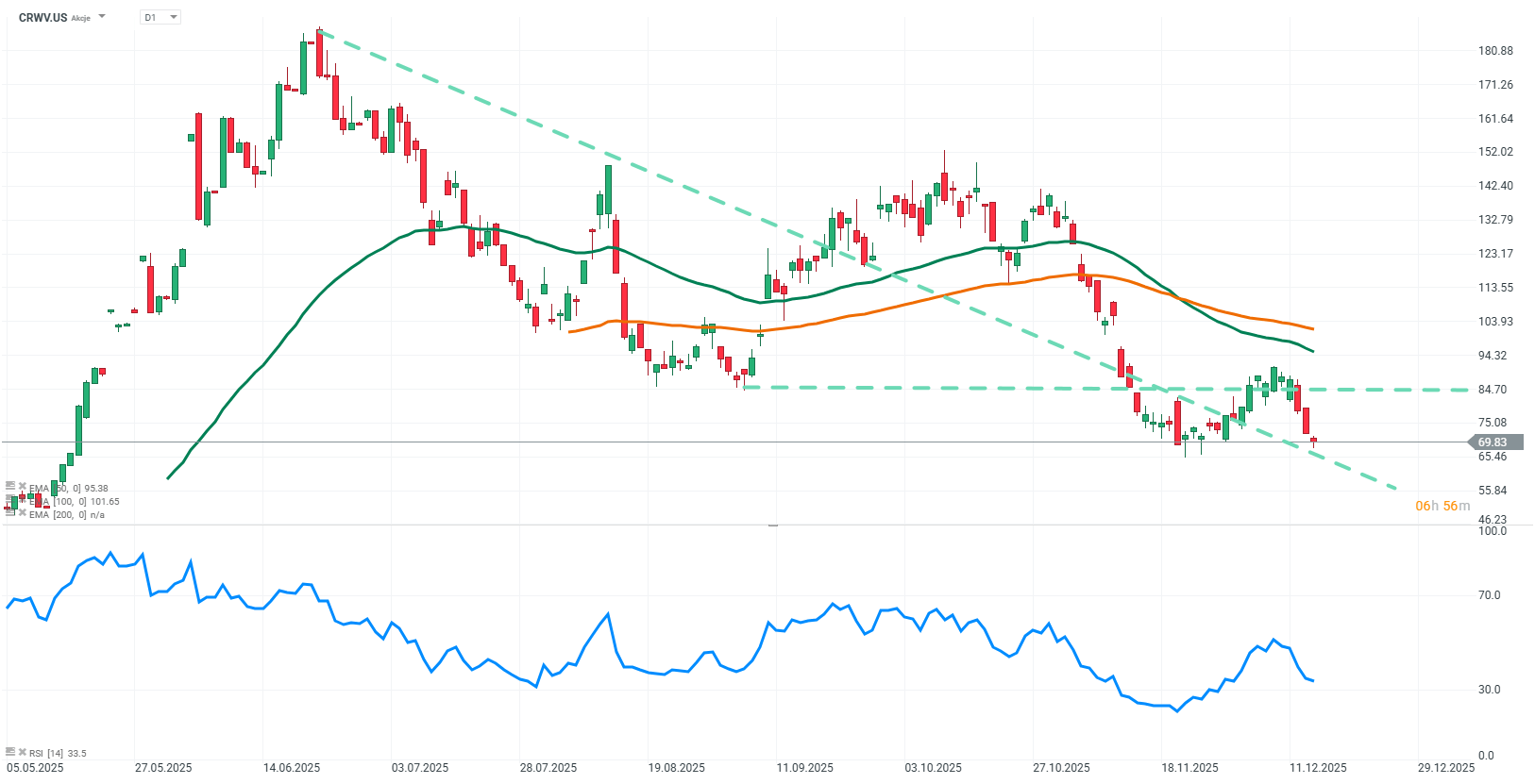
CoreWeave has recently become a symbol of cracks in the narrative of the seemingly endless AI infrastructure boom. The company, which until recently was considered a “pure play” on generative artificial intelligence, lost tens of billions of dollars in market capitalization within a few weeks. Its stock price dropped by several dozen percent, and markets are beginning to question whether its valuation reflects the real fundamentals of the business. This is not just a problem for a single company but a warning signal for the entire AI infrastructure segment, including specialized data centers, cloud providers, and hardware manufacturers.
The reasons behind CoreWeave’s decline are multiple. The company is facing delays in building data centers, including a key facility in Denton for OpenAI, a failed attempt to merge with Core Scientific, and criticism from investors holding short positions. Its business model relies on purchasing advanced GPU processors and renting computing power to large clients such as OpenAI, Microsoft, and Meta. Financing investments with high debt burdens cash flows and margins, and the pace of investment growth exceeding revenue growth raises concerns about a potential bubble in the AI sector.
Several key challenges come to the fore. A business model based on expensive hardware and large investments in data centers works well in an environment of cheap money and AI euphoria, but it becomes risky when interest rates rise and profitability is uncertain. The market is beginning to see the risk of overinvestment, as computing capacity is growing faster than the certainty that clients will fully use and pay for it. The company has come under scrutiny from critics and short-selling investors, accelerating capital outflows and increasing pressure on the entire segment of AI-related firms.
The CoreWeave situation has broader implications for the entire technology market and investors. Companies exposed to artificial intelligence and major tech corporations could benefit from potential interest rate cuts, which would improve access to credit and support investment and consumption. However, massive investments in AI do not benefit everyone. Leaders in the investment race can gain significant advantages, while less capital-intensive companies may soon face challenging financial conditions.
Source: xStation5


Daily summary: Dollar loses ground after NFP; OIL.WTI at its lowest since 2021 💡
OIL.WTI loses 2.5% 📉


EU Fines for Tech Giants — Their Role in EU/USA Competition
BREAKING: December PMI data from US slightly lower than expected
The material on this page does not constitute as financial advice and does not take into account your level of understanding, investment objectives, financial situation or any other particular needs.
All the information provided, including opinions, market research, mathematical results and technical analyses published on the website or transmitted to you by other means is provided for information purposes only and should in no event be interpreted as an offer of, or solicitation for, a transaction in any financial instrument, nor should the information provided be construed as advice of legal or fiscal nature.
Any investment decisions you make shall be based exclusively on your level of understanding, investment objectives, financial situation or any other particular needs. Any decision to act on information published on the website or transmitted to you by other means is entirely at your own risk. You are solely responsible for such decisions.
If you are in doubt or are not sure that you understand a particular product, instrument, service, or transaction, you should seek professional or legal advice before trading.
Investing in OTC Derivatives carries a high degree of risk, as they are leveraged based products and often small movements in the market could lead to much larger movements in the value of your investment and this could work against you or for you. Please ensure that you fully understand the risks involved, taking into account your investments objectives and level of experience, before trading, and if necessary, seek independent advice.