

The Euro is trading lower following the release of the final preliminary Purchasing Managers’ Index (PMI) data for December, which highlighted fatal weakness in Germany’s manufacturing sector and a mixed activity profile for France.
Germany: Preliminary December PMI Readings
-
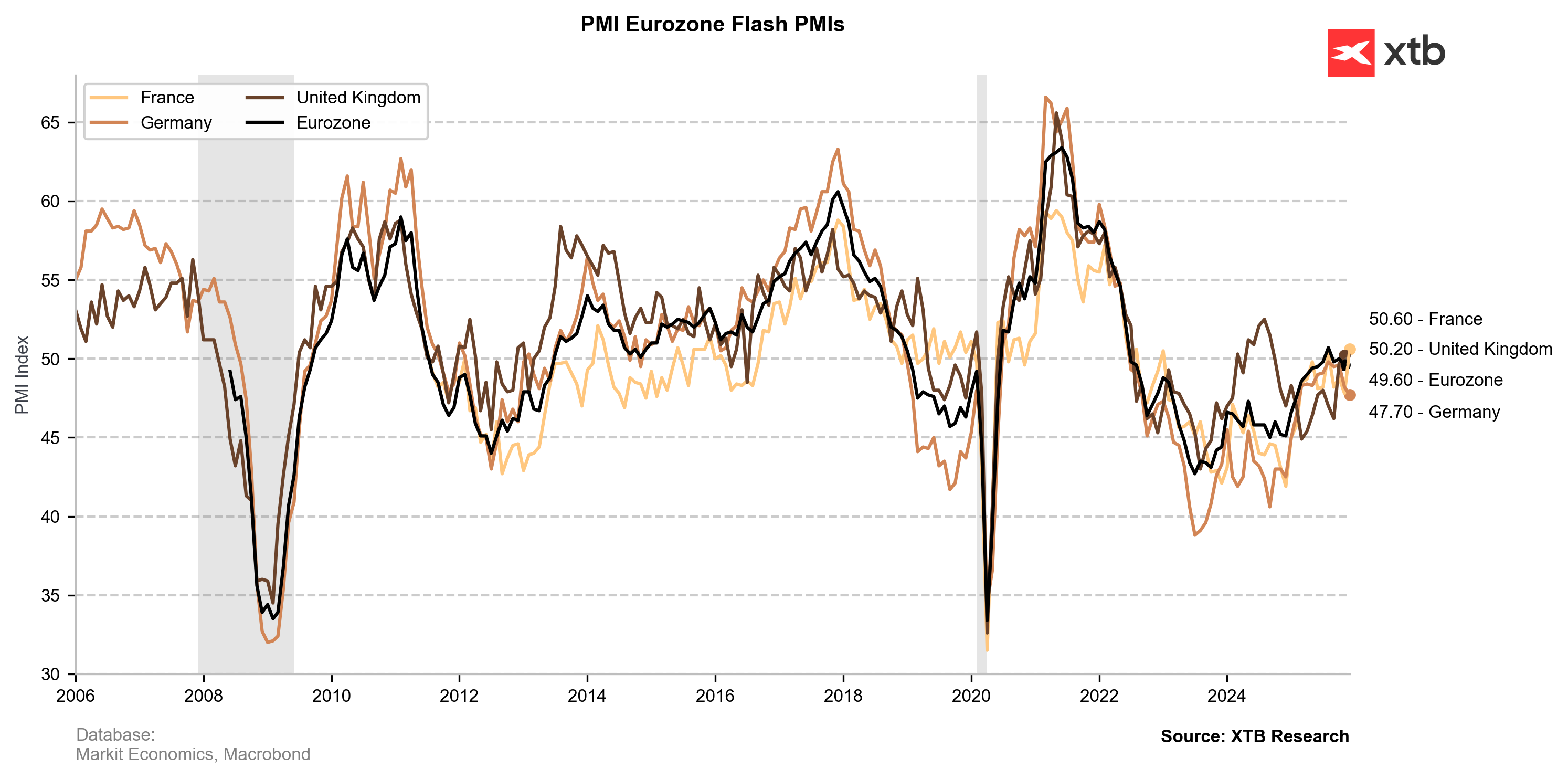
Manufacturing PMI: 47.7 (Expected 48.5; Prior 48.2). Significantly worse than anticipated. Signals further distress for the industrial sector, which has struggled to gain traction throughout the year.
-
Services PMI: 52.6 (Expected 53.0; Prior 53.1). Marginally below expectations. The sector remains in expansion territory but is losing momentum.
-
Composite PMI: 51.5 (Expected 52.4; Prior 52.4). Worse than expected. Indicates a slowdown in the overall rate of economic growth.
France: Preliminary December PMI Readings
-
Manufacturing PMI: 50.6 (Expected 48.1; Prior 47.8). Significantly better than anticipated. A surprise return to the expansion zone (above 50.0).
-
Services PMI: 50.2 (Expected 51.1; Prior 51.4). Worse than expected. A slowdown in the rate of growth, bordering on stagnation.
-
Composite PMI: 50.1 (Expected 50.3; Prior 50.4). Marginally worse than expected. The economy is effectively stagnating at year-end.
Market Reaction and ECB Implications
Despite an initial flicker of optimism sparked by the unexpected improvement in French manufacturing, the overwhelmingly negative tenor of the German data has dominated market sentiment. The Euro is distinctly weaker following the releases, with a similar reaction observed in German bond yields.

The current readings suggest that the European Central Bank (ECB) may lack the mandate to shift its rhetoric to a more aggressively hawkish stance in upcoming meetings.
Key Takeaways
-
German Industry Under Pressure: The primary disappointment lies with the German Manufacturing PMI (47.7). This sharp decline, falling well short of forecasts, signals a deepening contraction in the bloc's key industrial engine. Production is falling for the first time in 10 months, confirming substantial sector weakness. It raises questions over whether the anticipated economic recovery for 2026 will materialize.
-
France’s Faltering Stability: France presents a mixed picture: industrial stabilization is positive, but the services sector is rapidly losing steam. The French Composite activity (50.1) signals a precarious balance between expansion and stagnation. Despite domestic political headwinds, the expansionary nature of the manufacturing print is a welcome development.
-
Wider Eurozone Outlook: The acute weakness in Germany, the Eurozone's largest economy, outweighs the relative strength seen in French manufacturing. The German Composite PMI’s drop to 51.5 (vs 52.4 expected) implies a further deceleration in the region’s growth momentum.
-
ECB Policy Stance: The ECB is expected to maintain a neutral position in its forward guidance. The data is broadly consistent with the trend observed throughout 2025. Crucially, there appears to be little prospect for introducing a more hawkish tone for 2026. This dynamic may serve to neutralize any residual positive impact on the euro stemming from recent hawkish comments by policymakers like Isabel Schnabel.

EURUSD gains 0.12% ahead of NFP 📈


DE40: European stocks are falling as markets await U.S. data
BREAKING: German ZEW Index mixed! ↔️

Chart of the day: Bitcoin (16.12.2025)
The material on this page does not constitute as financial advice and does not take into account your level of understanding, investment objectives, financial situation or any other particular needs.
All the information provided, including opinions, market research, mathematical results and technical analyses published on the website or transmitted to you by other means is provided for information purposes only and should in no event be interpreted as an offer of, or solicitation for, a transaction in any financial instrument, nor should the information provided be construed as advice of legal or fiscal nature.
Any investment decisions you make shall be based exclusively on your level of understanding, investment objectives, financial situation or any other particular needs. Any decision to act on information published on the website or transmitted to you by other means is entirely at your own risk. You are solely responsible for such decisions.
If you are in doubt or are not sure that you understand a particular product, instrument, service, or transaction, you should seek professional or legal advice before trading.
Investing in OTC Derivatives carries a high degree of risk, as they are leveraged based products and often small movements in the market could lead to much larger movements in the value of your investment and this could work against you or for you. Please ensure that you fully understand the risks involved, taking into account your investments objectives and level of experience, before trading, and if necessary, seek independent advice.