



Preliminary data on November’s inflation in France came in significantly below market expectations, adding to today’s series of disinflationary surprises from the eurozone (a similar trend can be seen in Spain, where the HICP fell from 4.9% to 4.1% y/y, with prices down 0.7% m/m). Furthermore, the weaker price growth in France was accompanied by a downward revision to the final GDP reading for the third quarter.
Key macroeconomic indicators from France:
-
HICP inflation (year-on-year): 3.2% (forecast: 3.6%; previous: 3.7%)
-
HICP inflation (month-on-month): -0.7% (forecast: -0.4%; previous: +0.4%)
-
CPI inflation (year-on-year): 2.9% (forecast: 3.2%; previous: 3.4%)
-
CPI inflation (month-on-month): -0.7% (forecast: -0.4%; previous: +0.4%)
-
GDP for the third quarter (quarter-on-quarter, final): -0.2% (forecast: -0.1%; previous: -0.1%)
What is behind the price slowdown?
According to data from the national statistics office INSEE, the sharp monthly fall in prices (-0.7% m/m) and the significant drop in the annual CPI below 3% are primarily attributable to two main components of the basket:
-
Energy: the year-on-year growth rate slowed from 24.1 per cent in October to 19.2 per cent in November. The key factor was a sharp fall in the prices of petroleum products, which more than offset the rise in gas prices.
-
Services: inflation in this segment, which is of particular concern to the ECB, fell from 2.6% to 2.3% year-on-year, mainly due to a marked slowdown in accommodation prices and a seasonal fall in transport prices.
-
Other categories: prices of industrial goods remained in negative territory (-0.2% y/y), whilst those of tobacco products slowed slightly (from 3.3% to 3.2% y/y). The only significant upward exception was food, which accelerated from 1.2% to 1.3% y/y (driven by a rise in prices of fresh produce from 8.0% to 9.4% y/y).
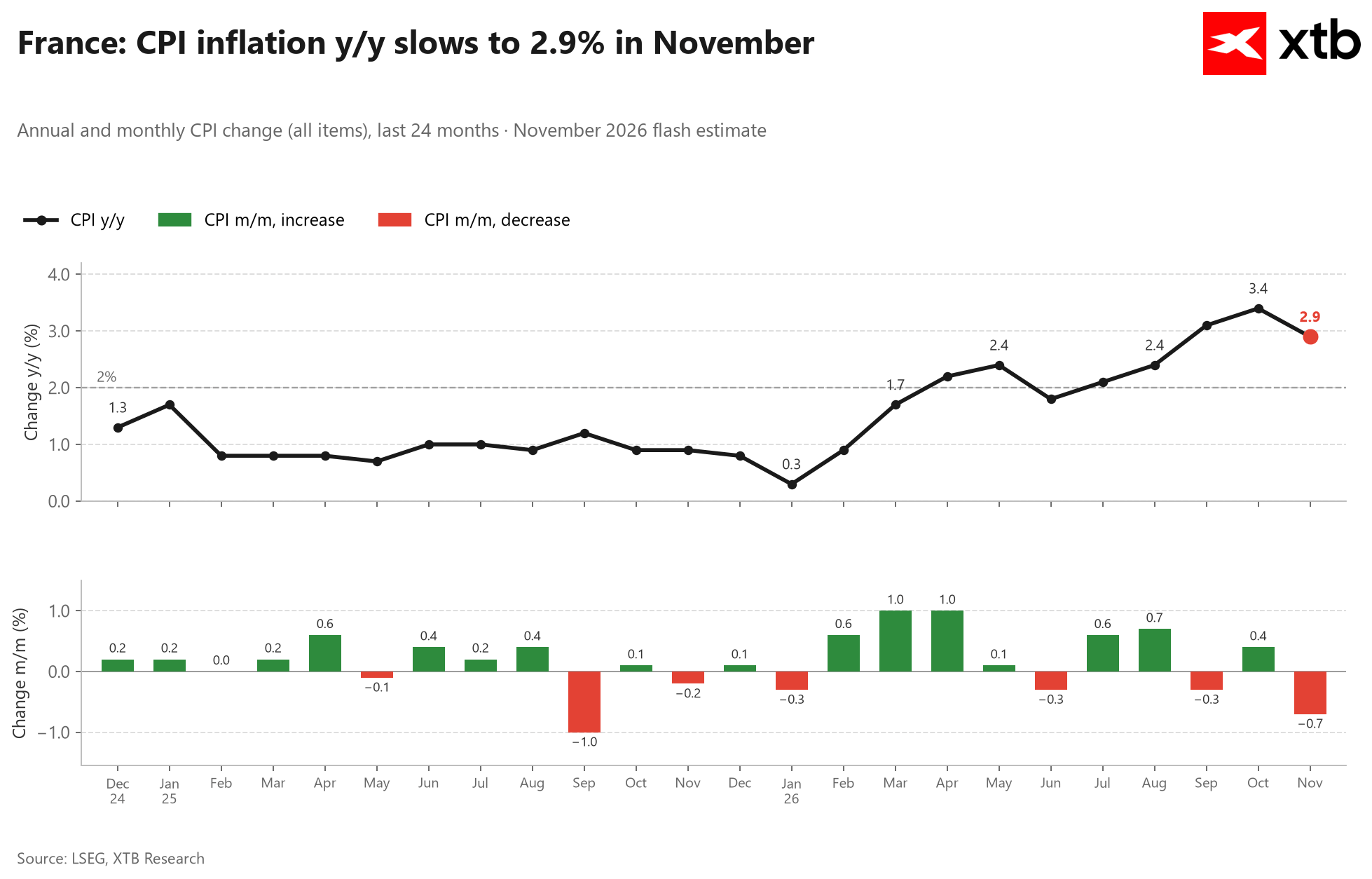
The combination of significantly lower inflation (particularly in the services sector) with a sharper-than-expected fall in GDP in the third quarter confirms a slowdown in the eurozone’s second-largest economy, which sends a clearly dovish signal regarding market expectations for the European Central Bank’s policy.


Daily Summary: Strong rebound on Wall Street and return of metals

📈 Brazilian real gains 4.8% after Lula’s decision



Three Markets to Watch Next Week (27.11.2026)


Ukraine proposes a Black Sea ceasefire 🚩 Which markets could react?