

Despite Jensen Huang’s determined efforts, including traveling to China alongside Donald Trump to negotiate easing restrictions on the export of American AI chips, it increasingly appears the mission ended in failure. Huang seemingly failed to secure any concessions, while Beijing is now sending one of its clearest signals in months. China’s technology sector is expected to rely more heavily on domestic solutions rather than American semiconductors.
According to the latest media reports, Chinese authorities have added Nvidia’s RTX 5090D V2 gaming GPU to a list of banned products. At first glance, this may appear to target only the gaming market, but the implications run far deeper. The chip was not only used by gamers, but also by certain AI engineers and companies developing artificial intelligence systems. The card provided access to Nvidia’s Blackwell architecture and was viewed by part of the market as a workaround to U.S. export restrictions.
This is where the biggest irony of the entire situation emerges. Washington has spent months trying to limit China’s access to the world’s most advanced AI chips, while Nvidia attempted to find a compromise by creating specially downgraded versions of its products exclusively for the Chinese market. The issue, however, is that even these restricted chips proved powerful enough to support AI development in China. Now Beijing appears ready to respond with its own measures, officially limiting Chinese companies’ access to Nvidia’s latest hardware while simultaneously promoting domestic alternatives from local manufacturers.
The timing of the decision is also highly symbolic. Reports about the RTX 5090D V2 being added to the banned list surfaced during the visit of Donald Trump and Jensen Huang to China. It is difficult not to interpret this as both a political statement and a demonstration of strength from Beijing. China is signaling that it no longer intends to depend on American technology suppliers and is prepared to accelerate the development of its own AI ecosystem.
For Nvidia, the issue is highly significant, as China has long been one of the company’s most important sources of demand for advanced AI hardware. If Beijing truly begins administratively restricting Nvidia chips while prioritizing domestic solutions, it could eventually lead to a permanent loss of part of the Chinese market for the American giant.
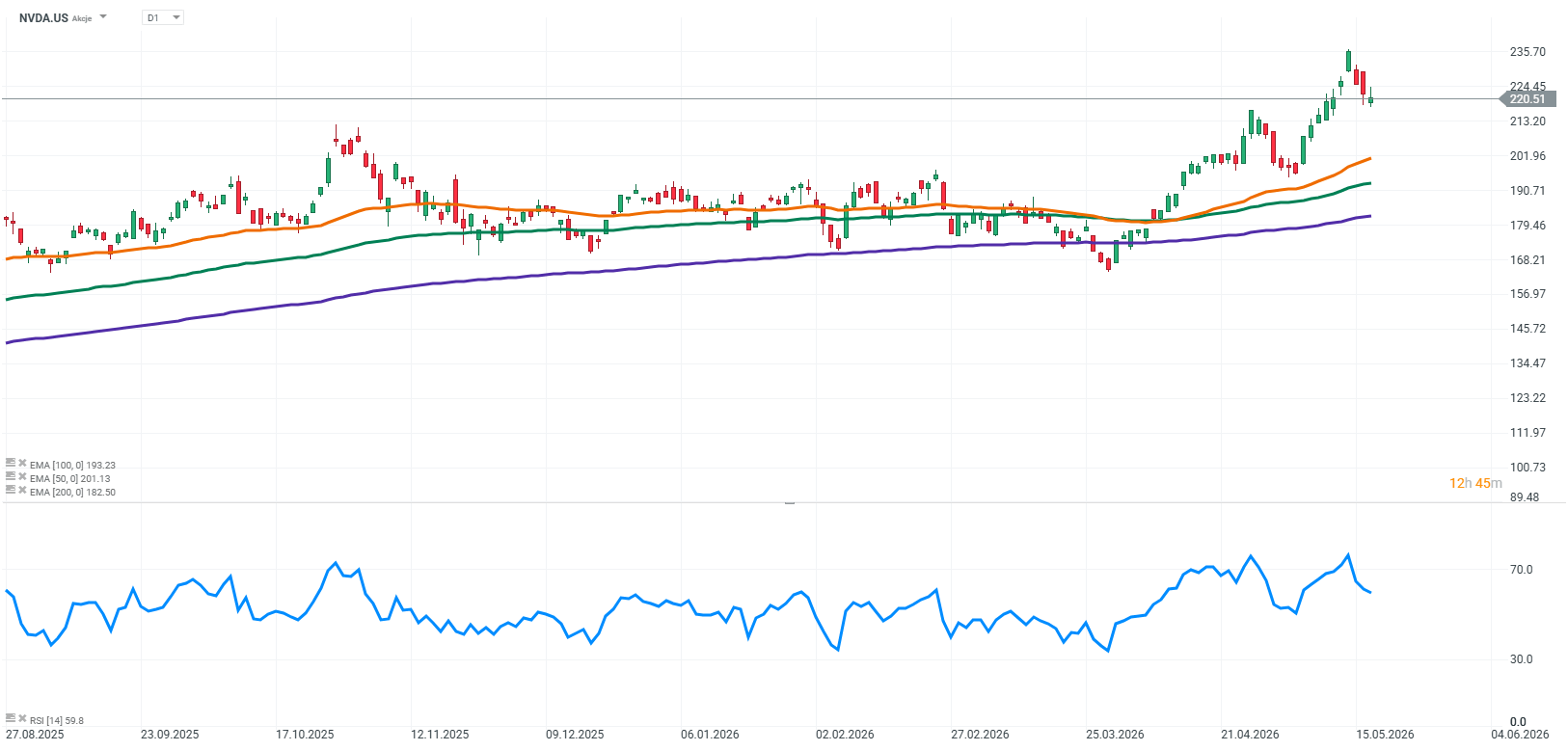
That is precisely why the market will be watching Nvidia’s quarterly earnings today even more closely than usual. Expectations remain enormous, the company’s valuation is extremely demanding, and investors have spent months pricing in a near-perfect growth scenario. The problem is that at Nvidia’s current scale, even the smallest crack in the narrative of unlimited AI demand could be quickly noticed by the market.
Source: xStation5



US OPEN: Wall Street Nears Record Highs Ahead of Long Weekend, Powered by AI


Market Wrap: Technology Stocks Keep European Markets Afloat💡


Walmart falls despite strong earnings


Oil keeps rising: is there reason to worry?
