A step-by-step guide on how to safely buy, manage, and store Bitcoin. Covers investment exposure methods, secure cold storage practices, and risk evaluation to help investors make informed decisions.
A step-by-step guide on how to safely buy, manage, and store Bitcoin. Covers investment exposure methods, secure cold storage practices, and risk evaluation to help investors make informed decisions.


How can a beginner start investing in bitcoin?
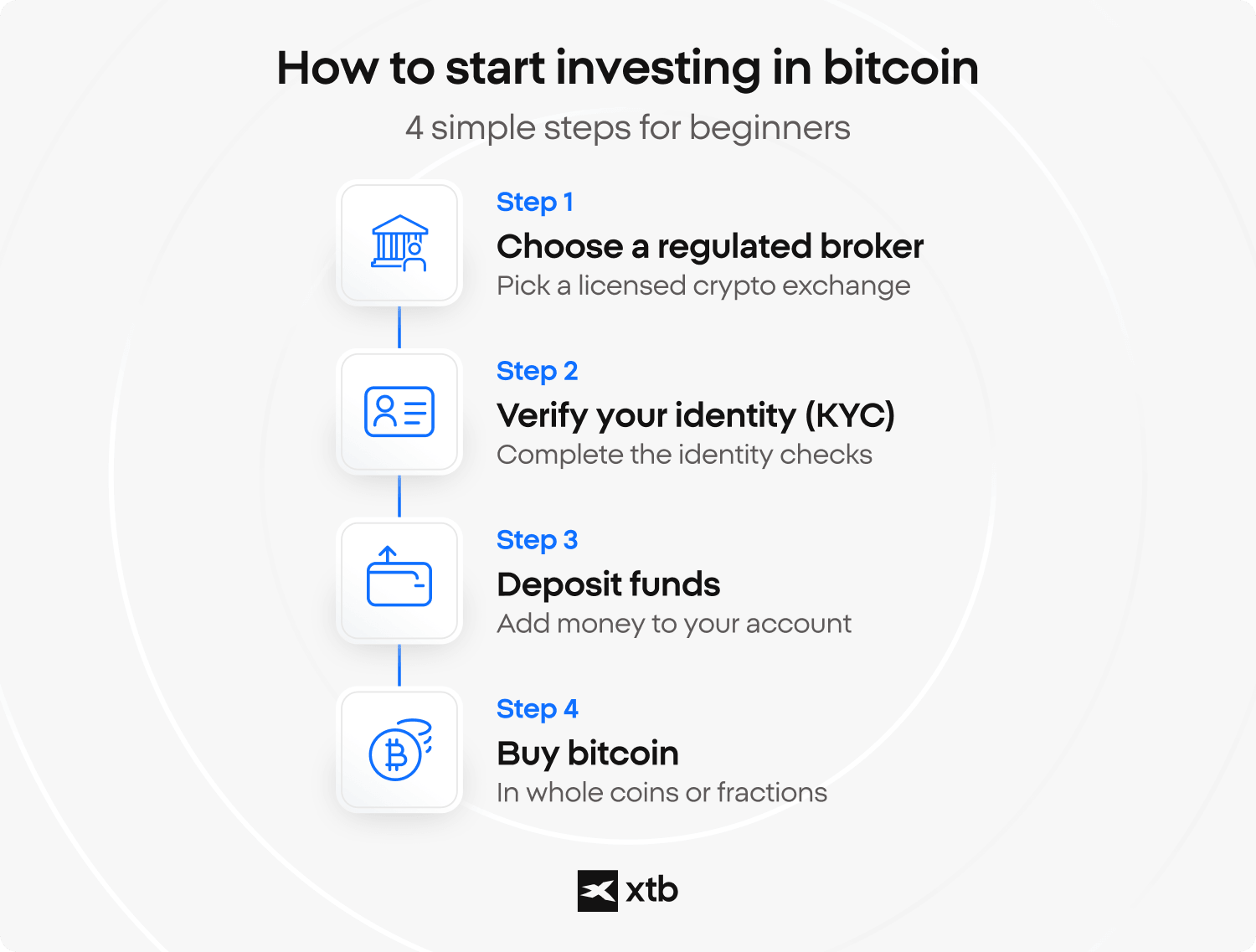
A beginner starts investing in bitcoin in a few steps:
- choosing a regulated crypto exchange or broker,
- completing identity verification (KYC),
- depositing funds,
- buying BTC in whole or in fractions.
Before allocating capital, you should understand what a bitcoin is and how it functions as a digital asset. The process demands attention to detail, as blockchain transactions cannot be reversed once broadcast to the network.
To initiate your first cryptocurrency purchase (under MiCA: crypto-asset), follow the structured onboarding process on your chosen platform. Standardising this process protects your capital and ensures compliance with global financial regulations:
- Platform selection: Register a brokerage account with a licensed provider that offers clear fee structures and strong security track records.
- KYC / verification: Submit a government-issued ID and proof of address to unlock trading capabilities and fiat deposits.
- Capital funding: Transfer fiat currency from your bank account or payment card into your new account.
- Asset acquisition: Execute a buy order for the desired amount, deciding whether to keep the digital asset on the platform or move it to a private crypto wallet.
Many beginners adopt a dollar-cost averaging strategy rather than buying a large lump sum. By purchasing $100 every two weeks, you can smooth out the average entry price over time and mitigate short-term volatility.
|
❓ Did you know? Bitcoin is highly divisible. You do not need to buy a whole coin to start investing. Each bitcoin breaks down into 100 million smaller units called satoshis. This means a beginner can purchase a tiny fraction of a BTC for a minimal amount, depending on the platform's minimum trade requirements. |
What are the ways to get exposure to bitcoin?
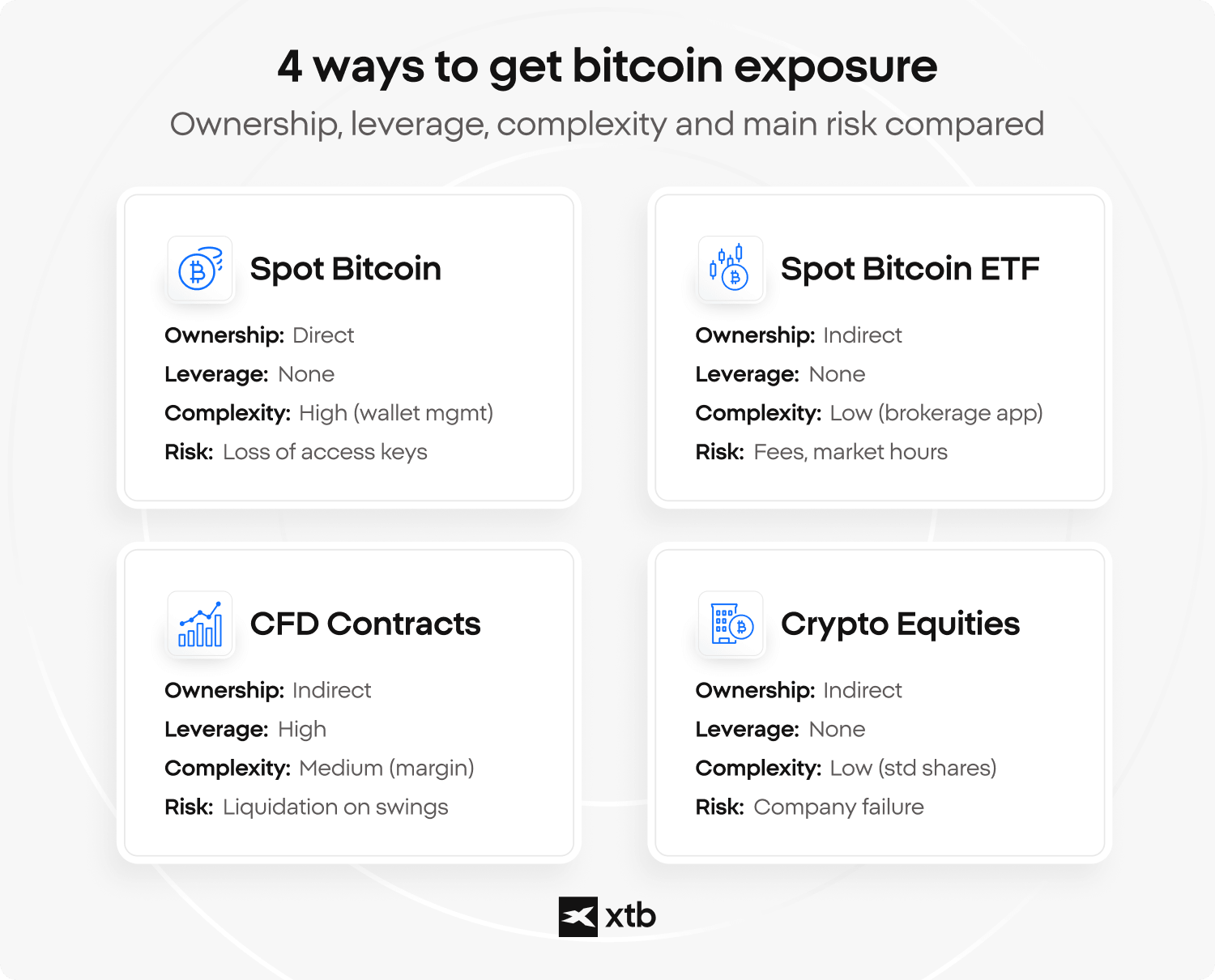
You can get exposure to bitcoin directly by purchasing BTC on an exchange, or indirectly through price-tracking products like a spot bitcoin ETF, CFD contracts, futures contracts, and shares of cryptocurrency-related companies. Each method serves a different financial goal and requires a distinct level of technical knowledge. Direct ownership means managing the asset yourself, while indirect exposure relies on traditional financial rails.
Understanding the differences between these instruments helps you align your investment strategy with your risk tolerance. A spot Bitcoin ETF trades on traditional stock markets, whereas Bitcoin CFD instruments allow you to speculate on price movements without holding the underlying asset.
To decide how to invest in crypto properly, compare the core attributes of each available vehicle:
Spot Bitcoin
-
Ownership: Direct
- Leverage: None
- Complexity: High (wallet management)
- Risk: Loss of access keys
Spot Bitcoin ETF
-
Ownership: Indirect
- Leverage: None
- Complexity: Low (brokerage app)
- Risk: Fees, market hours
CFD Contracts
-
Ownership: Indirect
- Leverage: High
- Complexity: Medium (margin)
- Risk: Liquidation on swings
Crypto Equities
-
Ownership: Indirect
- Leverage: None
- Complexity: Low (std shares)
- Risk: Company failure
If you prefer regulated securities over managing digital keys, learning how to invest in ETF products tracking digital assets provides a streamlined alternative to navigating decentralised networks.
How to Buy Bitcoin Safely?
The safest way to buy bitcoin is to use a large, regulated crypto exchange or brokerage account with two-factor authentication (2FA) enabled, rather than relying on unverified platforms. Since cryptocurrency transactions are immutable, establishing strong security fundamentals during the acquisition phase is critical to protecting your funds. Prioritising platforms with established operational histories minimises counterparty risk.
You must actively defend your account credentials from unauthorised access. Beyond securing your login data, it is crucial to verify website domains to avoid phishing attempts that mimic legitimate trading environments.
To confidently buy Bitcoin while prioritising crypto security adhere to these mandatory safety protocols:
- Enable hardware 2FA: Use authenticator apps or physical security keys instead of SMS-based codes to prevent SIM swap attacks.
- Verify domain addresses: Always bookmark your chosen crypto exchanges and never click on sponsored search links that might lead to phishing sites.
- Test transfer routes: Send a small test transaction of $5 to a new crypto wallet address before transferring your entire balance.
- Protect private data: Never share your login details, passwords, or recovery phrases with customer support or online forums.
⚠️ Caution
Be extremely wary of platforms promising guaranteed returns or unrealistic yields. A common scam involves directing beginners to fake platforms where their deposits are quickly stolen. Always stick to established, heavily regulated providers and remember that legitimate services will never ask for your recovery phrases.
Where should you store bitcoin after buying it?
Bitcoin can be stored in a custodial manner on an exchange, or through self-custody in a hot wallet or a cold hardware wallet. Custodial storage means the platform holds the digital assets on your behalf, offering a convenient user experience similar to a traditional bank. Conversely, managing your own crypto wallet shifts the absolute responsibility of safeguarding the asset onto you.
Taking direct control of your holdings requires securing the cryptographic private keys that prove ownership on the blockchain. A seed phrase acts as the ultimate master password to your funds, allowing you to recover your assets if your physical device breaks or is lost.
If you choose the self-custody route, you must decide between internet-connected software and offline hardware:
- Custodial accounts: The crypto exchange manages security and recovery; best for active traders but vulnerable if the company faces insolvency.
- Hot wallet applications: Software installed on a phone or computer; offers quick access for decentralised finance but remains vulnerable to malware.
- Cold wallet devices: Physical hardware storing keys completely offline; provides maximum security against remote hackers.
- Paper wallets: Physical printouts of public and private keys; completely immune to digital theft but susceptible to physical damage or loss.
Is bitcoin a good investment for you?
Whether bitcoin is a good investment depends on your individual risk tolerance, your time horizon, and the portion of your portfolio you are willing to allocate to a highly volatile asset. It functions differently than traditional equities or bonds, lacking cash flow, dividends, or physical utility. Consequently, its value relies entirely on network adoption and market sentiment.
Bitcoin has delivered strong long-term gains but also severe crashes. After peaking near $69,000 in November 2021, it fell to about $16,000 in late 2022 - a drop of nearly 77% - before recovering to new highs. A $1,000 position held from mid-2020 would be worth roughly $7,000 in July 2026.
Even after almost 50% correction in 2026, Bitcoin surged more than 4.3x outperforming by a large margin major stock indices such as S&P 500 and Nasdaq 100 over the August 2020 - August 2026 period. Past performance is not a reliable indicator of future results.
Before deploying capital, evaluate how this specific cryptocurrency fits into your broader financial plan. Allocating a small percentage of your net worth ensures that extreme volatility will not jeopardise your financial stability. Many investors treat it as an asymmetrical bet - investing an amount like $1,000 that they can comfortably afford to lose, but which could potentially yield returns over a decade-long horizon.
What are the risks of investing in bitcoin?
The main risks of investing in bitcoin include extreme price volatility, a lack of FDIC or SIPC protection, vulnerability to scams like a rug pull or exchange hacks, and ongoing regulatory uncertainty. Unlike traditional fiat currencies in a bank account, digital assets lost to fraud or user error typically cannot be recovered by centralised authorities. Investors must navigate a landscape fraught with technical and market-based hazards.
Market dynamics frequently trigger rapid portfolio devaluations within hours. You must remain aware of external factors, including changing governmental policies that could restrict trading access or impose severe tax burdens on digital assets.
To survive in this volatile ecosystem, you must continuously monitor the following critical threat vectors:
- Market volatility: Prices can drop by 50% or more during aggressive bear cycles, testing an investor's psychological resolve.
- Regulatory shifts: Governments may introduce stringent compliance laws or outright bans that negatively impact liquidity and widespread adoption.
- Security breaches: Hackers routinely target platforms and individual users, leading to the permanent loss of capital.
- Project fraud: Malicious actors create deceptive tokens designed to execute a rug pull draining investor liquidity without warning.

FAQ
FAQ
You do not need thousands of dollars to become a bitcoin investor. Because one bitcoin is divisible into 100 million satoshis, most exchanges allow you to purchase a small fraction of a coin.
The minimum investment depends on the platform, but many providers allow purchases starting from just a few dollars. Before investing, make sure you also understand the trading fees, deposit costs, and withdrawal charges that may affect your overall return.
The answer depends on your investment goals and experience. Buying bitcoin directly gives you ownership of the asset, while a spot Bitcoin ETF offers exposure through a traditional brokerage account without requiring you to manage private keys.
A Bitcoin ETF may be a better choice if you:
- prefer investing through a stock broker,
- do not want to manage a crypto wallet,
- value regulatory oversight and familiar investment accounts.
Direct ownership may suit investors who want full control over their digital assets.
There is no completely risk-free way to invest in bitcoin, but you can significantly reduce operational risks by following good security practices.
These include:
- using a regulated exchange or broker,
- enabling two-factor authentication,
- keeping recovery phrases offline,
- verifying wallet addresses before every transfer.
Good cybersecurity habits are often just as important as choosing the right investment platform.
That depends on how you plan to use your investment. Keeping bitcoin on an exchange is generally more convenient for frequent trading, while transferring it to your own wallet gives you greater control over your assets.
Long-term investors often choose hardware wallets because they reduce the risk of online attacks, although they also require greater responsibility for securely storing recovery credentials.
Bitcoin has delivered substantial long-term returns during certain periods, but it has also experienced multiple declines exceeding 70% from previous highs. Whether it is suitable as a long-term investment depends on your financial goals, investment horizon, and ability to tolerate significant volatility.
Many investors treat bitcoin as a high-risk allocation within a diversified portfolio rather than as a replacement for traditional investments.
Yes. Like any highly speculative asset, bitcoin carries the risk of substantial losses. Prices can fall sharply during bear markets, and investors may also lose funds through scams, exchange failures, hacking incidents, or by permanently losing access to their wallets.
Only invest money that you could afford to lose without affecting your financial security.
No. Unlike money held in many bank accounts, bitcoin is generally not protected by government-backed deposit insurance schemes such as the FDIC in the United States or similar programs in other countries.
If a cryptocurrency platform fails or your funds are stolen, recovery may be difficult or impossible, making careful platform selection and secure storage especially important.
Many long-term investors use dollar-cost averaging (DCA), which involves investing a fixed amount at regular intervals regardless of price. This approach reduces the impact of short-term market fluctuations and removes the pressure of trying to perfectly time market highs and lows.
Although DCA cannot eliminate investment risk, it can help investors build discipline and reduce emotional decision-making.
A reputable exchange should combine strong security, regulatory compliance, transparent pricing, and a long operating history. Before opening an account, compare several providers rather than choosing the first platform you find.
Look for exchanges that offer:
- robust security features such as two-factor authentication,
- clear information about trading and withdrawal fees,
- proof of regulatory compliance where applicable,
- a strong reputation among users and a history of safeguarding customer assets.