Can you buy Anthropic stock? Explore its IPO outlook, valuation, $30T AI opportunity and the key risks investors should know.
Can you buy Anthropic stock? Explore its IPO outlook, valuation, $30T AI opportunity and the key risks investors should know.

Anthropic became one of the most known technology companies and a major rival of OpenAI since the launch of Claude ecosystem in March 2023. As of September 2026, Anthropic has almost 30 million private consumers and visitors with over 300,000 business customers, but remains a privately held artificial intelligence company navigating the early stages of its public offering preparations. In September company has selected Nasdaq as the venue for its IPO and aims to achieve profitability in Q3 2026.
While awaiting the official Anthropic IPO date, market participants often explore indirect exposure through publicly traded strategic partners, private secondary markets or just await its stock market debut. Retail investors can only purchase Anthropic shares directly through a brokerage account after the company completes its Initial Public Offering (IPO) and begins trading on a recognized exchange.
Understanding the regulatory timeline and structural risks is essential before allocating capital to this high-profile AI entity.
Key Takeaways
- Direct access to Anthropic equity requires the completion of a formal IPO and the subsequent listing of its shares on a public stock exchange.
- The company has not confirmed an offering date. Media reports have pointed to a window around late 2026 and early 2027, but the company itself has not endorsed any timeline.
- The company's private market valuation is $965 billion as of September 2026, but Anthropic aims for $2 trillion valuation in the stock market debut, according to August WSJ reports.
- Antrhropic informed that its revenue jumped 14-fold to $11.5 billion in Q2, with annualised sales reached $65 billion in July.
- Amazon holds an estimated 19–21% stake in Anthropic (appx. $190 billion), while Alphabet owns approximately 14% (appx. $130 billion), which makes both major beneficiaries of a successful Anthropic stock market debut.
Is Anthropic publicly traded?
No, Anthropic remains a private company until the completion of its public offering and the start of exchange trading, meaning its shares are not currently available through a regular brokerage account. The AI research firm retains its private status to control its strategic direction without the immediate pressure of quarterly public market earnings expectations.
Currently, the ownership structure of Anthropic consists primarily of its founding members, early employees, private venture capital investors, and major strategic corporate partners. Understanding this structure clarifies why those researching how to buy Anthropic stock directly on the open market cannot do so today. Large technology conglomerates such as Amazon and Alphabet hold significant stakes in the firm: 19% and 14% respectively, though these agreements often include strict equity ownership limits to satisfy antitrust regulators.
The fundamental difference between a privately held entity and a publicly traded company lies in regulatory obligations and continuous market liquidity. A private company operates without mandatory public financial reporting, lacks an objective daily market valuation, and offers severely limited liquidity for its existing shareholders. Once a company transitions to a public exchange, it must adhere to strict Securities and Exchange Commission (SEC) transparency standards.
|
|
When will Anthropic go public?
The date will only become known after the SEC completes its documentation review and the prospectus is publicly disclosed. The company retains the full option to delay or completely withdraw the offering. Predicting exactly when will Anthropic go public depends entirely on the company clearing complex regulatory hurdles and identifying favorable macroeconomic conditions.
The journey to a public listing generally follows a strict three-stage pipeline that institutional market observers monitor closely. First, a company confidentially submits a draft S-1 registration statement to the SEC for an initial regulatory review. Second, the company publicly files the finalized S-1 prospectus, revealing its financial health, revenue models, and operational risk factors to the broader market. Third, the executive team conducts a global roadshow to gauge institutional interest and secure capital commitments before executing the debut and initiating the first day of open market trading.
A confidential S-1 draft submission simply initiates the SEC review process and does not establish a finalized debut date, share count, or offering price. Investors looking for concrete signals that the offering is imminent should watch for the public prospectus reveal, the selection of lead investment bank underwriters, the designation of a stock exchange ticker, and the announcement of preliminary price target ranges.
The timeline may also be influenced by broader market conditions, including the parallel progress of the OpenAI IPO, which serves as a critical valuation benchmark for the entire generative AI sector. Any media reports speculating on a precise debut month should be treated strictly until the company issues an official regulatory filing.
Anthropic’s $30 Trillion AI Market Thesis & Revenue Growth
Anthropic’s reported estimate of a total addressable market (TAM) above $30 trillion shows how broadly the company sees AI reshaping knowledge work. The figure is also higher than the $28.5 trillion TAM cited by SpaceX, which described its opportunity as the “largest actionable TAM in human history,” with much of that potential linked to AI. For investors, however, the real issue is execution. Anthropic’s future valuation will depend on whether it can convert this theoretical opportunity into scalable revenue, defend margins and justify the heavy infrastructure spending required to compete with OpenAI and Google.
The company itself is forecasting revenue between $190 billion and $200 billion by 2028 and already counts roughly 6,000 customers spending at least $100,000 a year. According to SemiAnalysis some investors expect Anthropic’s annualized revenue to reach $120 billion by the end of 2026 and almost triple that by the close of 2027.
- Anthropic reportedly sees its TAM at more than $30 trillion, above SpaceX’s $28.5 trillion estimate.
- The company is targeting roughly $190–200 billion in revenue by 2028.
- A larger TAM strengthens the long-term growth narrative ahead of a potential IPO.
- Key risks remain high capital intensity, strong competition and uncertainty over how quickly AI adoption translates into sustainable revenue..
How much is Anthropic worth?
Anthropic's valuation stems from its latest private funding round and sits at $965 billion as of September 2026, which is a distinct corporate metric rather than a direct indicator of its future share price or IPO target.Determining how much Anthropic is worth requires you to separate the total estimated value of the company from the individual price per share that will eventually trade on a public exchange.
The company's valuation has expanded rapidly across its Series F, Series G, and Series H private funding rounds, driven by aggressive institutional capital inflows. This valuation growth tracks a revenue run-rate that reached ≈$47 billion on an annualised basis in mid-August 2026, against $10 billion of revenue booked across the whole of 2025, driven by expanding enterprise software usage. However, the company currently operates without disclosed sustainable GAAP profitability, as massive computational infrastructure costs weigh heavily on overall gross margins.
A private post-money valuation often differs significantly from the final public offering valuation due to shifting macroeconomic environments and differing investor bases. Private funding rounds involve specialized venture capital firms willing to accept severe illiquidity premiums, whereas public markets demand transparent, quarter-over-quarter earnings consistency. Consequently, providing a reliable price prediction today is impossible without the finalized S-1 financial data and current institutional order book metrics. Furthermore, when evaluating AI stocks and their private market momentum, investors must remember that past performance does not guarantee future results.
📌 Example: Post-Money Valuation vs. Share Price
A common misconception among retail investors is equating a massive private valuation with a high individual share price. If a private AI developer secures a $20 billion post-money valuation, this simply represents the total estimated worth of the company's equity. If the company issues 1 billion shares, the theoretical price per share is $20. If it issues 10 billion shares, the price per share is $2. Therefore, a multi-billion dollar private valuation does not automatically mean the stock will debut at hundreds of dollars per share on the public exchange.
How to Invest in Anthropic?
After the IPO is completed, retail investors will be able to purchase shares directly through a standard brokerage account, but before the debut, direct share acquisition remains heavily restricted to investors meeting strict financial accreditation criteria. If you are wondering how to invest in Anthropic, you must evaluate distinct avenues for gaining exposure based on your available capital size and the company's current regulatory status.
After the debut
Once the company officially lists on a public exchange, investors can invest in stocks by placing standard buy orders via any licensed brokerage platform. Purchasing shares on the open market during the first day of trading differs significantly from receiving a primary IPO allocation, which underwriters typically reserve for exclusive institutional clients. Retail investors buying on the secondary public market must navigate the high price volatility of the initial trading sessions, heavily influenced by post-IPO lock-up period expirations that can suddenly increase the supply of available shares.
Before the debut
Attempting to acquire Anthropic pre IPO shares involves navigating the private secondary market, where existing shareholders attempt to sell their vested equity to outside buyers. This mechanism requires facilitating transactions through specialized private equity platforms and mandates that the buyer meets strict net worth and income thresholds to qualify as an accredited investor. Under SEC rules, accredited investor status is defined in Regulation D, Rule 501: broadly, an individual net worth above $1 million excluding the primary residence, or annual income above $200,000 on your own or $300,000 jointly with a spouse in each of the two most recent years. Certain professional certifications also qualify. These thresholds and definitions differ by jurisdiction. Minimum transaction sizes on these private networks often exceed $100,000, establishing a significant barrier to entry for the average retail participant.
Indirect exposure via public equities
Investors lacking private accreditation can gain fractional, indirect exposure to the company's growth by acquiring shares of its major publicly traded strategic partners. However, market participants must accurately weigh the proportion of this exposure; a stake in a trillion-dollar conglomerate like Amazon or Alphabet is overwhelmingly driven by their core e-commerce and search operations, not their minority investment in a single AI lab. Alternatively, investors may utilize an ETF or closed-end fund that explicitly tracks private technology companies, though these instruments carry internal management fees and often trade at a premium or discount to their net asset value.
|
|
What should you check before investing in a high-profile AI IPO?
Before committing capital to a public offering, investors should rigorously examine the S-1 prospectus for core profitability metrics, infrastructure cost burdens, and strategic partner concentrations, as a high private market valuation does not guarantee post-debut stock stability. Evaluating the fundamental health of an AI enterprise requires looking past the initial industry momentum and focusing on structural financial sustainability. Prudent investors use the official regulatory filings to map out the company's financial health by analyzing the following critical risk factors:
- Revenue sustainability and profitability: Verify the exact sources of recurring enterprise revenue and determine if the company demonstrates a clear path to GAAP profitability despite the high operational costs associated with continuous AI model development.
- Infrastructure cost burdens: Analyze the structural cost of raw compute power and third-party cloud hosting agreements, as these capital-intensive expenses can severely compress the operating margins of generative AI firms.
- Strategic partner concentration: Assess whether the enterprise relies too heavily on a single corporate partner for either technological infrastructure or widespread distribution, which amplifies systemic counterparty risk.
- Voting structures and lock-up periods: Review the dual-class voting right structures to understand if the founding team retains absolute corporate control, and identify exact lock-up expiration dates to anticipate future insider selling pressure.
Maintaining proper asset allocation is essential because the rapid pace of technological disruption in the artificial intelligence sector can quickly render existing language models obsolete. Ultimately, pricing an IPO involves aggressive forward-looking assumptions, and as with all equity investments, past performance does not guarantee future results.
What are the biggest risks of investing in Anthropic after its IPO?
Anthropic could enter the stock market with one of the strongest growth stories in technology, but a great business does not automatically make a great stock. The biggest risk may be valuation: if the IPO already prices in years of exceptional AI adoption, even strong revenue growth may not be enough to deliver attractive returns. Its reported $30 trillion TAM should therefore be viewed as a long-term opportunity, not as a realistic revenue forecast.
The economics of frontier AI also remain uncertain. Training and running advanced models requires huge infrastructure spending, while competition from OpenAI, Google and others could pressure pricing. Investors will need evidence that Anthropic can convert rapid adoption into durable margins and cash flow, rather than simply funding growth with ever-higher compute costs.
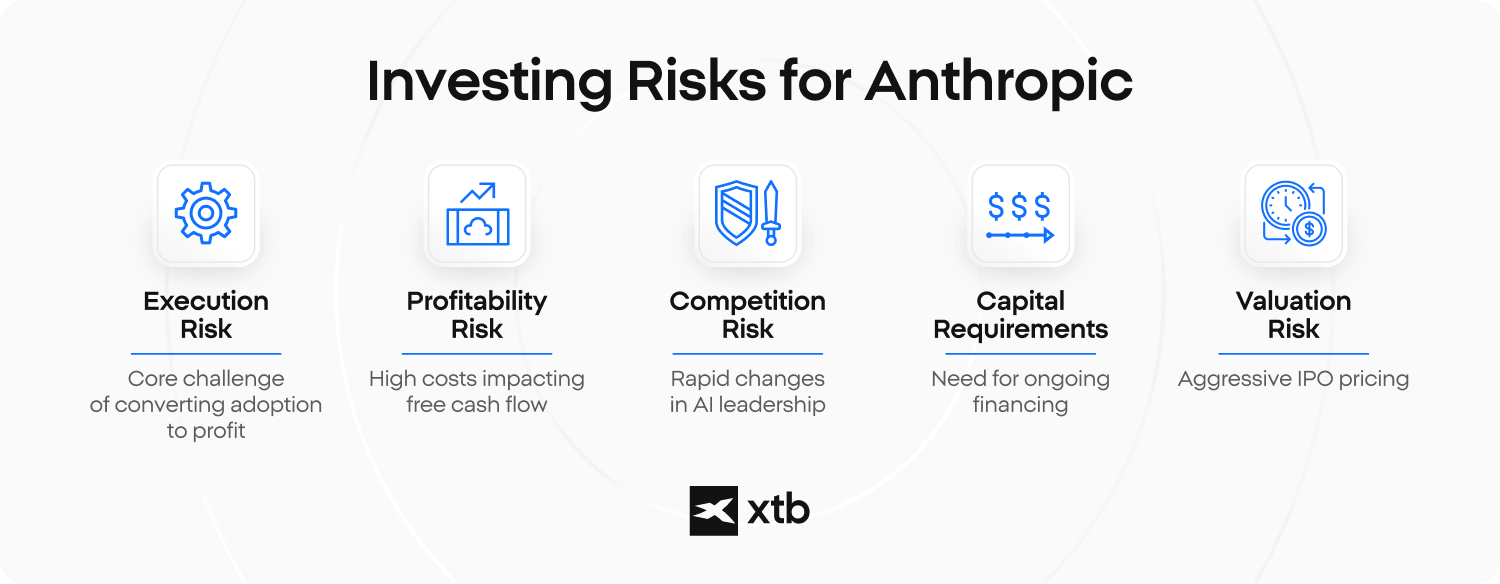
- Valuation risk: an aggressive IPO valuation could already discount years of exceptional growth.
- TAM risk: a theoretical $30 trillion market does not mean Anthropic can capture more than a small portion of it.
- Profitability risk: high cloud, chip and data-center costs may keep free cash flow below what headline revenue growth suggests.
- Competition risk: technological leadership in AI can change rapidly, potentially weakening Claude's pricing power or market share.
- Capital requirements: continued model development may require additional equity or debt financing after the IPO.
- Post-IPO volatility: limited initial float, lock-up expirations and early-investor selling can amplify price swings.
- Execution risk: Anthropic's valuation case will depend on converting strong AI adoption into recurring revenue, improving margins and eventually sustainable profitability.
FAQ

FAQ
No. Anthropic is still a privately held company, which means retail investors cannot currently buy Anthropic stock through a standard brokerage account. Direct access will only become available after the company completes an IPO and begins trading on a public exchange.
Anthropic has been preparing for a potential public debut, but no binding IPO date has been confirmed. Investors should distinguish between IPO speculation and an officially announced offering.
Anthropic could potentially go public in late 2026 or early 2027, but the timing remains uncertain. The company still needs to complete the regulatory process, publish its prospectus and decide whether market conditions are favorable enough to proceed.
The most important signs that the IPO is approaching would be:
- publication of the final S-1 prospectus,
- appointment of lead underwriters and disclosure of the exchange,
- announcement of the preliminary IPO price range.
For most retail investors, buying Anthropic shares before the IPO is difficult. Pre-IPO shares are usually available only through private secondary markets, specialized platforms or investment vehicles that may require accredited-investor status and large minimum commitments.
These transactions also involve substantially higher liquidity and pricing risks than buying a listed stock. A private transaction may additionally require company approval before ownership can be transferred.
One option is indirect exposure through publicly listed companies that own significant stakes in Anthropic. Amazon and Alphabet are among the most important strategic shareholders, although buying either stock should not be treated as a direct substitute for owning Anthropic.
The practical routes include:
- publicly traded strategic partners such as Amazon or Alphabet,
- private-market funds or SPVs where available,
- waiting for Anthropic to complete its public listing.
Anthropic's current valuation is based on private-market funding rather than a continuously traded public-market capitalization. The article cites a private valuation of around $965 billion as of September 2026.
That figure should not be confused with Anthropic's eventual IPO valuation or future share price. Public investors may assign the company a materially different valuation once detailed financial disclosures become available.
It is not possible to estimate a reliable Anthropic IPO share price before the company publishes its share count, capital structure and preliminary offering range. A company's total valuation does not directly determine the price of one share.
For example, the same company valuation can result in very different share prices depending on how many shares are outstanding. Any precise Anthropic stock-price target before those details are disclosed should therefore be treated as speculative.
Anthropic reportedly estimates its total addressable market at more than $30 trillion because it looks beyond chatbots and includes a broad range of work that could potentially be performed or assisted by AI models. The figure is higher than the $28.5 trillion TAM cited by SpaceX.
The estimate is best understood as a theoretical market opportunity rather than a revenue forecast. Its investment relevance depends on how much of that market Anthropic can realistically monetize.
Anthropic is reportedly targeting roughly $190–200 billion in annual revenue by 2028.
That target could become a key element of the IPO valuation debate, but investors will also need to consider margins, cash burn and infrastructure spending. Revenue growth alone does not determine whether an AI company can generate attractive long-term returns for shareholders.
Anthropic's ownership includes its founders, employees, venture investors and major strategic technology partners. Amazon is estimated to own roughly 19–21% of the company, while Alphabet holds around 14%.
These stakes make both companies potential beneficiaries of Anthropic's growth, but their own stock-market performance is still overwhelmingly determined by their much larger core businesses.
The main risks stem from the economics of frontier AI. Anthropic must continue spending heavily on computing infrastructure while competing with some of the largest and best-funded technology companies in the world.
Key risks include:
- high infrastructure and computing costs,
- intense competition from OpenAI, Google and other AI developers,
- uncertainty around profitability, governance and future shareholder dilution.
The company's eventual public filings will be essential for judging whether its growth rate can justify these risks.
The S-1 should provide the first comprehensive view of Anthropic's financial position. Investors should focus on revenue composition, gross margins, operating losses, cash flow, infrastructure commitments and customer concentration.
Governance will also matter. Voting rights, insider ownership and lock-up provisions can materially influence both long-term shareholder control and short-term post-IPO volatility.
It is too early to make a robust assessment because Anthropic has not yet disclosed the full financial information required to value it like a public company. The growth opportunity is significant, but so are the capital requirements and competitive risks.
The central question will be whether the IPO valuation leaves enough upside relative to the company's expected growth, profitability and cash-generation potential. A strong AI product and a huge TAM do not automatically make a stock attractively priced.