


- Markets jolted by Mid East events
- Oil price jumps, but not tripple figure oil yet
- Stocks point lower, but FTSE 100 could be supported
- Airlines, hotels and holiday stocks to take a hit
- Economic data watch
- Markets jolted by Mid East events
- Oil price jumps, but not tripple figure oil yet
- Stocks point lower, but FTSE 100 could be supported
- Airlines, hotels and holiday stocks to take a hit
- Economic data watch
Events in the Middle East are obviously dominating financial markets this morning. The Brent crude oil price is extending gains and is higher by more than 9%, stock futures are pointing lower and the gold price is higher by more than 2%. The dollar is the top performing G10 currency and sovereign bonds are also expected to attract fresh inflows later this morning.
Why moves in markets are moderate considering this situation is unprecedented
For such an unprecedented global event, the moves so far in financial markets have been moderate. This is a highly fluid situation and headline risk looms large for asset prices this week, however, stocks are moving within recent ranges, and so far, the fallout in the oil price is contained and Brent crude remains below $80 per barrel.
A few years ago, a prolonged conflict in the Middle East and one where the US and Iran were directly attacking each other and US allies, would have caused mayhem in markets and lasting damage. Instead, if the oil price maintains its 7.5% decline, this would be the 53rd largest daily decline, according to Bloomberg. Not insignificant, but certainly not a rout.
Geopolitical risk premium added to oil but no $100 oil yet
Why the relative calm in markets? For now, both sides have not targeted oil and gas infrastructure in the region, Opec announced an increase in production from next month to counter the effects of the conflict, and Iran has promised not to officially close the Strait of Hormuz. Although a tanker was struck by a drone on the Strait at the weekend, it was relatively small, and it is unclear how or who struck it. Thus, while there will be a risk premium added to the oil price, largely to cover the increase in insurance costs to transport oil through the Strait of Hormuz, we are not seeing triple figure oil on the back of this conflict.
FTSE 100 to remain an outperformer
Airline stocks, hotels and holiday companies are all expected to see large declines in their share prices, as travel to the region remains closed. The Middle East also sees 18% of air freight, which will now be impacted and could cause some supply chain disruption. In contrast, defense stocks are likely to surge. Although futures suggest that the FTSE 100 will open lower today, the UK index is set to be an outperformer, as the proliferation of defense names and oil majors help to prop up the index.
Newsflow to determine market direction
Donald Trump has said that the attacks could last for the next month, but it is unclear what the aims are. It appears that killing the Ayatollah has not wiped out the regime, and a temporary council in charge in Iran have vowed revenge. These are uncertain times, and newsflow could change the direction of markets. Volatility is likely to remain elevated at the start of this week, and if you are trading markets, watch out for the headline risk.
Macro data to watch
This week’s data may seem particularly out of date after the events over the weekend, however, there is still plenty of economic and corporate events to keep an eye on that could move the long-term dial for markets. It starts with global PMIs, before moving on to a flash ECB inflation print, a China Congress on the economic outlook, the UK’s Spring Statement and, finally, US Non-Farm Payrolls for February.
Below, we look at three events that are worth keeping an eye on in the coming days:
1, US Non-Farm Payrolls: modest jobs growth expected
The market expects a reading of 60k for February, which is less than half the 130k jobs recorded for January. US jobs growth is expected to moderate after a robust start to the year. The unemployment rate is expected to remain steady at 4.3% after falling back from 4.4% last month. There is a risk of a downside surprise, as weather -related issues could hurt jobs growth last month, after major snowstorms across the US in late January and early February may have acted as a short term hindrance to hiring. If construction and leisure and hospitality jobs are weaker than recent trends would suggest then this could be a sign that payrolls have been impacted by winter storms and investors may choose to look through this data.
After the slowest labour market outside of a recession since 2003, analysts will comb through this report to see if there are signs of stabilization in the US labour market, of if the data points to continued weakness ahead. A sluggish jobs market could weigh on consumer sentiment, and retail sales will also be released on Friday. Headline sales are expected to fall 0.3% for January, however, core sales are expected to expand at a 0.3% rate, bouncing back from a dismal -0.1% reading in December.
The double whammy of NFPs and retail sales could trigger a market reaction. Weak data may boost hopes of a faster pace of rate cuts from the Fed. There are currently 2.4 rate cuts expected from the Fed this year, with the first cut expected by June. If the data is weak, then we could see the market shift to pricing in a third cut in the back end of this year. The impact on the dollar will depend on if it is still a safe haven of choice post the conflict in the Middle East.
2, Europe: inflation steady for Feb
It’s a big week for inflation data. Eurozone inflation data is expected to remain at 1.7% for February, the weakest level since September 2024. Italy and France have very low inflation levels, which is weighing on the aggregate index. However, we do not think that this week’s data will be enough to move the dial for ECB rate cut expectations. There is less than 1 rate cut from the ECB currently priced in by the interest rate futures market for this year. We do not think that this data will change the picture too much, especially if we see a large bump higher in the oil price at the start of this week.
Elsewhere, German factory orders are also released this week, and the focus will be on whether defense and infrastructure stimulus from Berlin is feeding through to this data and whether it will boost growth in the near term. Although the annual rate of growth is strong, factory orders are expected to have plunged 4% at the start of this year. This index can be volatile, but a stronger than expected number could give the euro a little boost.
EUR/USD fell through the 50-day sma at the end of last week, as a wave of AI angst gripped markets and caused a burst of risk aversion. At the start of this week, we will be watching to see if EUR/USD can stay above the 200-day sma at $1.1650, as the dollar is likely to catch a safe haven bid.
3, Reeves’ Spring Statement in focus, but likely to be overshadowed by events in Middle East
The focus for the UK this week will be the Spring Statement and the updated OBR forecasts. As we mentioned in our preview, there could be some good news on the public finances, with borrowing for this fiscal year expected to be slashed by 20%. The bond market has benefitted from this in recent weeks, and in February, Gilts were the top performing global sovereign bond.
A subdued growth outlook is also expected, and the OBR may sound a warning on the unemployment rate. A rapid increase in unemployment could hurt the UK’s fiscal outlook and the amount of available headroom if it limits tax receipts and also increases the bill for unemployment benefits.
Private sector activity could be a bright spot. The UK’s composite PMI is expected to come in at 53.9 for last month, the highest level since April 2024. The FTSE 100 hit another record high at the end of last week, and we expect the FTSE 100 to be another top performer this week. Its strong mix of energy firms, materials and defense stocks are likely to be well supported in the current environment, and 11,000 is now in view for the UK index.
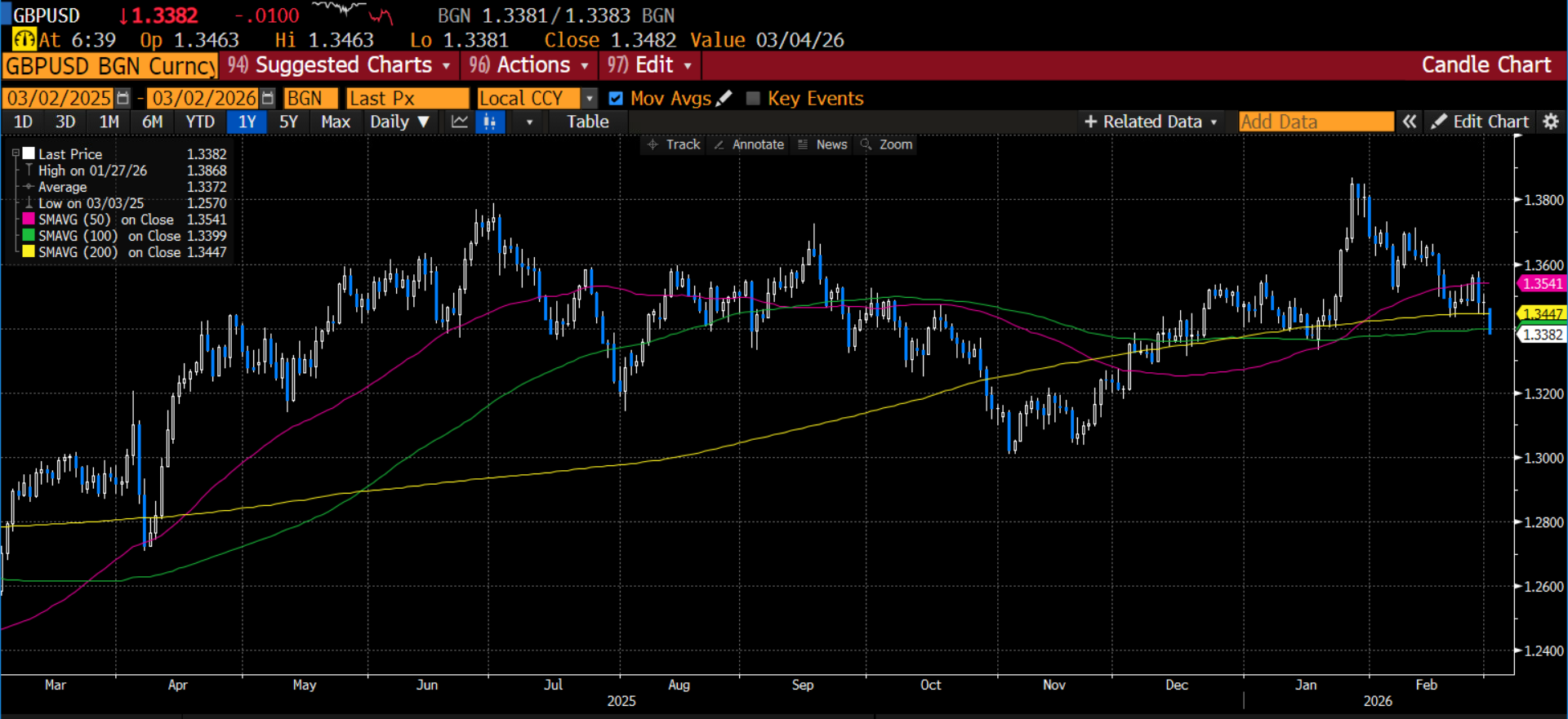
The pound has been battered by a weak showing for the Labour party in the Gorton and Denton by election last week and a resurgent dollar on the back of the US/ Iran conflict. GBP/USD fell through its 200-day sma at the end of last week, and is trading just above $1.3550. The risk is that a strong dollar pushes this pair back towards $1.3330, the low from 20th January.
Chart 1: GBP/USD, a resurgent dollar has weighed on the pound, but losses for sterling have been modest so far.
Source: XTB and Bloomberg


Sentiments on Wall Street are falling 📉S&P 500 earnings season highlight


BREAKING: Euro area manufacturing PMIs for February broadly confirmed a return to modest expansion

Economic calendar: PMI data in focus 💡



OIL and GOLD gain on Middle East tension ⚔️
This content has been created by XTB S.A. This service is provided by XTB S.A., with its registered office in Warsaw, at Prosta 67, 00-838 Warsaw, Poland, entered in the register of entrepreneurs of the National Court Register (Krajowy Rejestr Sądowy) conducted by District Court for the Capital City of Warsaw, XII Commercial Division of the National Court Register under KRS number 0000217580, REGON number 015803782 and Tax Identification Number (NIP) 527-24-43-955, with the fully paid up share capital in the amount of PLN 5.869.181,75. XTB S.A. conducts brokerage activities on the basis of the license granted by Polish Securities and Exchange Commission on 8th November 2005 No. DDM-M-4021-57-1/2005 and is supervised by Polish Supervision Authority.