

- Federal investigation of Powell and the Fed knocks risk sentiment
- Concerns grow about Fed independence as gold hits a record
- Are markets expecting Trump to scale back his rhetoric?
- Trump widens sphere of influence to domestic matters and the US private sector
- Trump wants lower interest rates, while taking stances that could push them up
- Oil traders ignore supply issues, for now
- US payrolls puts to bed hopes of a January Fed rate cut
- Q4 earnings season: banks report monster 2025 earnings, but risks linger
- More French political risk
- Economic data watch
- Federal investigation of Powell and the Fed knocks risk sentiment
- Concerns grow about Fed independence as gold hits a record
- Are markets expecting Trump to scale back his rhetoric?
- Trump widens sphere of influence to domestic matters and the US private sector
- Trump wants lower interest rates, while taking stances that could push them up
- Oil traders ignore supply issues, for now
- US payrolls puts to bed hopes of a January Fed rate cut
- Q4 earnings season: banks report monster 2025 earnings, but risks linger
- More French political risk
- Economic data watch
As we move through January, two things stand out. The first is geopolitics and America’s expansionist foreign policy, the second is Trump’s moves at home. Overnight, news broke that US prosecutors are launching a criminal investigation into Fed chair Jerome Powell, ostensibly over renovations of Federal Reserve buildings.
Powell has hit back at President Trump and claimed the investigation is because the Fed is resisting pressure from the President to cut interest rates at a faster pace. Powell said that he would stand firm in the face of threats.
Sell America trade back in focus
The gold price surged to a record, and is testing $4,600 an ounce, the silver price is also higher by 5% as precious metals benefit from a fresh bout of risk aversion. The dollar is lower, and the ‘sell America’ trade could come back into focus, as investors question once more the independence of the Fed.
Confidence in new Fed pick to be low
Jerome Powell’s term is up in May, the latest move by Trump means that the market will have low confidence in the new Fed chair being independent from the White House. Financial markets are also giving a thumbs down to Trump’s latest move, and after a strong performance last week, US and most European equity index futures are pointing to a lower open later this morning. The markets could send a message to the President this week: an interventionist foreign policy is one thing, but interfering too much at home is not welcome. Get ready for the first bout of volatility in 2026.
The President’s Donroe doctrine has also been front and centre this year. Last week it was the overthrowing of Maduro in Venezuela, then the President’s focus shifted to Greenland and further East to protests in Iran and US strikes on ISIS targets in Syria. Donald Trump’s focus on foreign expansionism, and the ‘Donroe’ doctrine, are turning out to be key features of the President’s second term in office.
2026 is already a year of great change, but markets remain resilient
The world is standing on the precipice of great change at the start of 2026. Understanding how this turns out could be crucial for investors in the medium term. The US is no longer the beacon of stability that upheld a rules-based system that dominated the western world for the post second world war period. A strong-man US that stands up to the likes of China, Iran and Russia could have many consequences for the global economy and financial markets.
Are markets expecting Trump to scale back his rhetoric?
However, at this stage it is too early to know what Trump’s ultimate goal will be. Up until now, financial markets have been able to absorb the geopolitical risk that has materialized in the opening weeks of 2026, and global stock markets had a strong start to the new year. This does not mean that markets will ignore geopolitics for good. Rather, it could be a sign that investors and traders are not discounting everything that Trump says because they expect him to scale back his rhetoric, especially some of his more inflammatory commentary, for instance around Greenland, and eventually focus on domestic issues. November’s mid-term elections are not that far away, and they tend to be tough for a sitting President and their party, especially one that is focused too much on external issues.
Trump’s interventionist approach towards the private sector
The second factor that investors need to account for is Trump’s series of demands on US industry and business. Just last week, President Trump said that he would stop defense contractors from engaging in share buybacks and dividends, he said that he would put in place a cap on interest rates charged by credit card companies for one year starting on Jan 20th, he publicly claimed that US oil companies would invest billions of dollars into Venezuela, he said that he would ban institutional investors like Blackstone from buying family homes and he also singled out the ‘cultural takeover’ of Netflix in a Truth Social post at the weekend.
An interventionist approach to the private sector is a huge departure for Trump and suggests that his second term as President could be notable for moving away from core Republican capitalist values, which includes leaving the private sector alone. Trump instead wants the US private sector to sort out the affordability crisis in the US for him. He is expected to formally announce the credit card interest rate cap at Davos next week. The US is also shifting rapidly on Donald Trump’s watch, and this could have big implications for financial markets.
The banking sector underperformed the broader market on Friday, as credit card companies came under Donald Trump’s glare and we will be watching to see how this sector performs later this week as we wait for bank earnings, see more below, and any fallout from Trump’s interest rate cap. JP Morgan, American Express, Bank of America and Citi are the US’s biggest credit card providers and their stock prices could get some heat at the start of this week.
Trump wants lower interest rates, while taking stances that could push them up
Added to this, Donald Trump’s two-pronged policy approach could prove to be contradictory. He is trying to limit cost of living increases through capping interest rates, this includes getting Fannie Mae and Freddie Mac to buy $200bn of mortgage-backed securities, yet his foreign policy goals and plans for increased spending on defense could push up the US deficit and ultimately push up interest rates. The impacts of Trump’s new policies are complex, and it is no surprise that, for now, the markets are willing to look through the murky political landscape that we find ourselves in. An example of this is that US bond yields barely budged last week.
Oil traders ignore supply issues, for now
Energy markets have been in focus in recent weeks as geopolitics take centre stage. If there is regime change in Iran, then this could lead to more oil flowing around the world as sanctions on Iran’s oil shipments would most likely be removed. Added to this, the US capture of Maduro has led to hopes, especially in the White House, that the country can exploit its vast oil reserves.
So far, oil prices have been extremely resilient to the prospect of a shift in supply dynamics. The oil price has had a strong start to 2026, Brent crude is higher by more than 4% this month, while WTI is higher by nearly 3%. It was also given a helping hand by oil executives who met with the President on Friday. They seemed lukewarm on the idea of investing up to $100bn in Venezuela’s oil infrastructure as Trump has requested. They cited security concerns, political instability and past experiences where assets have been seized as reasons for caution when it comes to stepping back into Venezuela. WTI and Brent crude rallied more than 2% on this news, as it removes one source of extra supply, for now, at least.
US payrolls puts to bed hopes of a January Fed rate cut
There is so much going on in the world right now, we need to remind ourselves to focus on fundamentals, including economic data and the Q4 earnings season, which will start with gusto this week. Last week was a key macro stress test for markets, topped off with US payrolls. A weaker reading on payrolls was balanced out by a steeper fall in the unemployment rate. The market focused more on the decline in the unemployment rate rather than the weak payrolls number, and the chance of a January rate cut from the Federal Reserve is slipping away. There is now a 5% chance of another cut, although this only had a mild impact on financial markets, with the Dow Jones underperforming the S&P 500 on Friday but still managing to eke out a strong 2.3% gain for the week.
Below we take a look at the three main events for market watchers this week.
1, Q4 earnings season: banks to report monster 2025 earnings
The banks kick off US earnings season this week. JP Morgan and Bank of New York will report 2025 earnings on Tuesday, Citigroup and Bank of America are on Wednesday, and Goldman Sachs, Blackrock and Morgan Stanley will report on Thursday.
For this earnings season, the tech sector is not taking centre stage. The 6 biggest banks in the US are expected to post their second-highest annual profit ever for 2025, with $157bn expected by market analysts. However, Q4 could see some of the trading boom that powered earnings at the biggest US investment banks taper off in the final months of last year, so the market reaction to big profits could be tempered.
The KBW US banking Index has surged 19% in the past 6 months, but it has underperformed other sectors, including semiconductors, at the start of this year. However, banking stocks could get a boost if JP Morgan, Citi and Bank of America do not think that Trump’s planned intervention in the credit card market will have a long-term impact on their business.
As mentioned, this year is not all about tech. Profit growth for the magnificent 7 tech stocks is expected to slow for Q4, and questions continue to be asked about the long-term profit impact from hundreds of billions of AI capex spending. Analysts are expecting profit growth to increase by 18% in 2026, the slowest pace since 2022, when tech stocks sold off sharply. The rest of the S&P 500 is expected to see 13% profit growth this year. Although tech is still profitable, the gap between it and other sectors of the US market is narrowing, which is helping to broaden the stock market rally. On the plus side, this is reducing valuations for the sector, which now stand at 29 times earnings, only marginally higher than the Nasdaq’s P/E ratio, which is 25 times earnings.
Overall, earnings season will be closely watched this week and may take the focus away from geopolitics.
2, More French political risk
Europe’s bond market will be in focus this week, specifically French bond yields, as the fragile government faces more confidence votes that could scupper the chances of getting a Budget passed until after municipal elections in March. The 2026 Budget is already overdue, and President Macron is reported to have said that if the government topples this week, he will call another snap election.
President Macron did this last year, and it caused months of bond market volatility for France. The Cac 40 also underperformed its European counterparts last year, partly as a result of political risks.
French bond yields followed the European trend lower last week, however, they have underperformed US and UK bonds for the last 6 months, as budget woes weigh on investor sentiment. Thus, if the French government does collapse, and if fresh elections are called, then we could see more upward pressure on French borrowing costs at a difficult time for the global economy.
3, Economic data watch
The key event to watch in the US this week includes the CPI report for December. The market is expecting a 0.3% increase on the month, and the annual rate of both core and headline CPI to remain at 2.7%, after a sharp fall in price growth in November. Some argue that inflation is running hotter than this, and November’s moderation in price growth was due to the effects of the government shutdown. Thus, the whisper as we lead up to Tuesday’s report is that the actual CPI rate could be slightly higher than expected.
Although we could see some upward pressure on prices in the US, retailers have reported slashing prices in the holiday season and tariff pass through has been milder than expected. Overall, US economic activity is rising and inflation is moderating because of productivity gains. If this continues, then we could see weaker inflation without this being an issue for economic growth. US retail sales and initial jobless claims will also be watched closely.
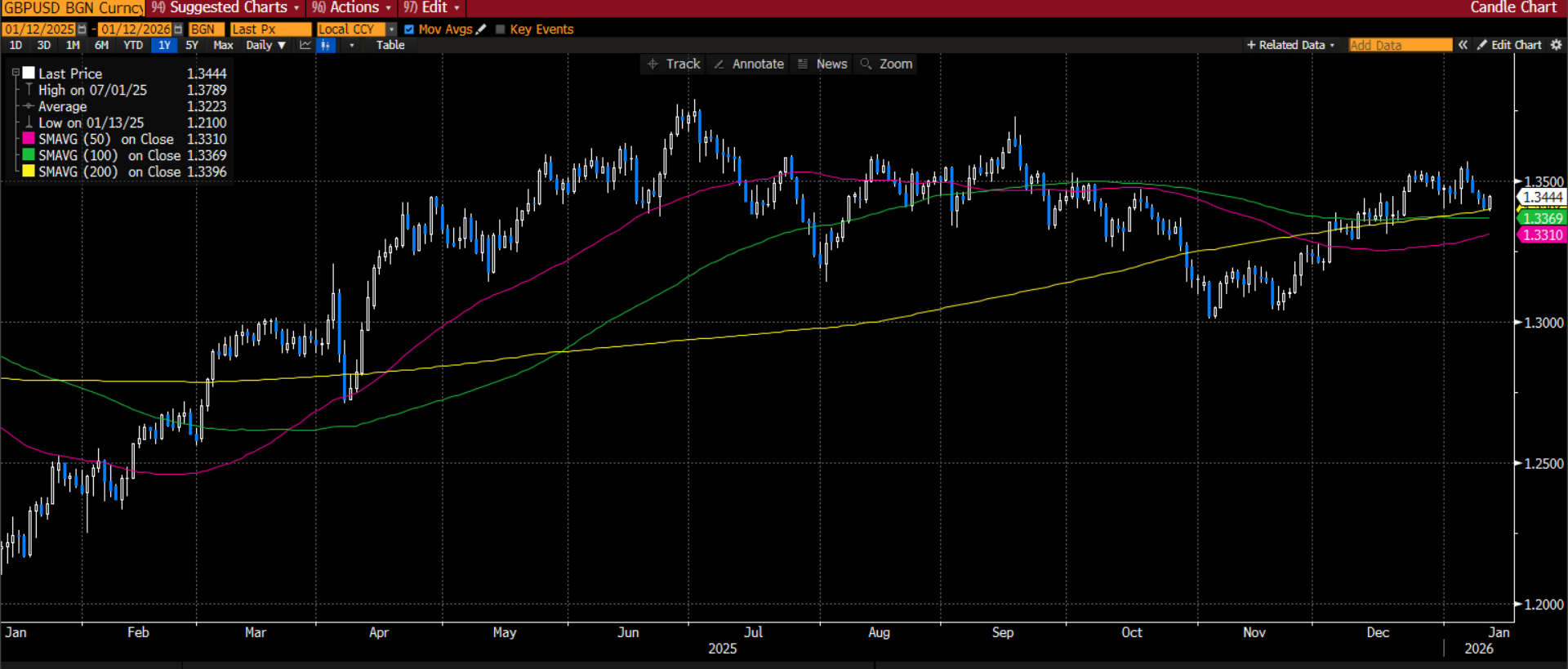
In the UK, monthly GDP for November is expected to pick up to 0.1% from a -0.1% reading in October. A downside surprise could lead to an increase in fears that a recession is coming to the UK, which could weigh on UK shares, especially small caps, which have so far remained resilient to UK growth fears. The pound could also come under pressure. It was the second weakest performer in the G10 FX space last week and fell more than 1% vs. the USD. It slipped below $1.34 and tested the 200-day sma. It has bounced above this level as the dollar has weakened on Monday, but the monthly GDP report could still have a negative impact on sterling later this week.
Chart 1: GBP/USD
Source: XTB and Bloomberg


US Open: Powell in Trouble, Wall Street in the Red


U.S. Banks Kick Off Earnings. What Can We Expect? 📊

⏫Silver surges nearly 7%


Defense Companies in 2026 – Who stands to gain or lose?
This content has been created by XTB S.A. This service is provided by XTB S.A., with its registered office in Warsaw, at Prosta 67, 00-838 Warsaw, Poland, entered in the register of entrepreneurs of the National Court Register (Krajowy Rejestr Sądowy) conducted by District Court for the Capital City of Warsaw, XII Commercial Division of the National Court Register under KRS number 0000217580, REGON number 015803782 and Tax Identification Number (NIP) 527-24-43-955, with the fully paid up share capital in the amount of PLN 5.869.181,75. XTB S.A. conducts brokerage activities on the basis of the license granted by Polish Securities and Exchange Commission on 8th November 2005 No. DDM-M-4021-57-1/2005 and is supervised by Polish Supervision Authority.