
- The Chancellor remains committed to her fiscal rules
- No broad-based support for household energy bills
- Ultimately Trump and co. have more power over what happens to energy bills than Rachel Reeves
- Global bond yields rise; stocks fall as energy prices rise again
- The Chancellor remains committed to her fiscal rules
- No broad-based support for household energy bills
- Ultimately Trump and co. have more power over what happens to energy bills than Rachel Reeves
- Global bond yields rise; stocks fall as energy prices rise again
Rachel Reeves has addressed the commons about the energy price spike and her main message is that she remains committed to her fiscal rules. Reeves said that any support with energy bills will be limited to those who need it most, she is also focusing on price gouging at petrol pumps.
She will also ask banks and supermarkets how they can help with rising costs. Presumably, she will ask them to refrain from putting up prices or interest rates for borrowers. However, this is a big ask since commodity prices and interest rates are generally set by global financial markets.
The government has already announced that it will not put up fuel duty for the fiscal year 26/27, which usually rises by the rate of inflation each year. This could have a limited dampening impact on the UK’s CPI rate, but it will likely be cancelled out by broad rises in commodity prices that are set on global markets.
The Chancellor was not only addressing the electorate today; she was also speaking to the bond market. She was clear: the UK’s fiscal rules are iron clad, and borrowing will not be used to protect better off households. Where the line is drawn for support for the neediest in UK society is not known, and she is likely to face plenty of pressure from her back benchers to ensure that the safety net is cast wide.
Reeves would rather use the Competition and Markets Authority, rather than an energy subsidy for all, to navigate the UK through this crisis. But with prices already rising sharply at the pump, and with more to follow, this could be a losing battle. If the conflict is not concluded quickly and if the oil price remains above $100 per barrel for Brent crude for the long term, then we may get yet another of Labour’s infamous U-turns.
The structure of the UK’s energy pricing market is also at play here. The energy price cap, which affects 19 million households in England and Scotland, will be lowered at the start of April. However, this 7% decline from next month is expected to be a temporary reprieve, since the price cap is set to be lifted in July, in line with rising energy prices. This buys the chancellor some time, but if the conflict does come to an end in the next few weeks, the effects of rising energy prices will still be felt in the UK economy for many months. Thus, households may be shielded from the worst of the energy price increases, but pain is coming down the line. Added to this, businesses are not impacted by the energy price cap, and are already seeing their input costs rise at the fastest rate for more than 30 years, according to the March PMI report.
There was notably no offer of help for businesses, from the government today, which is likely to cause a backlash. The government has already reduced business rates for pubs and live music venues earlier this year, so the bar for further help could be high.
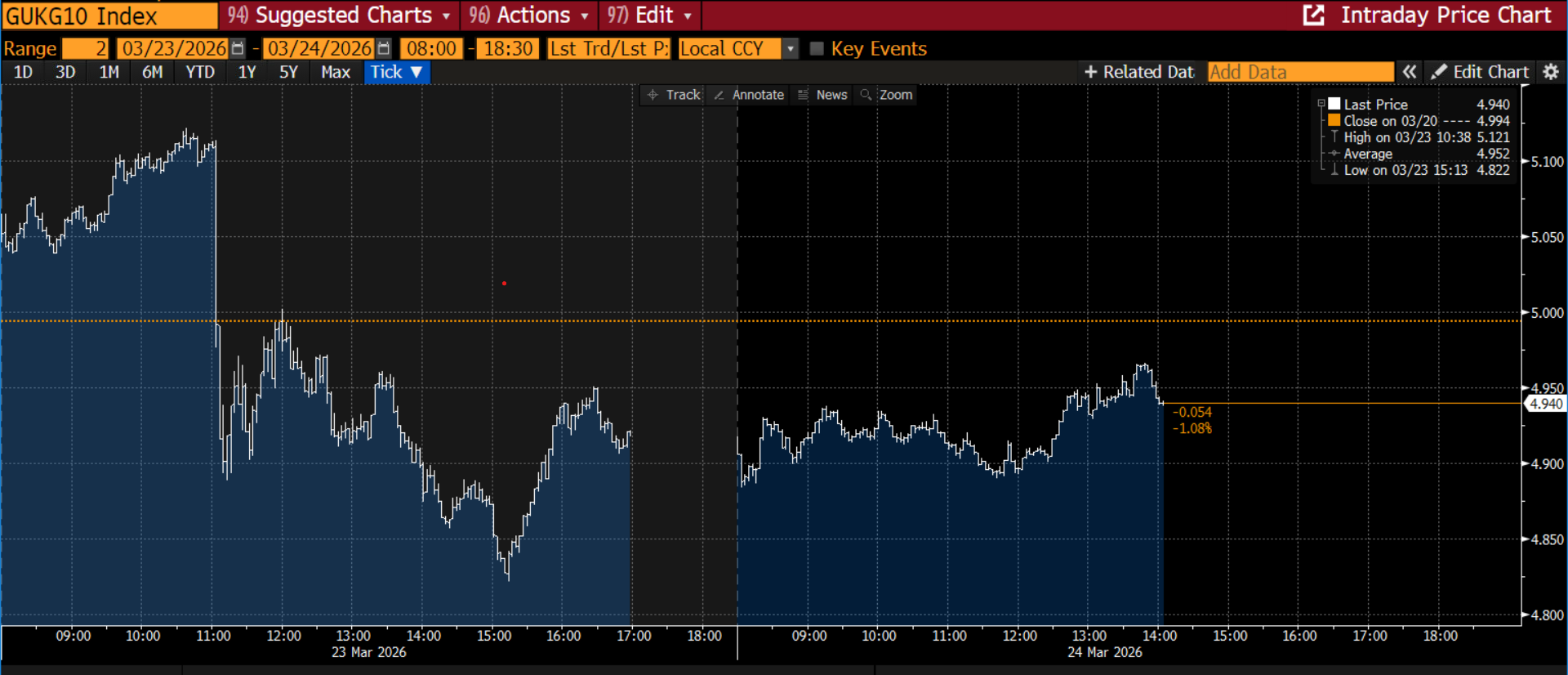
It’s a thankless job being the Chancellor, and Reeves seems to stumble from one crisis to another. She cannot control what happens in the Middle East and this is playing havoc with financial markets. Although the Chancellor was clear that she will not breach her fiscal rules to help subsidize energy bills, UK Gilt yields are rising once again on Tuesday, albeit by a lower rate than last week. This part of a broader move higher in global yields, as Monday’s respite gets unwound on Tuesday. The oil price is back above $103 per barrel for Brent crude this afternoon, after reports emerged that Saudi Arabia wants the US to continue with the war against Iran.
Overall, Donald Trump can offer more help to UK consumers and businesses than the Chancellor can by ending this war quickly and getting the Strait of Hormuz fully open once again. However, as today’s price action shows, starting a war is the easy part, ending one is much harder. This is why Chancellor Rachel Reeves is extremely limited in what she can do, especially if the government is refusing to open up the North Sea for more oil and gas extraction.
Chart 1: Short term chart, UK 10-year bond yield
Source: XTB and Bloomberg


What else might we be missing from the Persian Gulf❓


📈 US500 attempts a rebound

Wall Street under pressure again 📉IT stocks fall, oil & gas sector surge

Mixed US PMI data 🗽EURUSD gains
This content has been created by XTB S.A. This service is provided by XTB S.A., with its registered office in Warsaw, at Prosta 67, 00-838 Warsaw, Poland, entered in the register of entrepreneurs of the National Court Register (Krajowy Rejestr Sądowy) conducted by District Court for the Capital City of Warsaw, XII Commercial Division of the National Court Register under KRS number 0000217580, REGON number 015803782 and Tax Identification Number (NIP) 527-24-43-955, with the fully paid up share capital in the amount of PLN 5.869.181,75. XTB S.A. conducts brokerage activities on the basis of the license granted by Polish Securities and Exchange Commission on 8th November 2005 No. DDM-M-4021-57-1/2005 and is supervised by Polish Supervision Authority.