


Brent crude futures continued to decline on Thursday, approaching the $70 per barrel level and erasing virtually all of the gains triggered by the conflict between the United States and Iran. Investors are increasingly pricing in a lower risk of prolonged supply disruptions, with attention shifting back to market fundamentals, including U.S.-Iran negotiations, the upcoming OPEC+ meeting, and the outlook for global oil demand. Another factor helping calm the market is the gradual normalization of tanker traffic through the Strait of Hormuz, one of the world's most critical energy shipping routes.
Market prices in de-escalation
Brent crude fell to around $70.7 per barrel, its lowest level since before the outbreak of the U.S.-Iran conflict. U.S. benchmark WTI crude also declined, slipping below $67 per barrel.
During the conflict, both benchmarks rallied sharply as geopolitical risk premiums surged. However, most of those gains have now been erased following the 60-day ceasefire and the start of indirect negotiations aimed at reaching a lasting agreement.
Strait of Hormuz helps ease supply concerns
One of the strongest drivers behind the recent decline in oil prices has been improving conditions in the Strait of Hormuz. Tanker traffic through the strategic waterway has continued to recover, reducing concerns about potential disruptions to global energy supplies.
Before the conflict, roughly one-fifth of the world's oil and petroleum exports passed through the Strait, making any change in regional tensions an important driver of oil prices.
U.S. inventories fail to support prices
Additional downside pressure followed the latest report from the U.S. Department of Energy.
Crude oil inventories declined by around 2 million barrels, but the drawdown was smaller than the market had anticipated.
The data reinforced the view that the global oil market remains relatively well supplied, limiting the case for another leg higher in crude prices.
OPEC+ may increase production again
The next major event for the oil market will be this weekend's OPEC+ meeting.
According to media reports, the producer group is expected to increase output quotas by approximately 188,000 barrels per day starting in August. If confirmed, it would mark the fifth consecutive monthly production increase, reflecting OPEC+'s strategy of gradually restoring supply as prices ease.
Meanwhile, OPEC recently lowered its 2026 global oil demand growth forecast for a second consecutive month, cutting its estimate from 1.17 million to 970,000 barrels per day. Despite the downgrade, the organization continues to expect the global economy to remain resilient despite geopolitical uncertainty.
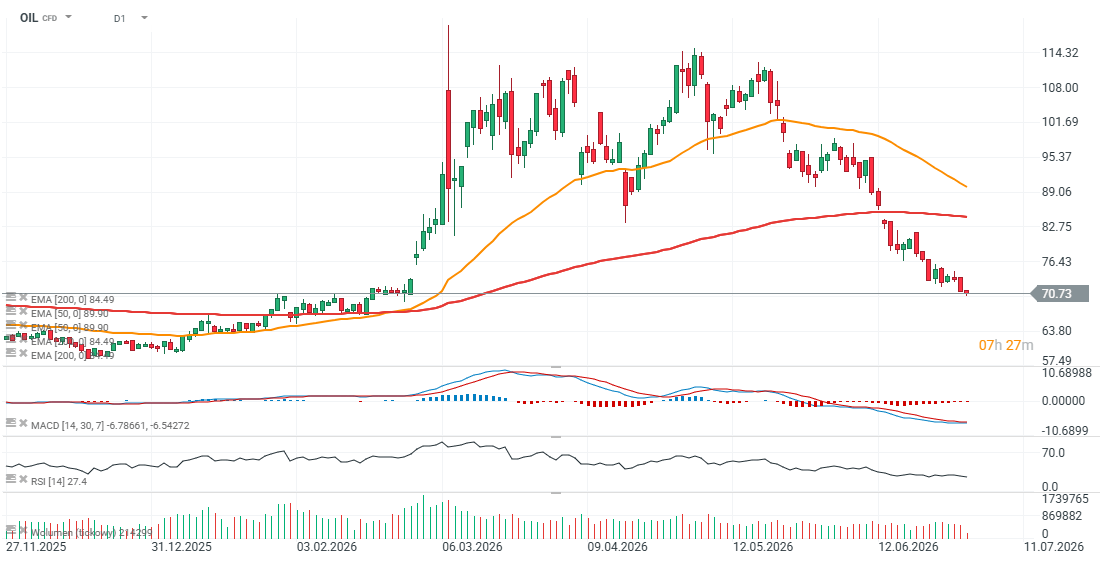
Focus shifts back to macroeconomics as the oil chart turns increasingly bearish (OIL, D1)
With geopolitical tensions easing, investors are once again focusing on central bank policy and the inflation outlook. Lower oil prices reduce the risk of renewed inflationary pressures, potentially allowing central banks to maintain a less restrictive monetary stance.
The coming weeks will determine whether negotiations between Washington and Tehran can produce a lasting agreement. If de-escalation continues and OPEC+ delivers another production increase as expected, crude oil could remain under pressure through the second half of the summer.
From a technical perspective, the picture has also become increasingly challenging for oil bulls. The OIL contract is down around 0.6% today, while the Relative Strength Index (RSI) has fallen to 27, signaling deeply oversold conditions following the sharp decline from the $115–120 per barrel area.
Source; xStation5


US100 falls almost 2% 🚩 Semiconductor stocks plunge as SanDisk tumbles 13%


📈 Bitcoin climbs above $62K


EIA Natural gas inventories change higher than expected


US Open: Nasdaq surges amid semiconductor rebound 🔼 Tesla shares down despite strong deliveries report
This content has been created by XTB S.A. This service is provided by XTB S.A., with its registered office in Warsaw, at Prosta 67, 00-838 Warsaw, Poland, entered in the register of entrepreneurs of the National Court Register (Krajowy Rejestr Sądowy) conducted by District Court for the Capital City of Warsaw, XII Commercial Division of the National Court Register under KRS number 0000217580, REGON number 015803782 and Tax Identification Number (NIP) 527-24-43-955, with the fully paid up share capital in the amount of PLN 5.869.181,75. XTB S.A. conducts brokerage activities on the basis of the license granted by Polish Securities and Exchange Commission on 8th November 2005 No. DDM-M-4021-57-1/2005 and is supervised by Polish Supervision Authority.
