


RBNZ: hawkish hold
The RBNZ delivered a decision that the market interpreted as a classic “hawkish hold.” The Official Cash Rate (OCR) was kept unchanged at 2.25%, but only after a rare 3–3 split within the Monetary Policy Committee. Governor Anna Breman, Karen Silk, and Paul Conway voted to keep rates unchanged, while Carl Hansen, Hayley Gourley, and Prasanna Gai supported an immediate 25 bp hike to 2.50%. Breman’s deciding vote left policy unchanged, but the broader message was clear: the easing phase is over, and the next move will be upward. The RBNZ explicitly stated that the OCR will need to rise sooner and by more than the bank expected as recently as February.
A more challenging macroeconomic environment
The macroeconomic backdrop has become significantly more complicated. The central bank is now dealing with a negative supply shock stemming from the Middle East conflict — primarily through higher oil, gas, and petrochemical prices — while domestic demand is already beginning to weaken. Inflation is now expected to peak at 4.3% in Q3 2026, with a return to the 2% inflation target not expected until mid-2027. At the same time, business and consumer sentiment indicators, housing market activity, and corporate hiring plans have all deteriorated.
In practice, this means that the RBNZ is facing a difficult combination of factors:
-
inflation risks are clearly higher, especially if firms and workers begin treating the energy shock as permanent;
-
growth risks are clearly lower, as higher fuel costs reduce real incomes, margins, and consumption;
-
spare capacity and elevated unemployment should partially limit second-round effects, but not enough for the bank to ignore the risk of inflation becoming entrenched.
Implications for investors
The key takeaway for investors is that the decision was not dovish despite rates being left unchanged. All six MPC members agreed that rate hikes at upcoming meetings will likely be necessary to prevent short-term inflation from feeding into medium-term inflation expectations. The updated rate path points to a significantly more restrictive stance in the future, and market commentary suggests a high probability of hikes at the July, September, and October meetings.
New Zealand dollar reaction
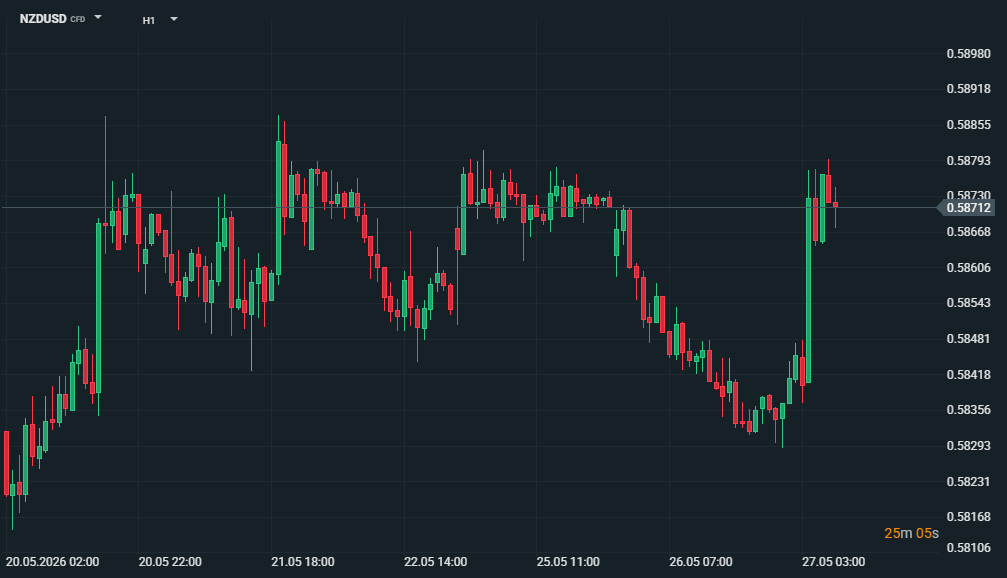
The New Zealand dollar reacted with gains. The market focused more on the hawkish forward guidance than on the hold itself. NZDUSD rose 0.70% toward the 0.5870 area following the decision release. Such a reaction is logical: the split vote, higher OCR path, and clear suggestion that hikes are likely later this year support the currency through expectations of wider interest rate differentials.
At the same time, the upside potential may not be one-directional. The same statement also emphasized weaker domestic growth, fragile economic sentiment, and risks to activity, while the RBNZ itself pointed to high volatility in the trade-weighted NZD exchange rate.


Oil extends losses and tests local lows 🚩 Piper Sandler bets on a rebound



UK Gilts brush off rising energy price cap, as US stocks reach fresh record highs

Economic Calendar: Richmond Fed Index and interesting companies' results ahead 🔎



Morning wrap (27.05.2026)
This content has been created by XTB S.A. This service is provided by XTB S.A., with its registered office in Warsaw, at Prosta 67, 00-838 Warsaw, Poland, entered in the register of entrepreneurs of the National Court Register (Krajowy Rejestr Sądowy) conducted by District Court for the Capital City of Warsaw, XII Commercial Division of the National Court Register under KRS number 0000217580, REGON number 015803782 and Tax Identification Number (NIP) 527-24-43-955, with the fully paid up share capital in the amount of PLN 5.869.181,75. XTB S.A. conducts brokerage activities on the basis of the license granted by Polish Securities and Exchange Commission on 8th November 2005 No. DDM-M-4021-57-1/2005 and is supervised by Polish Supervision Authority.
