

- European indices opened Friday higher, with the Euro Stoxx 600 and Euro Stoxx 50 gaining around 0.4% and 0.5%, respectively, even as elevated bond yields and higher oil prices remain key risks for valuations.
- Eurozone data are moderately supportive for the market: the composite PMI rose to 52.1, while manufacturing rebounded strongly, particularly in Germany.
- Investors are also focusing on the relative strength of commodities, precious metals and Bitcoin.
- CTS Eventim is trading lower despite solid results: second-quarter revenue rose by around 13% year over year. What did the company reveal?
- European indices opened Friday higher, with the Euro Stoxx 600 and Euro Stoxx 50 gaining around 0.4% and 0.5%, respectively, even as elevated bond yields and higher oil prices remain key risks for valuations.
- Eurozone data are moderately supportive for the market: the composite PMI rose to 52.1, while manufacturing rebounded strongly, particularly in Germany.
- Investors are also focusing on the relative strength of commodities, precious metals and Bitcoin.
- CTS Eventim is trading lower despite solid results: second-quarter revenue rose by around 13% year over year. What did the company reveal?
European indices opened Friday’s session higher, with the Euro Stoxx 600, Euro Stoxx 50 and DAX gaining around 0.4–0.5%, although they may still end the week with a second consecutive decline. The gains are accompanied by a cautious rebound in Wall Street index futures, with US100 up more than 0.3%. The biggest strategic problem for markets remains high bond yields — the relief following the U.S. Treasury’s actions faded quickly, and even Scott Bessent’s comments yesterday about potentially larger interventions than previously indicated failed to provide meaningful support to bonds. Higher oil prices are adding another layer of pressure, driven by the stalemate around the Strait of Hormuz and tougher rhetoric from Washington toward Iran. Despite all this, equity indices are holding up surprisingly well. One theme attracting increasing attention is the “return to hard assets”, with Bitcoin and precious metals among the assets performing relatively well.
- Eurozone data are better than individual readings from France and Germany might suggest. The composite PMI rose to 52.1, with manufacturing performing particularly well, especially in Germany. Services remain the weaker part of the picture, with readings in both of the region’s largest economies falling below 50. At the same time, lower inflation expectations could give the ECB slightly more room for manoeuvre, making the overall setup moderately supportive for European assets.
- U.S. Treasury yields are rising again, even though Scott Bessent suggested that debt buybacks could be increased further and mentioned the possibility of fiscal consolidation.
- Basic resources are the strongest sector, gaining around 1.5%, supported by a weaker U.S. dollar and higher gold prices, with bullion up nearly 1% today and approaching $4,600 per ounce.
- The situation around Iran is creating additional pressure. Bessent announced the “toughest sanctions in history,” reducing hopes for a rapid and full reopening of the Strait of Hormuz.
- Oil is trading slightly lower after the rollover but remains above $90. More expensive energy is once again increasing inflation risks, putting upward pressure on yields and potentially weighing on margins in parts of the corporate sector.
- ASML is gaining around 1.5% despite reports surrounding potential U.S. efforts to take further steps in the sector.
- Germany and the broader eurozone are issuing record amounts of debt, adding to upward pressure on bond yields. The yield on 30-year German Bunds has reached around 3.8%, the highest since 2011, while long-term French yields are close to 5%. Higher financing costs mean more expensive borrowing for governments, companies and households, which could eventually act as a drag on economic activity.
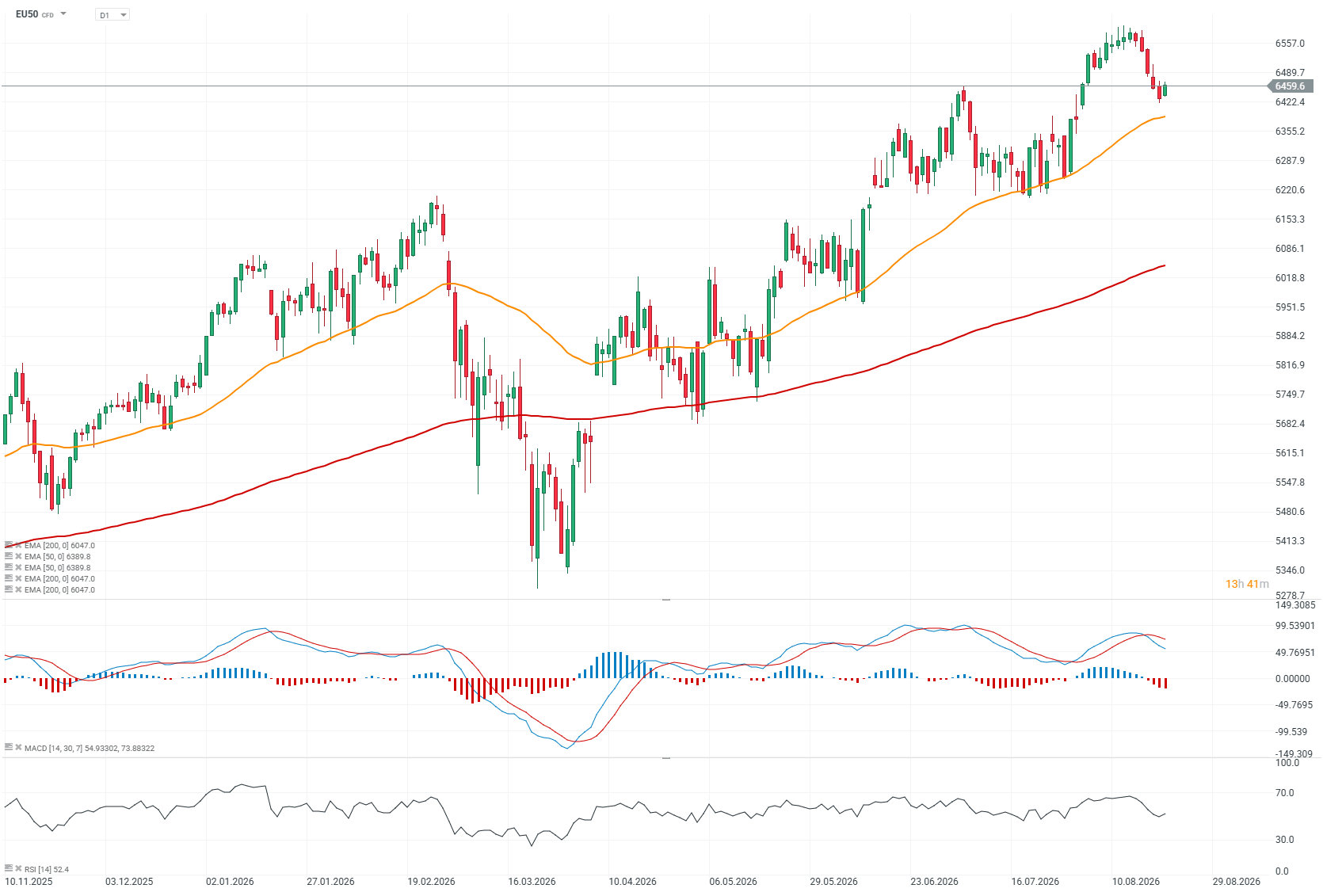
EU50 chart (D1 interval)
Bulls in Euro Stoxx 50 futures are clearly trying to reclaim the 6,500-point area. The EMA50, shown by the orange line, provides an important support zone around 6,400 points, while the 6,600 area, corresponding to the latest highs, remains the key medium-term resistance.
 Source: xStation5
European macro data
- The eurozone flash composite PMI rose to 52.1 in August versus expectations of 51.7, pointing to a somewhat stronger pace of economic activity.
- The French manufacturing business climate index rose to 103 points, above expectations of 101 and the previous reading of 101.
- France’s flash manufacturing PMI increased to 51.5 from 49.8, beating the 50.0 consensus and moving back above the expansion threshold.
- France’s flash services PMI fell to 48.4, below expectations of 49.4 and the previous reading of 49.6.
- The French flash composite PMI slipped to 48.8 versus 49.5 expected and 49.4 previously, indicating continued weakness in overall activity despite the improvement in manufacturing.
- Germany’s flash services PMI fell to 48.5, below expectations of 50.1 and the previous reading of 49.8, remaining in contraction territory.
- Germany’s manufacturing PMI rose to 54.1 from 52.2, clearly beating the 52.1 consensus and signaling stronger expansion in the sector.
- Germany’s composite PMI eased to 51.0 versus 51.3 expected and 51.3 previously, meaning overall activity is still expanding, but at a slightly slower pace than the market had anticipated.
- Eurozone one-year inflation expectations fell to 2.9% in July from 3.0%, while three-year expectations eased to 2.7% from 2.8%, suggesting a modest improvement in the medium-term inflation outlook.
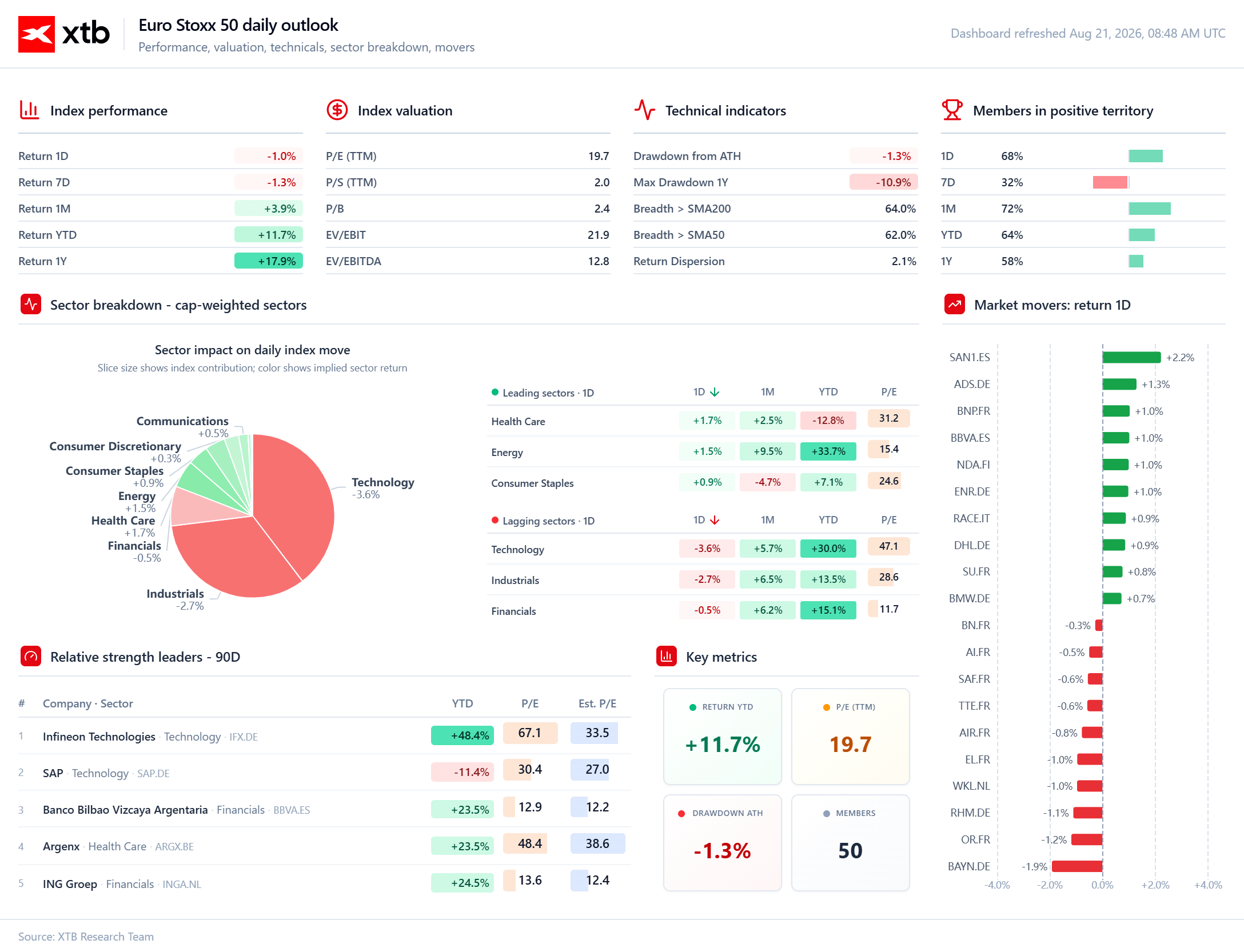
The Euro Stoxx 50 remains close to historical highs, trading only around 1.3% below its record, while 64% of its constituents remain above the SMA200 and 62% above the SMA50, indicating that market breadth is still relatively healthy. Valuation does not look extreme compared with the U.S., but it is no longer cheap either: a P/E of 19.7x and EV/EBITDA of 12.8x suggest investors are already paying a clear premium for the quality and resilience of Europe’s largest companies. Today, technology is down around 3.6% and industrials around 2.7%, while energy gains 1.5% and healthcare 1.7%, highlighting a visible rotation away from more yield-sensitive segments toward defensives and commodities. Interestingly, technology remains one of the strongest sectors year to date, with a gain of around 30%, even though its current P/E is as high as 47x, meaning the market has little tolerance for disappointment in this part of the index. Financials, by contrast, trade at a P/E of around 11.7x and have delivered solid returns this year, which could continue to attract capital if bond yields remain elevated.
Source: XTB Research
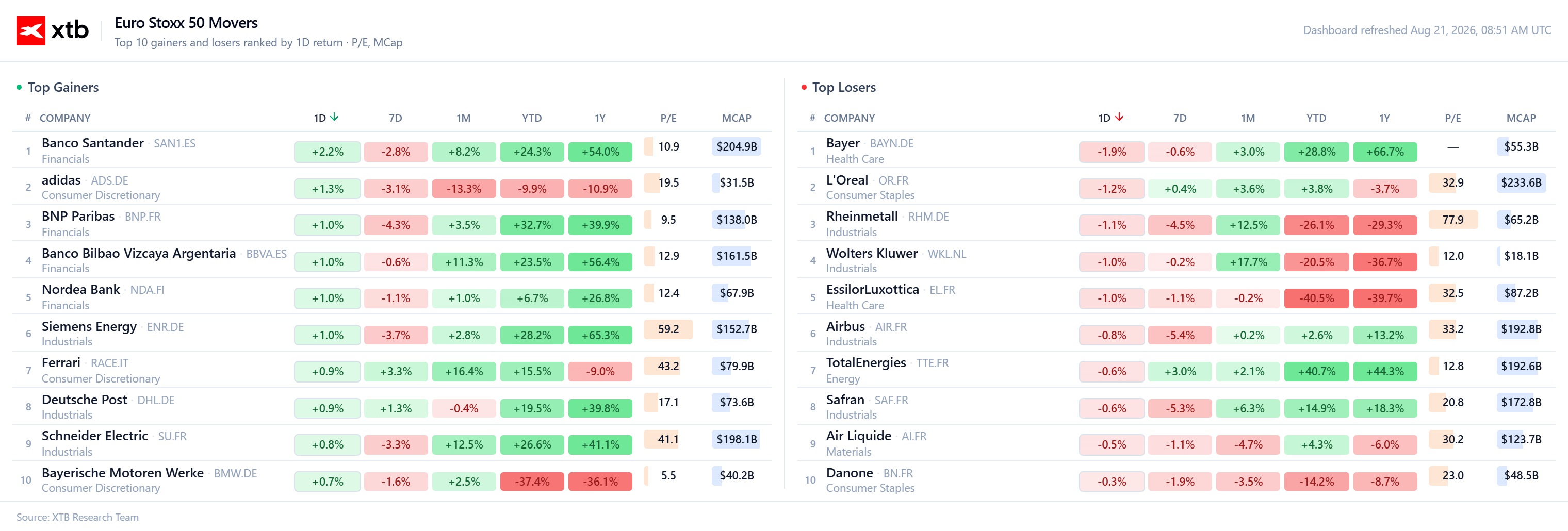
Today’s Euro Stoxx 50 structure points to clear stock selection rather than a broad-based index move. Banks dominate the gainers, with Santander up 2.2%, BNP Paribas 1.0% and BBVA 1.0%, while Bayer, L’Oréal and Rheinmetall are among the weaker names. Valuation differences are significant, which matters in the current yield environment: Santander and BNP trade at P/E multiples of around 10.9x and 9.5x respectively, while Siemens Energy and Rheinmetall remain considerably more expensive at roughly 59.2x and 77.9x. Capital still appears willing to move toward sectors offering more reasonable valuations and visible earnings improvement rather than paying indiscriminately for growth.
Source: XTB Research
Germany attempts to rebound
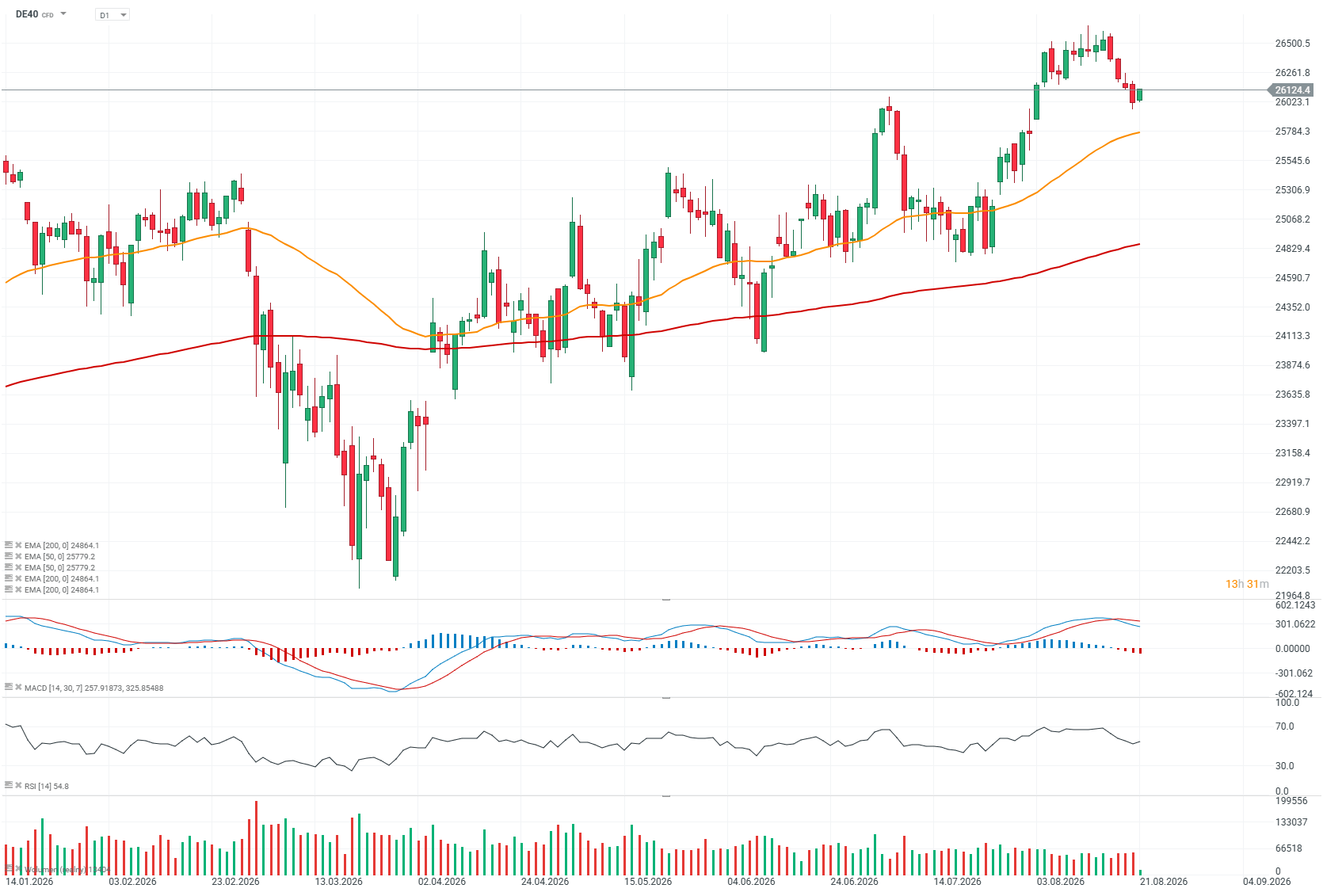
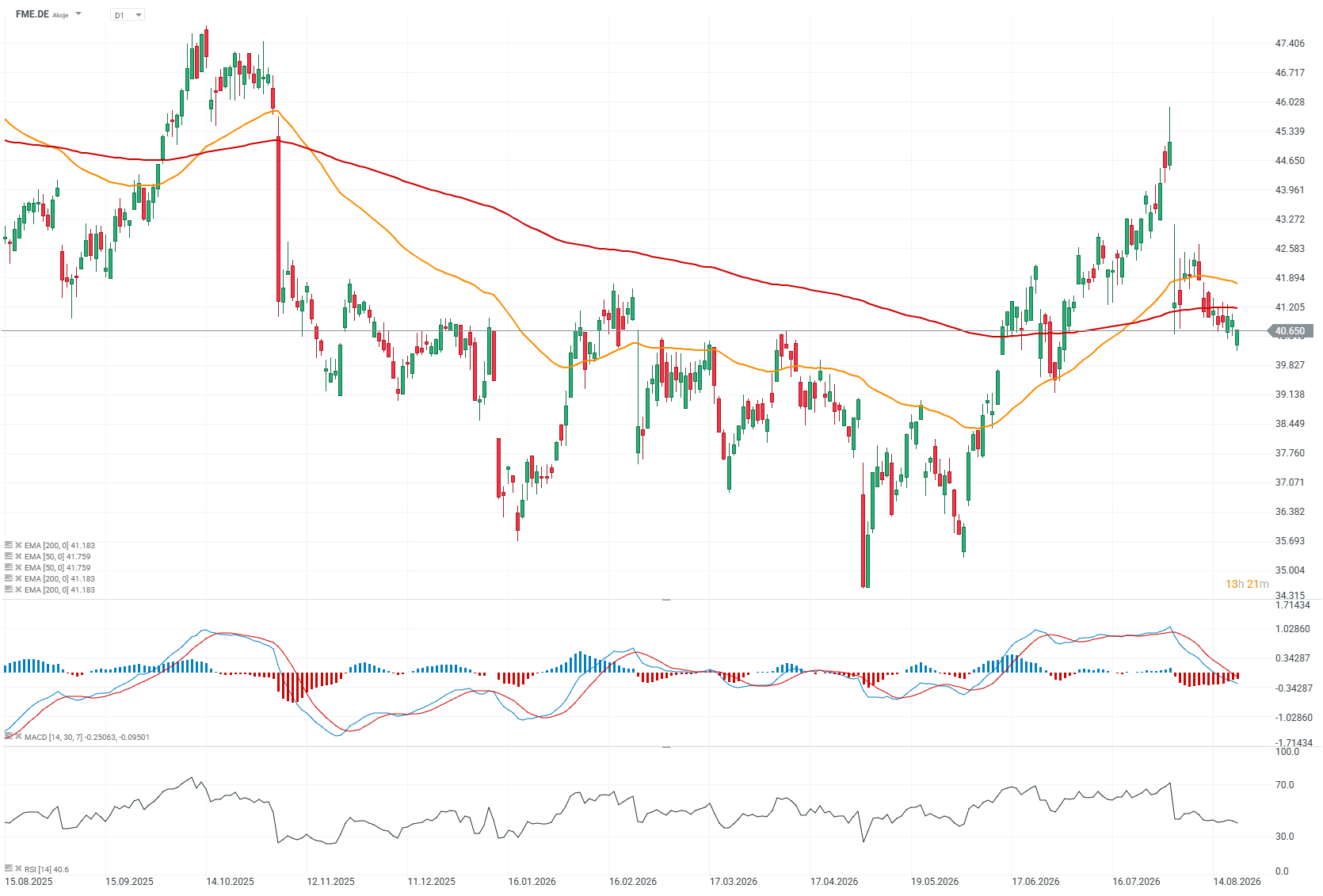
DAX futures (DE40) enter Friday’s session higher after Thursday’s 0.4% decline to 25,983 points, when rising oil prices and another increase in bond yields weighed on the market. On the corporate side, Fresenius is attracting attention as it continues to reduce its stake in Fresenius Medical Care. The company sold around 7.8 million FMC shares worth close to EUR 300 million to institutional investors.
- Bond supply is expected to remain very high in the coming years. Commerzbank estimates that gross German government bond issuance will rise to a record EUR 400 billion in 2027 from EUR 349 billion in 2026, while Barclays expects gross eurozone issuance to reach a record EUR 1.54 trillion. At the same time, the ECB continues to shrink its balance sheet and is no longer fully reinvesting maturing securities, meaning private investors must absorb an increasingly large share of new supply.
- The market is already showing signs of greater caution. Germany recently sold EUR 3.8 billion of 10-year bonds versus EUR 6 billion planned, while some asset managers are avoiding the very long end of the curve. The main drivers of this supply are higher defence and infrastructure spending, rising social costs and persistently large fiscal deficits, particularly in France, where the deficit is expected to remain above 5%.
DE40 chart (D1 interval)
DAX futures are attempting to erase yesterday’s losses. The key short-term resistance area is around 26,300 points.
 Source: xStation5
Fresenius Medical Care shares (FME.DE)
Source: xStation5
CTS Eventim attempts to recover after quarterly results
CTS Eventim, one of Europe’s largest entertainment and ticketing groups, is among the more interesting German names following its latest results. In the first half of the year, revenue increased by 16.9% to EUR 1.513 billion, adjusted EBITDA rose by 12.4% to EUR 225.4 million and EPS climbed by 34.2% to EUR 1.25. Jefferies maintained its Buy recommendation after the report with a EUR 100 price target, but the market reaction has been far from euphoric. Operationally, the results were solid, but the EBITDA margin declined to 14.9% from 15.5%.
CTS Eventim delivered another solid second quarter, although growth slowed noticeably compared with the start of the year. Revenue increased by around 13% year over year to just over EUR 899 million, adjusted EBITDA rose by around 6% to more than EUR 106 million, and net profit jumped 30% to EUR 56.7 million. Ticketing remains the main growth engine, supported additionally by preparations for the Los Angeles Olympic Games. The shares initially fell almost 10%, then recovered most of the losses and were down around 1% by late morning, while still trading roughly 27% lower year to date. Investors do not appear to be questioning the quality of the business, but they are becoming increasingly sensitive to the pace of growth and valuation, which remains relatively demanding with a P/E close to 20x.
The numbers were also better than expected. According to Berenberg, revenue came in around 8% above consensus, while JPMorgan argued that business momentum remains intact. The key issue is that revenue growth slowed from 23% in the first quarter to 13% in the second, while EBITDA increased much more slowly than sales. Investors want to see that rising scale translates into stronger margin expansion and faster EBITDA growth. Expectations around a high-quality business have been set high, so even a moderate slowdown in growth is being punished quickly. If ticketing continues to expand and margins begin to improve again, the current valuation reset could eventually look more constructive.
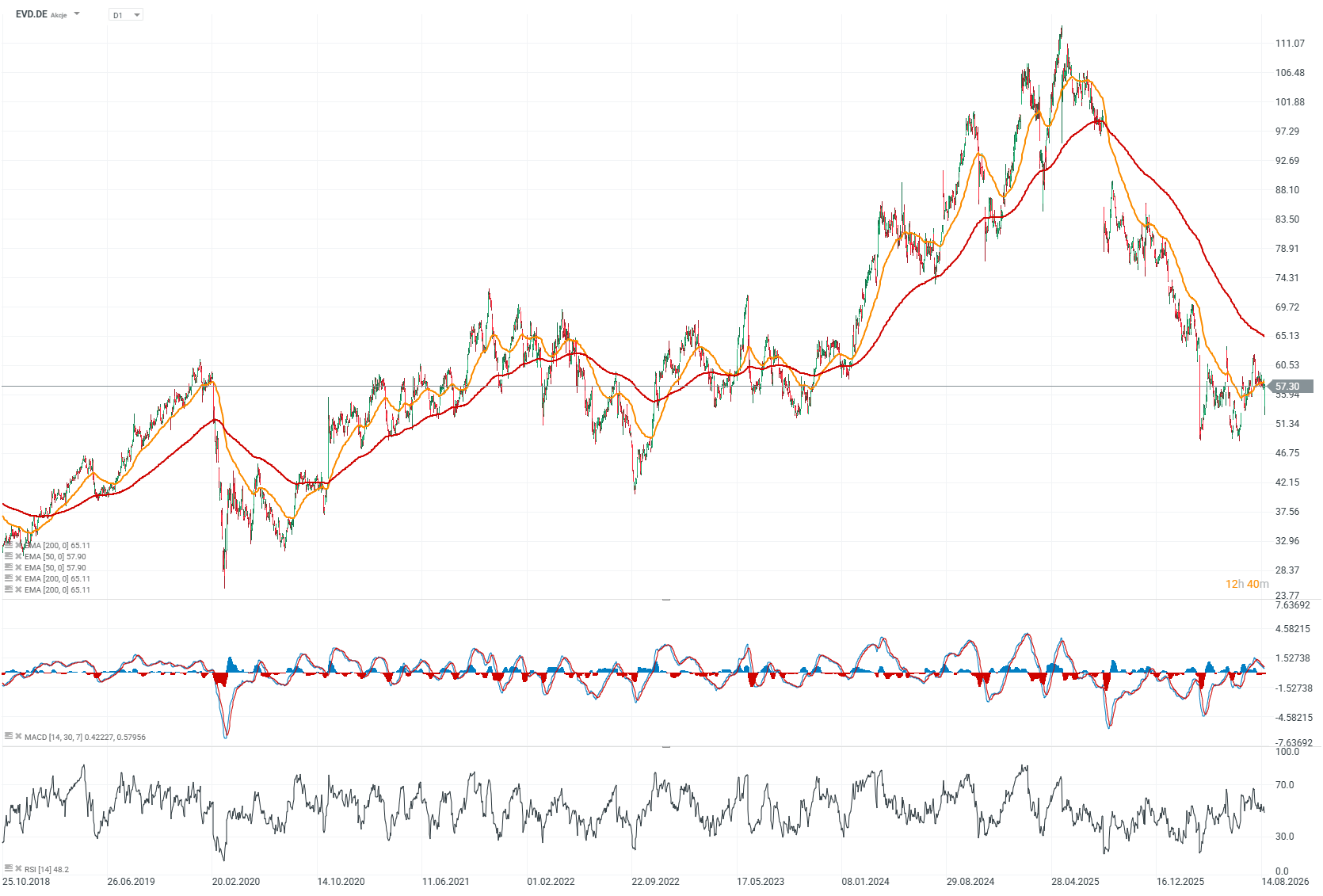
CTS Eventim shares (EVD.DE, D1 interval)
The shares are trading around 50% below their historical peak and roughly 15% below the 200-session moving average. Higher bond yields are not helping the stock, but the underlying business continues to grow despite the weakness in the market valuation.
Source: xStation5



Morning wrap: Bitcoin surges to $75k, Wall Street tries to stabilize


Daily Summary: Dollar Recovers Losses, Oil Near 3-Week Highs 🗽 US30 Falls 1%


US Open: US100 falls 0.7% as Treasury yields and oil prices surge 🚩 Walmart under pressure


Walmart falls 6% despite strong results 📉 What did the largest U.S. retailer reveal?
This content has been created by XTB S.A. This service is provided by XTB S.A., with its registered office in Warsaw, at Prosta 67, 00-838 Warsaw, Poland, entered in the register of entrepreneurs of the National Court Register (Krajowy Rejestr Sądowy) conducted by District Court for the Capital City of Warsaw, XII Commercial Division of the National Court Register under KRS number 0000217580, REGON number 015803782 and Tax Identification Number (NIP) 527-24-43-955, with the fully paid up share capital in the amount of PLN 5.869.181,75. XTB S.A. conducts brokerage activities on the basis of the license granted by Polish Securities and Exchange Commission on 8th November 2005 No. DDM-M-4021-57-1/2005 and is supervised by Polish Supervision Authority.
