


- FOMC minutes revealed hawkish sentiment, with policymakers considering larger rate hikes if inflation data worsens.
- Gold prices dropped below 3 800 USD per ounce due to rising bond yields and hawkish central bank messaging.
- US housing starts rose by 9.9% month-on-month, while building permits fell by 7.4% amid high mortgage rates.
- Nvidia faced investor scrutiny and management changes, while Microsoft and Intel deepened their strategic partnership.
- US crude inventories rose by 3.38 million barrels, pushing crude oil prices lower.
🏛️ Central banks and monetary policy
- Minutes from the FOMC meeting revealed distinctly hawkish sentiment among policymakers, with the absence of a rate hike turning out to be merely a compromise based on the fact that the market itself was pricing in further tightening.
- Several meeting participants explicitly indicated that if incoming inflation data proves unfavorable, a move larger than 25 bps should be considered in December.
- Nearly all officials considered further policy tightening to be the appropriate baseline scenario, fearing the unanchoring of inflation expectations after five years of elevated price dynamics.
- Many Federal Reserve representatives also pointed to infrastructure spending in the artificial intelligence sector, assessing it as a significant, pro-inflationary risk to the economy.
- Fed Board Member Christopher Waller called for more decisive action and suggested a rate hike of 50 bps, pointing out that nearly 70% of items in the core services basket are rising at a rate exceeding 3%.
- A similar stance was taken by Michael Barr, stating that restrictive policy must be maintained to bring inflation down to the 2% target. Meanwhile, Mary Daly advocated for a more balanced approach, while acknowledging that consumption remains surprisingly resilient, complicating the fight against price growth.
- European Central Bank President Christine Lagarde emphasized the resilience of the European economy, while warning that high valuations of tech companies linked to artificial intelligence could undergo a correction in the future. Speaking in a similar tone, Boris Vujčić noted that a December rate hike in the euro area is highly likely due to inevitable second-round effects in 2027.
- Bank of England Governor Andrew Bailey expressed frustration over persistent inflation in the UK, while announcing the creation of a special analytical unit to study the economic impact of AI development.
- Bank of Canada Deputy Governor Toni Gravelle warned of energy price inflation spilling over into other sectors, highlighting the necessity of maintaining confidence in the targeted inflation rate.
📈 Stock markets and companies
- Initial enthusiasm following the quarterly report published by Nvidia quickly faded, as investors began questioning the continued momentum of AI infrastructure spending following changes in the company's management. Sentiment surrounding the tech giant was further dampened by subpoenas from a US Congressional committee regarding semiconductor export controls, leading analysts at UBS to cut their price target for the stock.
- At the same time, Microsoft and Intel announced a deepening of their strategic partnership covering the Azure cloud and next-generation processors, while Claude creator Anthropic closed its order book ahead of its stock market debut with reported interest reaching USD 500 billion.
- American retail chain Target positively surprised investors, posting operating profit above expectations and raising full-year forecasts thanks to margin growth and comparable sales. Despite solid results from the retailer, consumer caution in a high interest rate environment prompted financial institutions to lower valuations for Home Depot.
- The domestic WIG index showed relative calm against fluctuations on foreign exchanges, consolidating around reference levels. Meanwhile, shares of medical company Synektik came under heavy supply pressure in reaction to disappointing Q4 results, despite the firm reaching record revenue on a full-year basis.
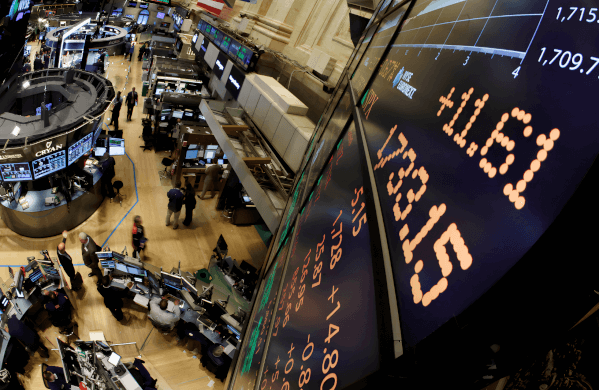
- As of 20:08, the S&P 500 stands at 7,340, down 0.36% for the day and down 2.91% for the week, while the Nasdaq 100 stands at 27,136, up 0.04% for the day and down 2.83% for the week, whereas the Dow Jones stands at 50,265, down 1.1% for the day and down 3.95% for the week.
- As of 20:08, Nvidia stands at 151.48, down 2.42% for the day and down 6.94% for the week, while Microsoft stands at 508.74, up 0.52% for the day and down 2.89% for the week, whereas Amazon stands at 266.80, up 3.51% for the day and up 0.06% for the week, and Google stands at 282.90, up 1.06% for the day and down 4.34% for the week.
🌍 Macroeconomics and geopolitics
- The US housing market sent mixed signals: housing starts rose by 9.9% month-on-month to 1.309 million, beating analysts' expectations. On the other hand, building permit volume fell by 7.4% to 1.295 million, and pending home sales dropped by 4.7%, directly impacted by high mortgage rates reaching 7.35%.
- Final readings confirmed that consumer inflation in the euro area stood at 4.0% year-on-year, while the core indicator settled at 2.6%. In the UK, CPI price dynamics reached 3.6%, while producer input prices rose as much as 10.8%, signaling continued cost pressure in the British economy.
- During the APEC summit in Shenzhen, China, a series of diplomatic meetings took place involving leaders from the US, China, and Russia, while Beijing and Seoul finalized negotiations regarding the next stage of their free trade agreement.
- Concurrently, US officials dismissed speculation regarding cyberattacks on critical infrastructure, indicating that recent technology system disruptions were purely technical in nature.
- In the Middle East, further shipping unrest was recorded in the Strait of Hormuz following reports of a missile strike on a commercial vessel, coinciding with warnings from Israel regarding readiness to expand operational zones in the event of conflict escalation.
🛢️ Commodities and raw materials
- Precious metals came under heavy selling pressure, as rising bond yields and hawkish central bank messaging completely outweighed the geopolitical risk premium. Gold prices broke through a key psychological threshold, dropping below USD 3,800 per ounce for the first time in over a year and rapidly approaching USD 3,700.
- Silver recorded an even steeper sell-off, deepening year-to-date losses amidst mass liquidation of long positions by leveraged funds. CFTC report data shows that speculators were caught off guard in the metals market, having failed to position for hawkish central banks.
- Crude oil prices trended lower following the release of the EIA report, which showed US crude inventories rising by 3.38 million barrels along with a significant build in gasoline stocks.
- Declines could not be stopped even by reports of paralyzed Russian refining capacity due to drone strikes, while Polish conglomerate Orlen entered preliminary talks with QatarEnergy regarding the renegotiation of long-term LNG supply contracts.
- Coffee prices experienced heightened volatility as part of a technical trade of the day, influenced by supply fluctuations in emerging markets and maritime logistics.
- As of 20:08, gold stands at 3,729, down 3.11% for the day and down 3.97% for the week, while silver stands at 45.01, down 4.92% for the day and down 7.53% for the week, whereas Brent crude stands at 88.66, down 4.68% for the day and down 7.7% for the week, and copper stands at 12,600, down 4.7% for the day and down 5.59% for the week.
💵 Currencies and bonds
- The US dollar returned to appreciation driven by hawkish rhetoric from Federal Reserve officials, reducing room for a pullback in the US currency. In the debt market, the Treasury Department auctioned USD 16 billion in 20-year bonds at a yield of 5.459%, meeting stable demand from institutional investors.
🪙 Cryptocurrencies
- Sentiment in the digital asset market deteriorated sharply, with the industry fear index sliding to 11 pts, signaling extreme investor pessimism. Pressuring prices were reports of BTC reserve sales by leading miners seeking liquidity to fund infrastructure transformation toward AI data centers.
- As of 20:08, bitcoin stands at 62,618, down 3.0% for the day and down 3.82% for the week.



🟡⬇️Gold below 3800 USD for the first time in over a year



Fed Minutes: Virtually everyone in favor of further rate hikes. Is there a chance for 50 basis points in December?

🔴US500 decrease ahead of FOMC minutes



Market Wrap: Stocks under pressure, Iceye reaches for Avio
This content has been created by XTB S.A. This service is provided by XTB S.A., with its registered office in Warsaw, at Prosta 67, 00-838 Warsaw, Poland, entered in the register of entrepreneurs of the National Court Register (Krajowy Rejestr Sądowy) conducted by District Court for the Capital City of Warsaw, XII Commercial Division of the National Court Register under KRS number 0000217580, REGON number 015803782 and Tax Identification Number (NIP) 527-24-43-955, with the fully paid up share capital in the amount of PLN 5.869.181,75. XTB S.A. conducts brokerage activities on the basis of the license granted by Polish Securities and Exchange Commission on 8th November 2005 No. DDM-M-4021-57-1/2005 and is supervised by Polish Supervision Authority.