


The main factor driving volatility
The main driver of the markets today was the technology sector, specifically Dell’s spectacular results, which raised its full-year revenue forecast to $165–169 billion, with AI server revenue growing nearly ninefold year-over-year. The AI boom has boosted the entire computer hardware segment (Dell +35%, HPE +17%, NetApp +19%), while undermining the narrative of a “SaaS apocalypse,” as results from companies such as Salesforce (+8.3%), Palantir (+9.3%), SAP (+4%), and Oracle (+8%) showed that companies are aggressively investing in AI-powered software. The downward revision of U.S. GDP had one positive aspect: strong growth in corporate technology spending of 17.2%.
Geopolitics
The main geopolitical issue was the chaotic messaging surrounding the U.S.-Iran agreement on the Strait of Hormuz. Trump announced via Truth Social that the naval blockade of Iran would be lifted, contingent upon, among other things, Iran’s renunciation of nuclear weapons and the removal of sea mines, but the Iranian Fars News Agency disputed these claims, calling them a “mixture of truth and lies” and denying that Iran had agreed to dismantle its nuclear materials. A diplomatic lull at the end of Friday’s session calmed the mood and allowed the indices to recover their losses, while Trump himself announced that the final decision would be made after a meeting in the Situation Room. At the same time, reports emerged regarding a U.S. proposal as part of the USMCA renegotiations, requiring that 50% of the value of components in every car sold under preferential tariff conditions come exclusively from the United States, which triggered volatility in automotive stocks.
Macroeconomic data
On the macroeconomic front, three key releases drew attention. First, the preliminary HICP inflation reading for Germany came in at 2.7% year-over-year versus a forecast of 2.8%, while the CPI fell to 2.6% from an expected 2.9%, which sends a clearly dovish signal ahead of the next ECB meeting. Second, Polish CPI inflation in May surprised sharply to the downside, falling to 3.1% against a consensus of 3.6%, and on a monthly basis, prices fell by 0.3%, marking the sharpest decline since September 2023. Third, Canadian GDP contracted by 0.1% in the first quarter of 2026, while the market had expected growth of 1.5%, confirming the mounting effects of trade wars and paving the way for further rate cuts by the Bank of Canada.
Indices
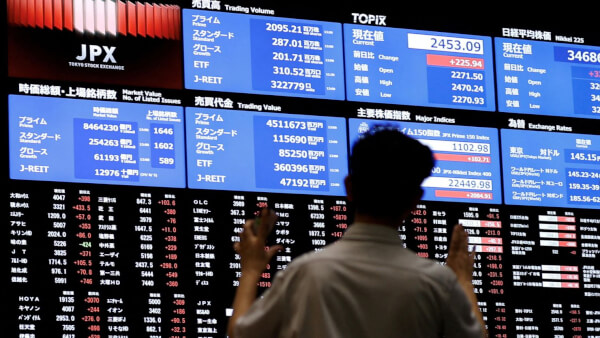
On Wall Street, the Dow Jones Industrial Average led the session with a gain of 0.8%, outperforming the S&P 500 (+0.35%) and the Nasdaq (+0.3%), while small-cap stocks in the Russell 2000 (-0.9%)—which are most sensitive to rising bond yields—ended the day in the red. The European Stoxx Europe 600 gained 0.5%, and the EU50 index rose by about 0.4%, with 71% of companies in positive territory for the day, trading just 1.5% below historical highs. In Hungary, the main BUX index rose 2.4% following news that the European Commission had released €16.4 billion in EU funds after reaching an agreement with new Prime Minister Peter Magyar.
Stocks
The stars of the session were primarily companies from the technology and cloud sectors: Dell (+35%), Palantir (+9.13%), CrowdStrike (+8.20%), Palo Alto Networks (+7.32%), Adobe (+6.08%), and ARM Holdings (+5.08%), while among European stocks, Airbus stood out (+1.95%). On the losing side, the apparel sector dominated (Gap down 15% after lowering its full-year forecasts), along with SentinelOne (down 16% following weak forecasts and an announcement of an 8% workforce reduction) and space companies AST SpaceMobile and Rocket Lab, which were sold off after the explosion of Blue Origin’s New Glenn rocket on the launch pad. Among the European losers was Deutsche Bank, which, despite generally positive sentiment, fell 2.29%.
Currencies
The U.S. dollar came under pressure amid reports of a potential agreement with Iran and an improvement in global sentiment, with the USD index (USDIDX) losing 0.11% to around 98.84. The EURUSD pair is consolidating in the 1.1570–1.1760 range, below the key EMA200 resistance, with the RSI around 47 indicating a balance of forces, although a break above 1.1760 would open the way to 1.19. The Hungarian forint strengthened following news about EU funds, with EURHUF falling 0.5%, while the Canadian dollar came under heavy pressure after data showed a contraction in GDP, and the USDCAD pair rose significantly. The Polish zloty reacted modestly to the positive inflation reading, with EURPLN rising 0.1% to 4.23.
Commodities
Crude oil was in the spotlight due to conflicting signals from the Middle East. Brent and WTI fell by more than 2% after Trump announced an agreement with Iran regarding the opening of the Strait of Hormuz, through which approximately 20% of global oil exports pass, but after Iran denied the report, some of the losses were recouped, with WTI trading around $87 per barrel. Gold gained 1.44% and was trading around $4,560 per ounce, confirming its historical inverse correlation with the USD, while natural gas rose 0.42% to $3.32. Silver remained virtually unchanged, losing just 0.07%.
Cryptocurrencies
Bitcoin tested levels below $73,000 despite gains in the stock markets, confirming seasonal weakness ahead of the summer season and a challenging 2026 for the broader cryptocurrency industry. The BTC price approached the 200-session exponential moving average on the weekly timeframe, and historically, a similar situation occurred in the spring of 2020, in the middle of the 2022 bear market, and in February 2026. On-chain data from CryptoQuant indicates a significant decline in whale buying activity, analogous to the cyclical weakness seen in the spring of 2022, and a drop back below $72,000 could pave the way for a test of local lows at $60,000. An additional negative signal for the industry was the suspension of trading on the Sui blockchain (Mysten Labs) for the second day in a row.


📆Three markets to watch next week (29.05.2026)



Hungary Unlocks EU Funds; EUR/HUF Drops 0.5%

🔄 UPDATE: Iran rejects Trump's statement - Oil prices rebound 💥


🚩 Bitcoin slips testing important support zone amid cyclical crypto market weakness
This content has been created by XTB S.A. This service is provided by XTB S.A., with its registered office in Warsaw, at Prosta 67, 00-838 Warsaw, Poland, entered in the register of entrepreneurs of the National Court Register (Krajowy Rejestr Sądowy) conducted by District Court for the Capital City of Warsaw, XII Commercial Division of the National Court Register under KRS number 0000217580, REGON number 015803782 and Tax Identification Number (NIP) 527-24-43-955, with the fully paid up share capital in the amount of PLN 5.869.181,75. XTB S.A. conducts brokerage activities on the basis of the license granted by Polish Securities and Exchange Commission on 8th November 2005 No. DDM-M-4021-57-1/2005 and is supervised by Polish Supervision Authority.
