



The Bank of Japan did exactly what the market expected, raising the interest rate by 25 basis points to 1.25%, the highest level since 1995. In a textbook scenario, such tightening should support the currency. Meanwhile, the yen reacted with a weakening, and the USDJPY pair dynamically returned above the 157 barrier. This is the best proof that the market cares today not about the decision itself, but about the signal regarding the future path, and this one turned out to be disappointingly dovish.
Two Dissenters Ruin the Narrative
The key is the vote breakdown, which was 7 to 2. Voting against the hike were Toichiro Asada and Ayano Sato, the two newest board members nominated by Prime Minister Sanae Takaichi, known for their favorability toward loose monetary and fiscal policy. The market read this unambiguously. Two distinct camps emerged within the Bank of Japan, and the bank is less united on the pace of further tightening than assumed just a few days ago. The bar for further moves has just risen, and the hawkish tone of the statement was effectively diluted by the mere existence of the split.
Fed Wins the Rhetoric Duel
The background remains relentless for the yen. Two days earlier, the Fed not only raised rates but, through Kevin Warsh, communicated a hard stance in the spirit of "higher for longer," driving US bond yields toward 5 percent. The effect is simple. The rate divergence between the United States and Japan still strongly favors the dollar, and carry trade—borrowing cheap yen to invest in higher-yielding assets abroad—remains attractive. A hawkish Fed paired with a less hawkish BoJ is a simple recipe for a weak yen, even despite the formal hike in Tokyo.
BoJ Forecasts: The Paradox of a Weak Currency
It is worth looking deeper into the bank's projections, because that is where the biggest paradox lies. The BoJ forecasts that core inflation, excluding fresh food, will accelerate clearly above 2 percent from the second half of fiscal year 2026, driven by the pass-through of earlier oil price increases, rising semiconductor and AI-boom-related components, and, most importantly, yen depreciation translating into durable goods prices. The bank expects inflation to return to the 2 percent target only later in the forecast horizon. Additionally, there are rising inflation expectations and the risk that companies will increasingly boldly raise wages and prices.
Technical Analysis and Z-Score
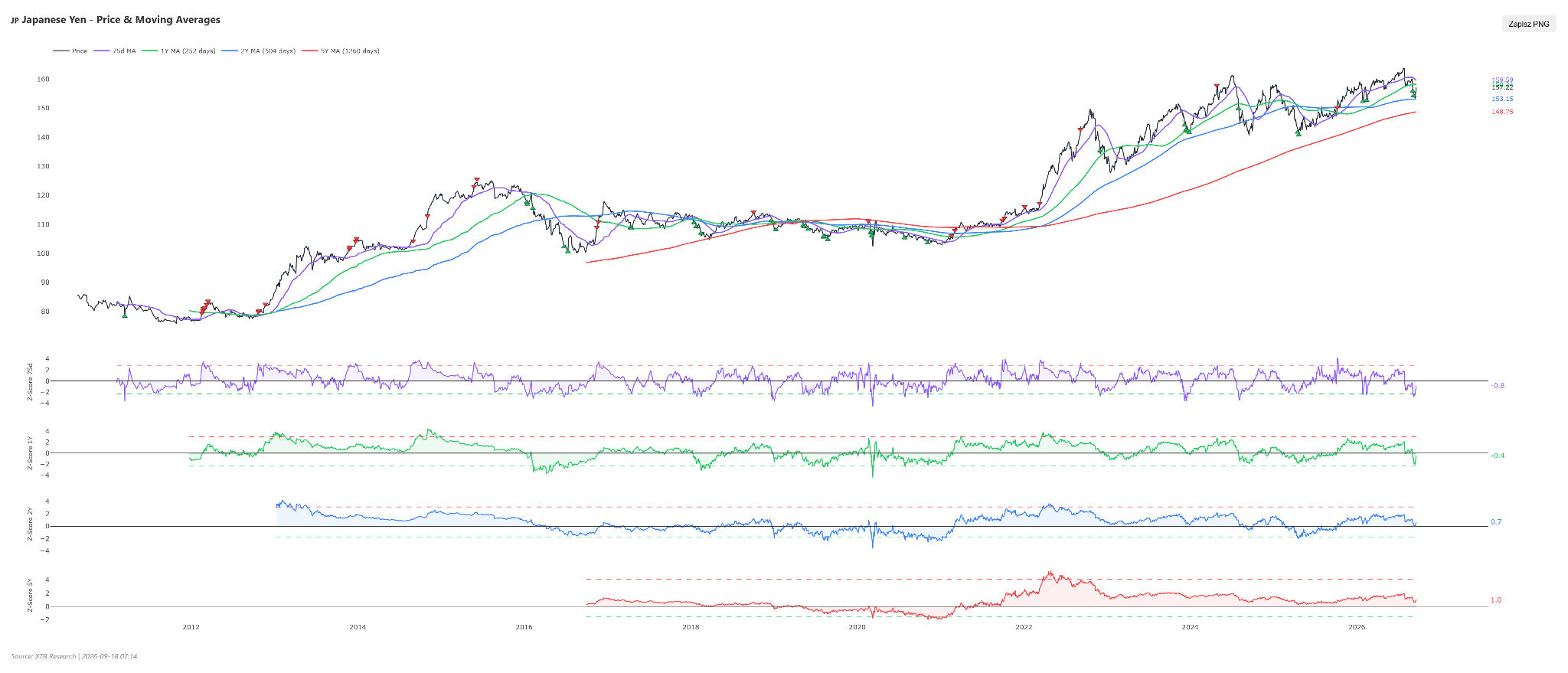
On the USDJPY daily chart, quotes around 157.2 have just broken above the 38.2 percent Fibonacci retracement at 157.15, determined for the downward move from the 164.07 to 152.87 region. Maintaining above this level opens the way toward the 50 percent retracement at 158.47, and then the key 61.8 percent resistance in the 159.79 region. This is where the barrier deciding on the return to the broader upward trend runs. Support remains at the 23.6 percent retracement at 155.51, the breach of which would direct attention back toward the lows around 152.87.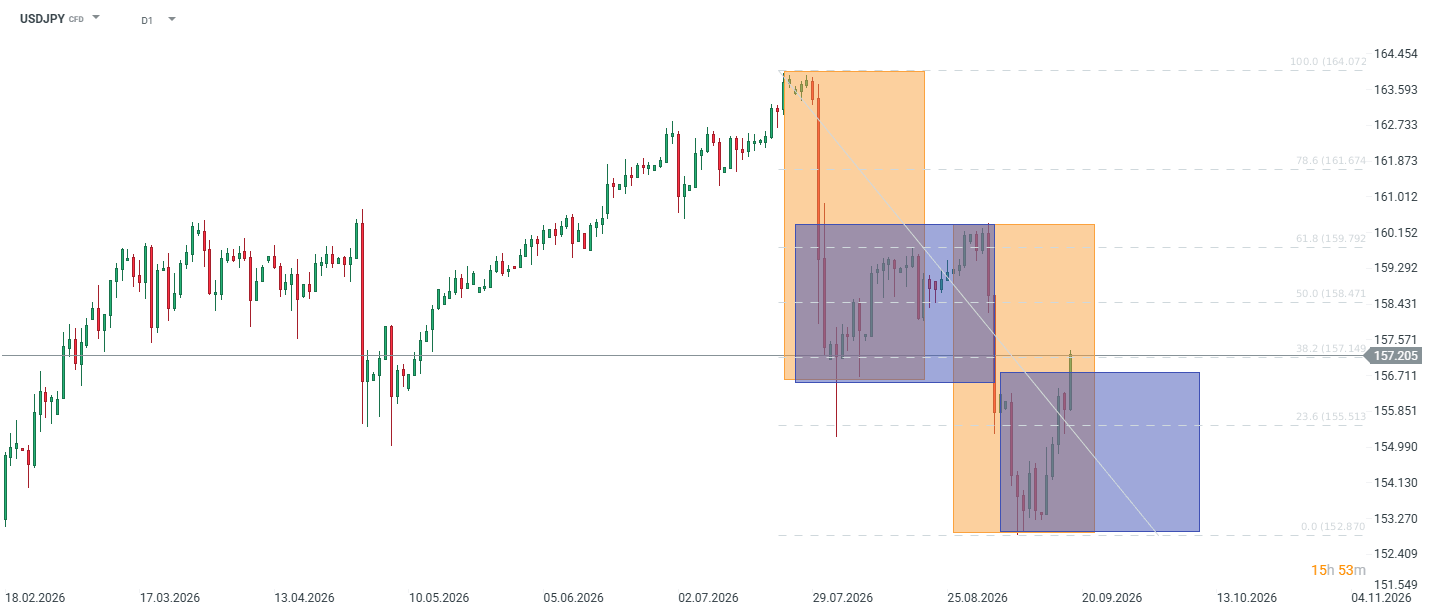


Yen loses ground after the BoJ decision
Hawkish remarks by BOJ Governor strengthen the yen – key takeaways



Macro Calendar – Dovish BoJ Pivot and Key Data from Europe and the US



📊Morning Briefing: BoJ raises rates, but the yen paradoxically weakens (18.09.2026)
This content has been created by XTB S.A. This service is provided by XTB S.A., with its registered office in Warsaw, at Prosta 67, 00-838 Warsaw, Poland, entered in the register of entrepreneurs of the National Court Register (Krajowy Rejestr Sądowy) conducted by District Court for the Capital City of Warsaw, XII Commercial Division of the National Court Register under KRS number 0000217580, REGON number 015803782 and Tax Identification Number (NIP) 527-24-43-955, with the fully paid up share capital in the amount of PLN 5.869.181,75. XTB S.A. conducts brokerage activities on the basis of the license granted by Polish Securities and Exchange Commission on 8th November 2005 No. DDM-M-4021-57-1/2005 and is supervised by Polish Supervision Authority.