


At today's press conference, Bank of Japan Governor Kazuo Ueda presented a cautiously optimistic assessment of the Japanese economy, emphasizing that the economy is showing moderate growth, although some weaknesses remain. Ueda pointed out that data from the Tankan survey show reduced uncertainty regarding corporate earnings forecasts, suggesting an improvement in business sentiment. The governor noted that risks to the US economy and trade policy have caused less uncertainty, indicating a change in the perception of geopolitical risks.
In the context of monetary policy, Ueda pointed to three key elements: wage growth should continue next year thanks to companies' active wage policies, which is a positive signal for consumption. He also emphasized that real interest rates in Japan will remain very low, despite nominal rate hikes, which means that the expansionary monetary policy stance will be maintained. Finally, he noted that rate hikes will continue if the economy and inflation develop in line with the BoJ's projections, leaving room for flexibility in further decisions.
Governor Ueda expressed minimal concerns about the impact of the current tightening of monetary policy, stating that the Bank of Japan had not observed any significant effects from either the current rate hikes or previous hikes. He also emphasized that the fact that interest rates have reached a 30-year high is not particularly significant to him, suggesting that the nominal level of interest rates is not the main indicator to watch.
Regarding the future direction of policy, Ueda noted that the BoJ will explore the so-called neutral rate as the economy and prices respond to rate changes, which means a flexible approach tailored to actual economic conditions. The governor emphasized an important methodological approach: when assessing the state of the economy, one should look beyond short-term and natural rates, instead paying attention to real rates and credit conditions, suggesting a more holistic view of monetary policy effectiveness. In addition, Ueda pointed out that the BoJ's neutral rate projection remains wide, which leaves the BoJ considerable flexibility to adjust its policy stance in response to changes in economic conditions.
Finally, the BoJ governor added that the recent weakness of the yen may affect price changes in the economy, so it is necessary to keep an eye on this issue.
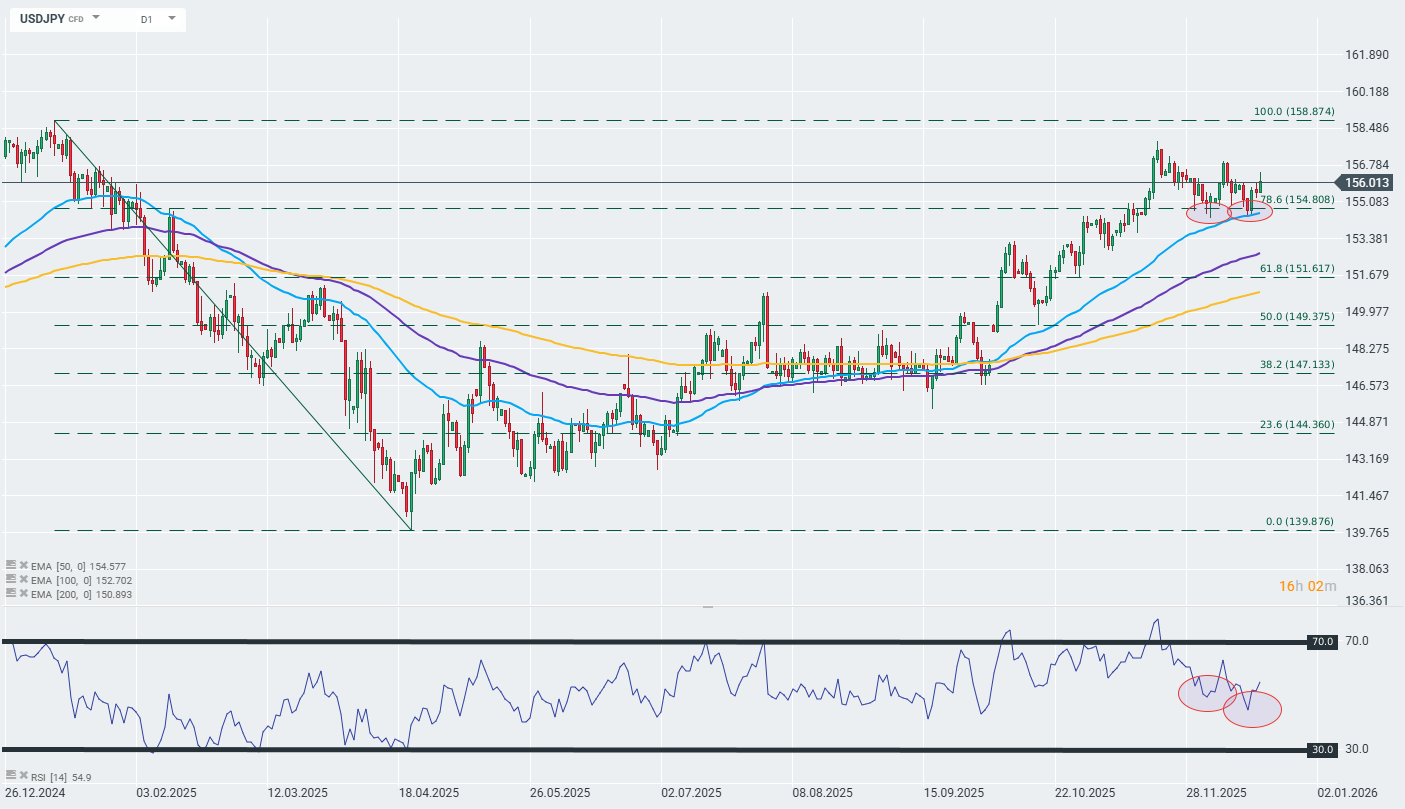
The USDJPY pair resumes its long-term uptrend following the BoJ's decision and Ueda's comments. The pair defended the support zones marked by the 50-day EMA (blue curve on the chart) and negated the bearish divergence that was laying the groundwork for the end of the current trend. However, it is worth remembering that USDJPY is a highly volatile pair and may negate the current movements, especially immediately after the BoJ's decision, which in itself increases speculative movements. Source: xStation


Economic calendar: Retail sales from Canada; UoM data from the US

BREAKING: UK retail sales below expectations; GBPUSD ticks lower
Morning Wrap (19.12.2025)


Daily summary: US100 gains after CPI print; markets await BoJ decision 🏛️
This content has been created by XTB S.A. This service is provided by XTB S.A., with its registered office in Warsaw, at Prosta 67, 00-838 Warsaw, Poland, entered in the register of entrepreneurs of the National Court Register (Krajowy Rejestr Sądowy) conducted by District Court for the Capital City of Warsaw, XII Commercial Division of the National Court Register under KRS number 0000217580, REGON number 015803782 and Tax Identification Number (NIP) 527-24-43-955, with the fully paid up share capital in the amount of PLN 5.869.181,75. XTB S.A. conducts brokerage activities on the basis of the license granted by Polish Securities and Exchange Commission on 8th November 2005 No. DDM-M-4021-57-1/2005 and is supervised by Polish Supervision Authority.