

This was another historic week for the UK. Keir Starmer stepped down as Prime Minister, Andy Burnham is our de-facto next leader, and the horse trading for positions in a new cabinet have begun. Not that long ago, Andy Burnham sent bond markets into a panic, but although he is not yet PM, his impact since winning the Makerfield by-election has been mild so far.
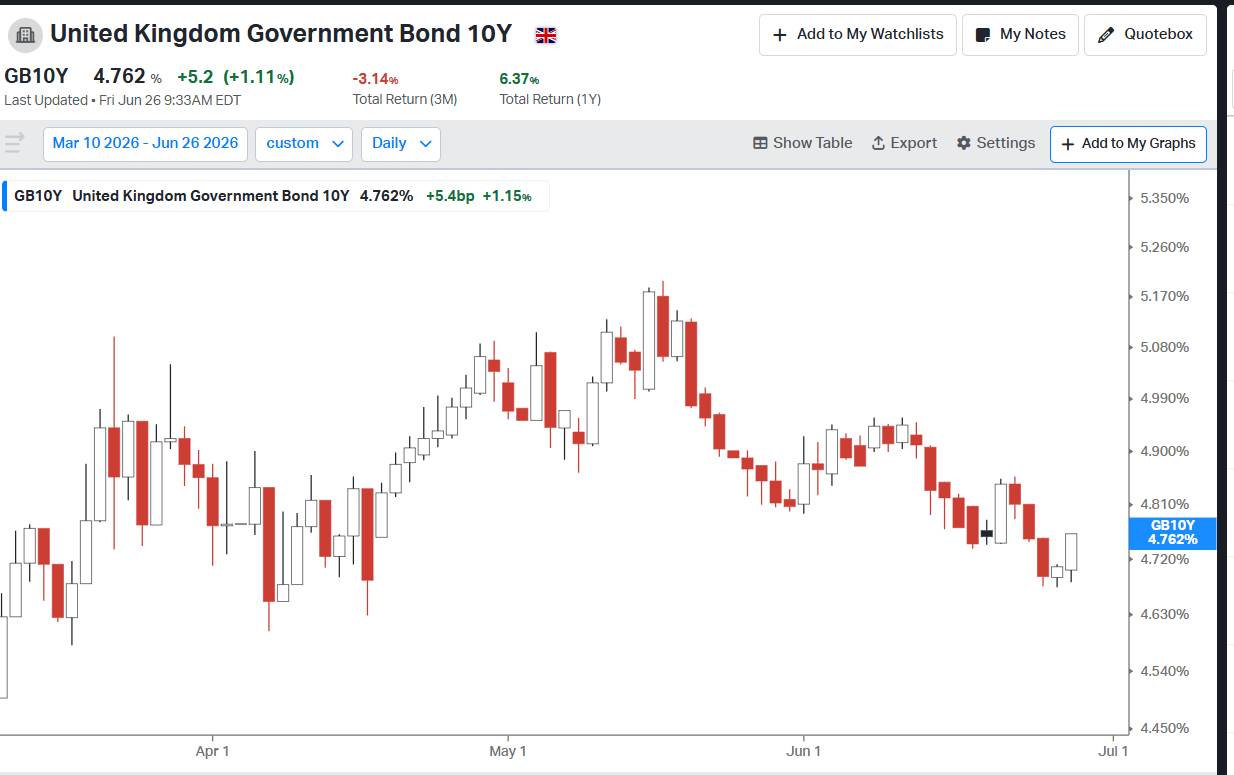
Gilt yields have been remarkably stable this week. The 2-year Gilt yield is down 10bps, while the 10-year is lower by a similar amount. The decline in the 2-year yield is more closely linked to the fall in the oil price, which is back to pre-war levels, however, the stability in the 10-year yield is a sign that bond investors are not expressing any concerns with the 7th UK prime minister for the UK in 10-years. This comes even though the May public finance data showed borrowing for the first two months of the financial year was £9bn higher than a year ago.
Not long ago, the prospect of Andy Burnham in number 10 sent bond markets into decline, and yields shooting higher. Since then, he has honed his message. We now know that:
1, Burnham will abide by Rachel Reeves’ fiscal rules.
2, He may stick to the Labour Party manifesto not to raise the three main taxes.
3, He could cut the welfare bill to fund defense spending.
Burnham beefs up his economic muscle
Burnham has also boosted his economic team with outsiders, including former BOE chief economist, Andy Haldane. He is considered a pragmatist and is on the centre-left economically. During his time working at the BOE, Haldane was noted for his data-driven approach to policy and the economy. This is the type of approach that Burnham might be wise to take as PM, for example, if you haven’t got the money, don’t spend it.
He has also appointed former Goldman Sachs alumni, Jim O’Neil, which may reassure corporates and the banking sector. O’Neil has already spoken out against a wealth tax, which could mean potential future tax rises are on the back burner for now, after Rachel Reeves raised a combined total of £66bn in taxes in less than two years.
The future of economic policy
However, at this stage, we do not know much about Burnham’s economic policy. He is expected to become PM on 17th July, and he may announce his key cabinet posts 2 weeks before that. This means that Burnham’s new Chancellor could be announced at some point next week.
This is the next test for the bond market. If Burnham appoints someone considered too left-wing and more likely to boost borrowing without boosting growth, then the bond market could turn on him once again.
Who will be the next Chancellor?
Names in the running for Chancellor include Shabana Mahmood, Wes Streeting and Ed Miliband. The latter would not be a good choice if Burnham wants to keep investors and financial markets onside. Miliband is considered too left-wing, too zealous when it comes to net zero and completely out of touch with our economy that needs to compete in global markets.
If Burnham wants to placate the hard left of his party and appoint Miliband, then he might find pleasing his MPs is all that he will do. Borrowing costs are likely to soar and this could seriously dent his own popularity.
All eyes will be on the announcement of the next Chancellor as we move into the last few trading days of June, and this could be the main driver of UK markets next week.
Elsewhere, the pound is down versus the dollar in the past month, however, it managed to eke out a gain this week and is the strongest currency in the G7 FX space this week. GBP/USD is trading round $1.32 on Friday. This suggests that the FX market could warm to Burnham. Likewise, along with the Dow Jones, the FTSE 100 is a top performing global index this week. We do not attribute this to Burnham, and it is more a factor of the main UK index’s lack of tech exposure.
Why the markets seem to like Burnham, for now
So, why are markets now willing to give a warm welcome to Andy Burnham? We think there are a few reasons for this. Firstly, Burnham seems to be popular in the party and could usher in a period of stability after a fractious couple of years for the Labour party. Secondly, and most importantly, the fact he is liked by the Labour party could make it easier for him to push through policies that are disliked by the hard-left, including benefit and immigration reform. Lastly, Burnham’s resounding win in Makerfield could ease some fears that the far-right will win power in the UK, which could come with its own economic ramifications.
July is going to be an interesting month for the UK, and bond investors are watching.
Chart 1: 10-year UK bond yield
Source: Koyfin


University of Michigan sentiments lower than expected


Rheinmetall: Is the drop already overdone?



Market Wrap: Declines spread across the European market


Nasdaq down 1.3% ahead to the US open 📉On Semiconductor dips 13%
This content has been created by XTB S.A. This service is provided by XTB S.A., with its registered office in Warsaw, at Prosta 67, 00-838 Warsaw, Poland, entered in the register of entrepreneurs of the National Court Register (Krajowy Rejestr Sądowy) conducted by District Court for the Capital City of Warsaw, XII Commercial Division of the National Court Register under KRS number 0000217580, REGON number 015803782 and Tax Identification Number (NIP) 527-24-43-955, with the fully paid up share capital in the amount of PLN 5.869.181,75. XTB S.A. conducts brokerage activities on the basis of the license granted by Polish Securities and Exchange Commission on 8th November 2005 No. DDM-M-4021-57-1/2005 and is supervised by Polish Supervision Authority.
