



Oil prices have pulled back slightly on Thursday, and Brent crude is back below $101 per barrel, which is giving stock index futures some breathing room. The focus is now shifting to the ECB meeting later today and the latest inflation readings from the US. European and US index futures are pointing to mild increases later, the dollar is broadly weaker, and the yen is holding on to recent gains.
The two-speed global economy
The market is balancing multiple risks right now: geopolitics, macro events and developments in the AI trade. There is no unifying theme, for example, TSMC, the world’s largest contract chip maker, reported that revenue reached a record high in August, rising 53% YoY, and up 10% in a month. This suggests that demand for AI infrastructure is strong, regardless of the challenging backdrop, and this news should boost the semiconductor sector on Thursday.
The semiconductor sector has been resilient throughout the recent bout of bond and commodity market volatility. The S&P 500 semiconductor sector is higher by 8% in the past week, and it eked out a gain on Wednesday.
There is a two-tier economy right now. In one lane is the AI infrastructure buildout, which shows no sign of slowing down, and chip stocks are continuing to surge, in the other is the real economy, which is under strain from higher borrowing costs and inflation concerns. There is still a lot of demand out there, demand for semiconductors and physical assets like energy.
Could the war last until next year?
President Trump downplayed concerns about the spike in the oil price on Wednesday, and instead said that the war would be over after the November mid-term elections. This suggests that we could have weeks more of tit-for-tat strikes that threaten energy supplies through the Strait of Hormuz. We do not see the oil price falling below $100 until the market knows for sure that the Strait of Hormuz is fully operational and safe.
This suggests that oil above $100 per barrel could be here for the long-term. The move above $100 for oil on Wednesday weighed heavily on stocks and bonds. However, tech was flat, and large cap growth stocks are currently outperforming large cap value stocks in the main blue chip index. This suggests that the AI trade may continue to do well even though the overall economic picture is deteriorating.
Scott Bessent finds out he can’t control the bond market
Although volatility is rising in the US stock index space, the Vix index still remains at relatively low levels of 16. Instead, volatility is surging in the bond market. Bond market volatility has surged in the past month, and bonds sold off sharply on Wednesday due to oil prices moving into triple figures, and news that the US Treasury would purchase up to $6bn of long-dated US Treasuries.
If Scott Bessent thought this move would stabilize the US bond market, he was wrong. The 10-year US Treasury yield rose 5bps and closed at 4.84%, the 30-year yield is trading close to 5.3%, and yields are expected to rise later this morning. The sell off in US Treasuries had a ripple effect, and, unsurprisingly, UK bond yields took the brunt of the global sell off. 10-year Gilt yields rose 8bps to 5.26%, and 30-year yields rose 6bps to 5.83%.
The move in global bond markets shows that Scott Bessent is not as powerful as the house when it comes to the bond market, and it is a gnarlier beast compared to the forex market, and is harder to control.
UK Gilts in trouble
Global markets are adjusting to higher oil prices and an impulse from central banks around the world to tighten policy. The problem is that UK yields are higher than elsewhere, and show no sign of moderating. In the past month, 2-year Gilts are higher by nearly 30bps, and 10-year yields are higher by 35bps. This is not sustainable.
Burnham’s misstep weighs on Gilts
The bond vigilantes are out in force, and they will have been watching Prime Minister’s questions earlier on Wednesday, when Andy Burnham effectively ruled out benefit cuts to fund defence spending. This is a terrible signal to send to the bond markets. It means that 1, the budget is likely to be full of tax rises that depress growth, 2, the government will try to borrow more to fund defence, and/ or 3, the UK becomes less safe as a nation, which is also unattractive to bond investors.
Number 10 needs to do some serious clarifying to stop yields from rising faster than elsewhere, and to help pull them back from these elevated levels.
ECB: Has the market done the tough-talking for Christine Lagarde?
This is an interesting backdrop for today’s ECB meeting, where interest rates are expected to rise 0.25%. The sharp increase in European bond yields, which includes a 10bp jump in Spanish and Italian 10-year yields on Wednesday, suggests that the bond market is tightening European monetary policy, without the need for too much signalling about future rate hikes.
Could Christine Lagarde surprise the market and talk down the prospect of back to back rate hikes for the ECB? It would be difficult for her to signal a long-term monetary policy tightening cycle when bond market volatility is already this elevated.
If she is less hawkish than expected, the euro could be in trouble. EUR/USD has traded in a tight range in the last 2 weeks, and is getting stuck around the 200-day sma at $1.1620. The tone of today’s ECB press conference will determine if attempts to break fresh ground above $1.1750, or if this pair retreats to the 50-day sma at $1.1540.
Chart 1: EUR/USD
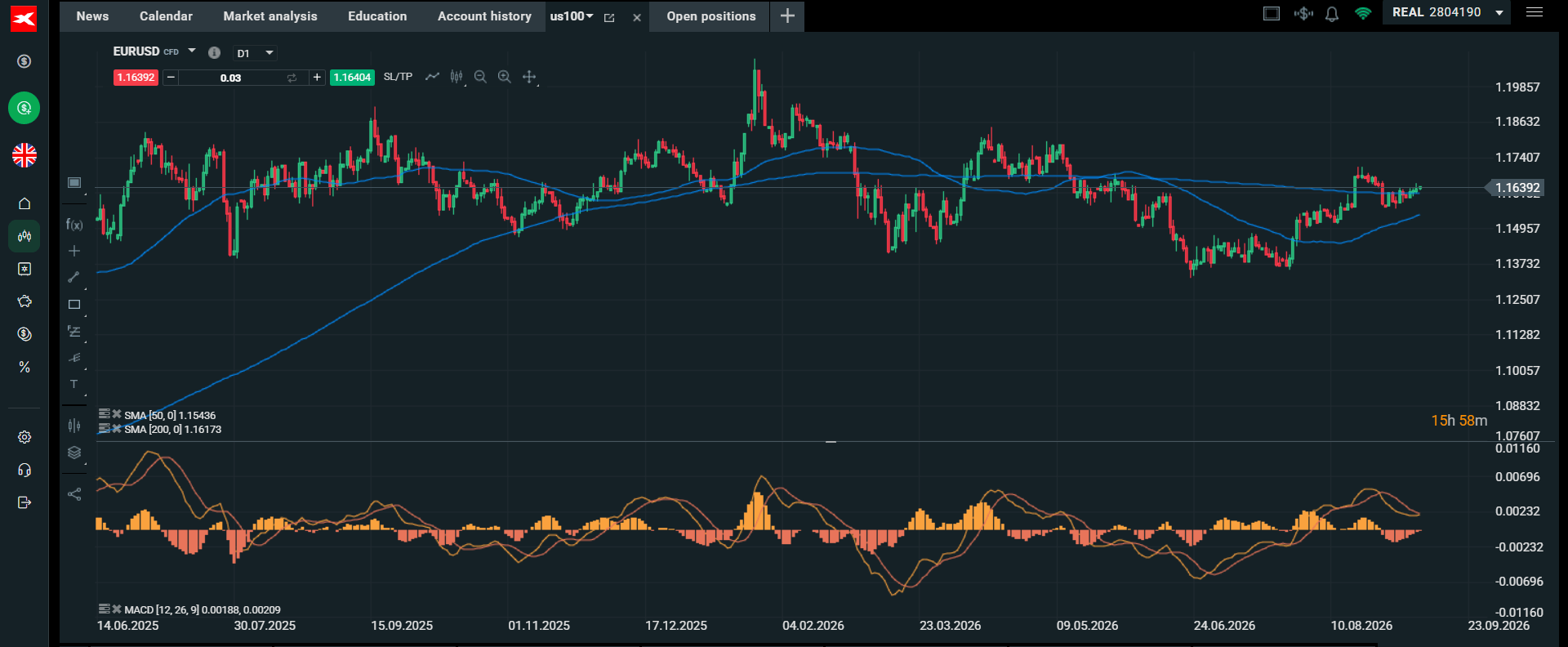
Source: XTB
Investors taking their time to assess the foldable iPhone
Rising bond yields, oil prices and central bank meetings are not the only thing on investors’ minds today. Apple’s new foldable iPhone, the iPhone Duo, had a successful launch on Wednesday. With a starting price of £1999 in the UK, and $1499 in the US, the price is lower than some analysts expected, which could lead to a wave of upgraded sales forecasts.
However, so far the stock market reaction has been mild. The share price is higher by 0.5% in overnight trading. This may seem like an historic moment for Apple, as this is the biggest revamp of the iPhone in two decades, however, foldable phones are only 2% of the overall smartphone market. Apple’s latest iPhones, which includes the 18 models, do not usher in any new AI features. This may be the main reason why the stock price has been muted, although it is worth watching this stock closely on Thursday.


US OPEN: Bonds keep climbing, semiconductors give back gains



Oil prices surge to $105 as bond market sell off could wipe out UK Chancellor’s fiscal headroom


ECB won’t commit to future hikes, which weighs on the euro

LIVE: ECB Conference
This content has been created by XTB S.A. This service is provided by XTB S.A., with its registered office in Warsaw, at Prosta 67, 00-838 Warsaw, Poland, entered in the register of entrepreneurs of the National Court Register (Krajowy Rejestr Sądowy) conducted by District Court for the Capital City of Warsaw, XII Commercial Division of the National Court Register under KRS number 0000217580, REGON number 015803782 and Tax Identification Number (NIP) 527-24-43-955, with the fully paid up share capital in the amount of PLN 5.869.181,75. XTB S.A. conducts brokerage activities on the basis of the license granted by Polish Securities and Exchange Commission on 8th November 2005 No. DDM-M-4021-57-1/2005 and is supervised by Polish Supervision Authority.