


The Office for National Statistics (ONS) published inflation figures for April 2026 today, which took the markets by surprise in a positive way — at least from the perspective of the fight against inflation. The year-on-year CPI fell to 2.8%, whilst the market consensus had predicted a reading of 3.0% and the March figure stood at 3.3%. This is the lowest CPI level since March 2025, bringing inflation back close to the Bank of England’s 2% target.
Of particular note is the slowdown in core inflation (Core CPI) to just 2.5% year-on-year — the lowest reading since July 2021, well below expectations of 2.6% and significantly lower than March’s 3.1%. Services inflation, a key indicator for the Bank of England, plunged to 3.2% from the previous 4.5%, also beating market expectations of 3.5%. Both these readings open the door to further monetary policy easing by the Bank of England.
Energy bills proved to be the main factor driving down inflation — Ofgem’s reduction of the price cap and government measures aimed at lowering unit costs led to a month-on-month fall of 8.4% in electricity prices and 4.4% in gas prices. This was by far the largest negative contributor to the change in the annual CPIH rate between March and April 2026. On the other hand, motor fuels remained a strong pro-inflationary factor — petrol rose by 16.6 pence per litre and diesel by as much as 31.3 pence, reaching their highest levels since November 2022 and July 2022 respectively.
The PPI data are also significant, as they point to rising cost pressures in the supply chain — output producer price inflation jumped to 4.0% y/y against expectations of 3.0%, whilst the PPI Input rose to as much as 7.7% y/y against a consensus of 6.3%. This may mean that some of the cost pressures from the manufacturing sector will be passed on to consumers with a lag in the coming months.
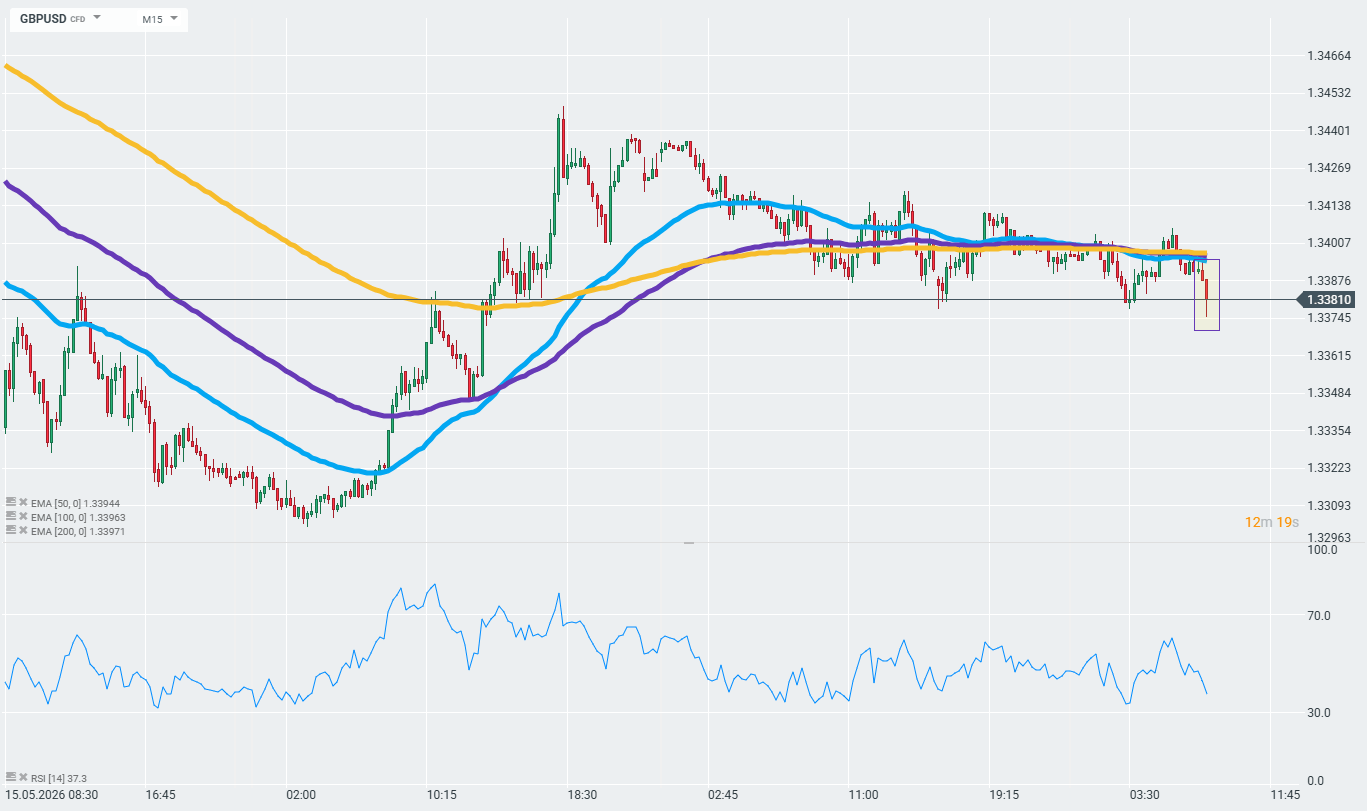
The reaction in the foreign exchange market was clear-cut — the pound sterling weakened significantly following the release of the data, and the GBP/USD pair plunged below the 1.3381 level, breaking through support and forming a candlestick with a long lower shadow. All three EMAs (50, 100 and 200) converged around 1.3394–1.3397, creating a strong resistance zone above current prices. The RSI fell to around 37, signalling increasing selling pressure, though not yet clearly oversold.
The markets have interpreted this data as a green light for the Bank of England to accelerate its cycle of interest rate cuts, which is directly undermining the pound’s appeal.


Oil extends losses and tests local lows 🚩 Piper Sandler bets on a rebound


NZD the strongest currency after a hawkish surprise from the RBNZ 📄

Economic Calendar: Richmond Fed Index and interesting companies' results ahead 🔎


Morning wrap (27.05.2026)
The material on this page does not constitute as financial advice and does not take into account your level of understanding, investment objectives, financial situation or any other particular needs.
All the information provided, including opinions, market research, mathematical results and technical analyses published on the website or transmitted to you by other means is provided for information purposes only and should in no event be interpreted as an offer of, or solicitation for, a transaction in any financial instrument, nor should the information provided be construed as advice of legal or fiscal nature.
Any investment decisions you make shall be based exclusively on your level of understanding, investment objectives, financial situation or any other particular needs. Any decision to act on information published on the website or transmitted to you by other means is entirely at your own risk. You are solely responsible for such decisions.
If you are in doubt or are not sure that you understand a particular product, instrument, service, or transaction, you should seek professional or legal advice before trading.
Investing in OTC Derivatives carries a high degree of risk, as they are leveraged based products and often small movements in the market could lead to much larger movements in the value of your investment and this could work against you or for you. Please ensure that you fully understand the risks involved, taking into account your investments objectives and level of experience, before trading, and if necessary, seek independent advice.
